I think this is C Tolle Run at its best: short, informative videos that present valuable information in a unique way. I love filming and editing these pieces together, and I hope we get the chance to do more of them in the future.
Stay tuned for the abundance of high-quality bloopers at the end.
C Tolle Run - Strength Training for Runners with Kirk DeWindt
originally shared here on
As everyone knows, people's attention spans these days are quite small. Bearing that in mind, we usually try to keep episodes under 4 minutes. In this case, however, it seemed like the length of the episode didn't really matter much. Kirk and Carrie have great chemistry in front of the camera, which you can really catch at the end of the outtake we show at the end of the episode.
Plus, the content in this episode is great for anyone training for a marathon, half marathon, or even 5k. Strengthening your hips and core is unbelievably important for staying injury-free.
C Tolle Run - Carrie's Road to the Medtronic Twin Cities Marathon - Part 1
originally shared here on
It's funny how these "day in the life" type episodes shake out; we usually go into it with no idea what we're gonna do, and come out of it with a polished episode that gives a great look into Carrie's life.
Even if you're not interested specifically in Carrie's progress toward her first ever marathon, you'll love the back-and-forth banter she has with her husband, Charlie. Seriously funny stuff.
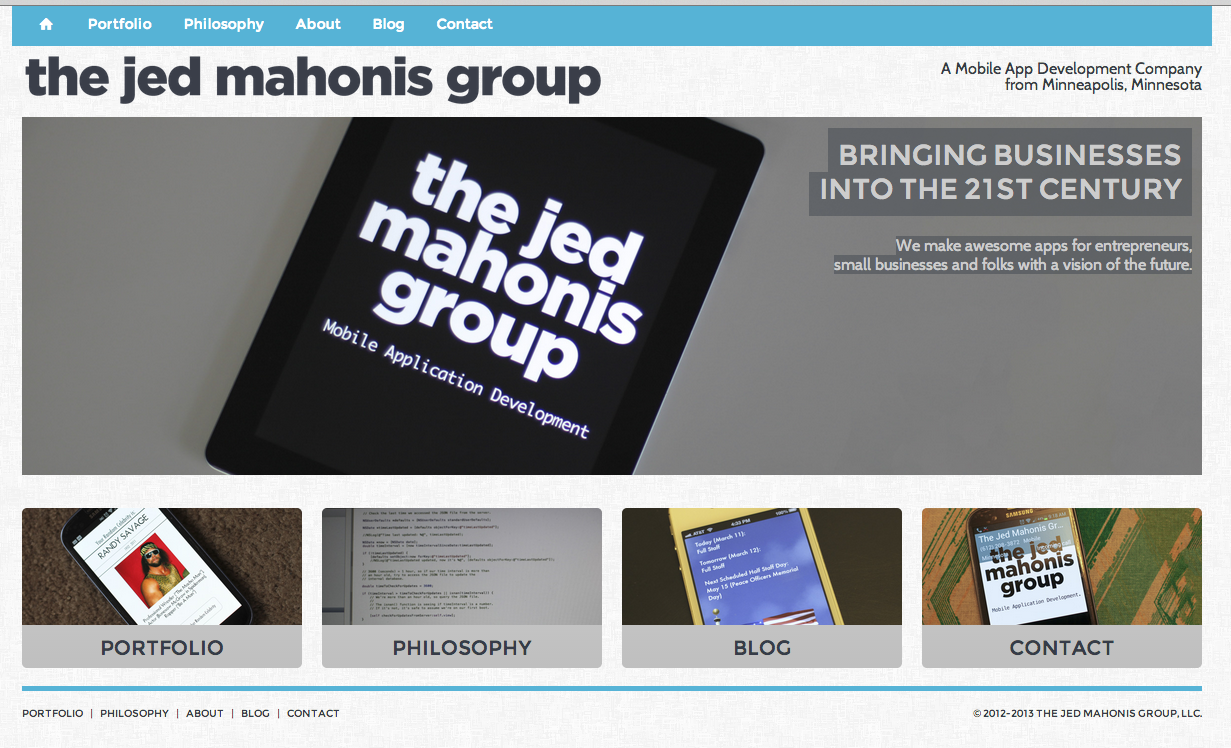
We finally launched the new version of the Jed Mahonis Group's website. I've actually been working on this for a few months now, figuring that we needed something more complex than our last single-page design.
The biggest feature of our new site is a responsive layout. This lets us show an optimized layout for any screen resolution (whether it's on a 27" desktop monitor or an iPhone). In addition, we're now able to better explain our app development philosophy and showcase our apps.
I also really like how the site really lets our personality shine through. Just look at the about page to see what I'm talking about.
The Get in Gear Races were the first we attempted to cover when we started C Tolle Run. The reason we merely "attempted" to cover it was because the rain was pouring so hard that year, we didn't want to risk ruining our camera.
I missed out on last year's Get in Gear, but I'm really glad they brought us back this year. This was the first warm day we've had in Minnesota since October 2012, and it was awesome to be able to play out in the sun for a while. I think most of the participants we interviewed would agree; the vast majority of people around the finish line had huge smiles on their faces.
I really enjoyed cutting the first part of the episode. It's always nice to try out new techniques. The one regret I had from this episode was not keeping a consistant white balance. If you watch very closely, there are a few clips that look a little "cool" (meaning there is a bluish/purplish tint). Oh well, even after 123 episodes, we're still not perfect.
But, like Carrie said, "C Tolle Run fans don't judge."
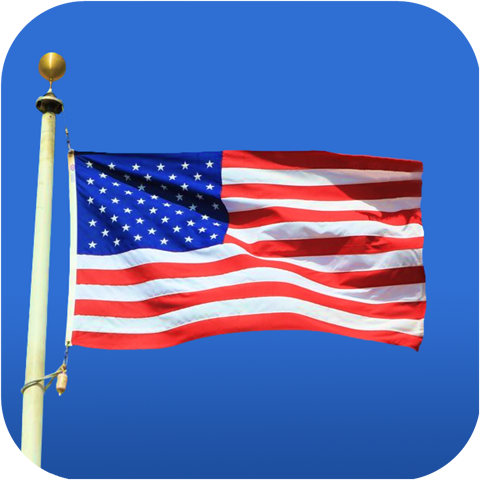
We decided a few months ago that in order to build our portfolio up, we should focus on core app technologies that companies would like to have in their own apps. Coincidentally, for Christmas this year, my girlfriend bought me an American flag.
After some simple Googling, I found a few websites that offered a service like this, but they mostly a) served to sell flags and b) looked like garbage. In addition, none of them offered direct push notifications (although there were a couple that offered e-mail and Twitter notifications).
The biggest challenge in this app was implementing the server API. After monkeying with tools like RestKit, I just opted to use some standard Apple methods to send a basic POST command to my API.
Besides that, it's a relatively simple app: we have a custom CMS that we can add new days in, then push the changes to a static JSON file. On launch, the app loads that JSON file and migrates changes into an internal SQL database.
There are a few changes I'd like to make (specifically, I'd like to combine the push token call and the database call into a single call), and we are working on a way to implement state-level notifications, but for now, I'm very proud of the way this app turned out.
It's only 99¢ on the App Store, so get it today and let me know what you think.
Let's be honest: any video where Ruby says she wants a "baby daddy" instead of a "baby brother" or "baby sister" is gonna be pretty solid.
I love doing these "day in the life" segments, and I'm pretty sure our audience loves them too. I set the video to automatically publish at 8am, and due to technical issues, I didn't get to post it to ctollerun.com until 10am. By the time we went live on our website, we already had 20 views and a like.
I hope we start branching into more segments like this with other high-profile athletes. I bet it'd be a huge draw.
C Tolle Run - Carrie's Dumbbell Workout: Upper Body
originally shared here on
This episode was shot in under a half hour and edited in under 90 minutes. We're really getting in a rhythm with this show. It's partly due to time constraints that we're all facing (me with my app development company, Julie with her freelance theatre directing and Carrie with her upcoming second child and other media appearances), but I mostly attribute it to our solid chemistry as a team. Carrie is nailing her lines in 1 take, Julie is writing solid copy and I'm cutting episodes together very efficiently. It's a cool experience when you can be a part of something so superb and efficient.
This very well could be the most thrilling post on my site to date. I can't remember exactly which blog I saw this on, but somebody posted the contents of their wallet for posterity not too long ago. I thought, "well, that's kind of a cool idea", so I'm going to share with you my pockets:
A wallet. I used to carry a serious George Costanza wallet, but have since pared it down to the essentials.
A key ring. I used to think it was really cool to carry a ton of keys, but I've cut back on a substantial amount of my collection. Right now, I've got my Hawkeye Point keychain and my Summit bottle opener attached. I don't know why I still have my Gopher lanyard connecter still connected... Perhaps that'll be cut by the time I do Part 2 of this thrilling series.
An iPhone 4S. This will almost certainly be upgraded to the iPhone 5S or whatever comes out this year.
Some $20 Sony Headphones. I treat my pocket headphones with a decent amount of respect, but I seem to churn through these things like hotcakes. Some day, I'll have a solid pair of desk headphones.
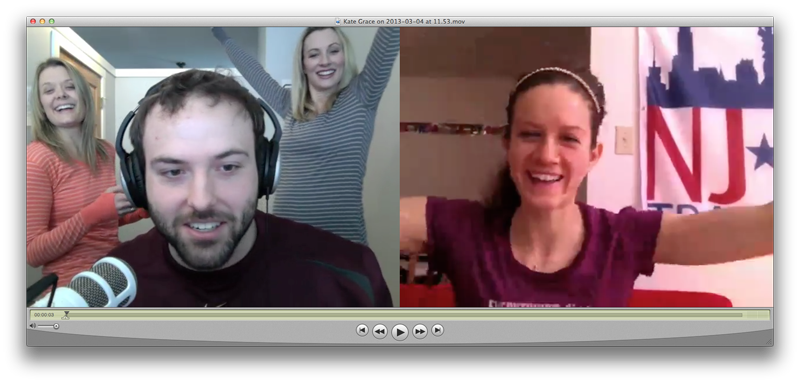
Although we got off to a rough start with some technical difficulties, our Skype interview with Kate was a rousing success. For those who want a little more technical behind-the-scenes for how to record a video Skype call, we use Ecamm's excellent Call Recorder for Skype to record both streams to a single file.
We use an all-Apple Intermediate Codec workflow when editing our shows. We could keep the recorded Skype call in the same H.264-compressed MPEG-4 container, but two problems arise:
1) You can't watch the file in Safe RT; you have to roll with Unlimited RT.
2) The audio doesn't even render, making the whole thing useless anyway.
In order to just save headaches, I convert our MPEG-4 file to AIC with the infinitely-useful MPEG Streamclip. If you're a professional video editor using a Mac and don't have this as part of your tool chain, you're nuts.
Like I said before, Call Recorder for Skype places both streams side-by-side in a single file. That's pretty much what you see when both Carrie and Kate are on screen at the same time:
For those curious as to how we turn that into a single-clip, we just crop the video to the full width and height of Kate and drop it on a second track. In order to do the multi-track switching, I just cut the parts of Track 2 where I want to see both of them: