stuff tagged with "vibe coding"
Living in the Weimar era of Ruby
🔗 a linked post to
blog.julik.nl »
—
originally shared here on
There was an interesting time in German history, right between the two World Wars - the “interbellum”, the time of the Weimar Republic. It was very turbulent, and a lot of it wasn’t pretty in the slightest - social difficulties, unemployment, incredible inflation, squalid living conditions, the emergence of the wildest movements, cabarets and cults imaginable… but there was also something else. The “Roaring Twenties” of Weimar Germany also produced an incredible number of great, whimsical, fascinating artistic movements. From the Bauhaus to the Berlin gay cabarets, from Kurt Weill to Fritz Lang’s Metropolis - it was a booming time, and a lot of what appeared then is still valued and cherished today.
And it was a technological boom as well - the ever more widespread use of electricity, the large-scale deployment of modern pharmaceuticals, the subways, the automobile… fascinating times.
I know how that era ended, and no - that is not the part of the analogy I am after. The part I am after is this: the old order had lost interest, nobody was in charge, the ground was shifting under everybody’s feet - and that is precisely when the most interesting work got made. Great turmoil, great industrial change, no adult supervision. Sound familiar?
Yes, there's a lot about our current AI situation that sucks. Companies are straight up committing felony hacks with zero consequences. Data centers are popping up everywhere, the cost of GPUs is sky high, etc. etc. etc.
But.
The cost to make a computer do something useful is now exponentially cheaper. One dork with Claude Code can, for example, completely recreate the entire Adobe suite.1
Yeah, the bad guys are doing terrible things with it. But think about the other side of the coin!
With LLMs and some good ol' fashioned engineering, I'm hopeful that those performance geeks among us will pick up the mantle that DHH dropped and keep making Ruby and Rails better for us all.
-
Which, itself, should probably be an entrant on FelonyBench, but also maybe not? ↩
SaaS is dead; long live SaaS!
🔗 a linked post to
jamie.ideasasylum.com »
—
originally shared here on
Found myself nodding along during this entire article.
The vast majority of people in the software industry today were not in the industry in 2000. They did not experience ordering a floppy disk of software from a classified ad in a computer magazine. Or license codes on CD boxes. Or running a SparcStation server under the receptionists desk because that’s the only machine compatible with the business-critical software she used.
In short, most developers were professionally born into the era of SaaS and have never considered an alternative model. They have not even conceived that software could, or should, be sold in another way.
I'm excited to see what new business models pop up from this approach. Frankly, I am close to no longer needing to pay for a Claude Max plan with the way that open source models are performing on my M3 Max.
That era of building a viable SaaS business in a few months is gone. I mean, it technically still exists today but only in the arbitrage sense that the rest of the world hasn’t yet caught on to how quickly and easily software can be built. It’ll be gone soon, I promise.
If you could previously develop a new app in a few months, I can now build that by the end of the week—if not the end of the day. That’s especially because I don’t need to build any of the trappings of a multi-tenant app destined for the mass market. I can choose HTTP basic auth if it suits me. Or none at all. I might not worry about backups. I can host it alongside other internal apps with barely a glancing-thought towards scalability. I don’t need branding. Or marketing. Or billing. I can reuse internal design systems or let the AI run with whatever comes to its mind first.
The sophistication of the software I’ll produce this way is much lower than what an indie dev might have written 2 years ago. It’s not the same product—mine isn’t even a product—but it’ll solve my problem equally well. I don’t have to build the same amount of software to solve my problem that you do to deliver a solution to everyone’s problems.
You can see most of the software I've vibe coded for myself. I'm sure all of it will be useless garbage for you, but it's been hugely invaluable to me.
And most important of all: vibe coding from my phone has been the most fun I've had building software in decades.
vibes is live
Taking inspiration from my buddy Paul's talk, I decided this week that I needed to commit to finishing my patio project.
For those who forgot, I started redoing my patio last summer, but sort of lost steam + got bad anxiety about doing things to my house, so it's sat dormant. A giant sand pit, a daily reminder that I can't finish anything.
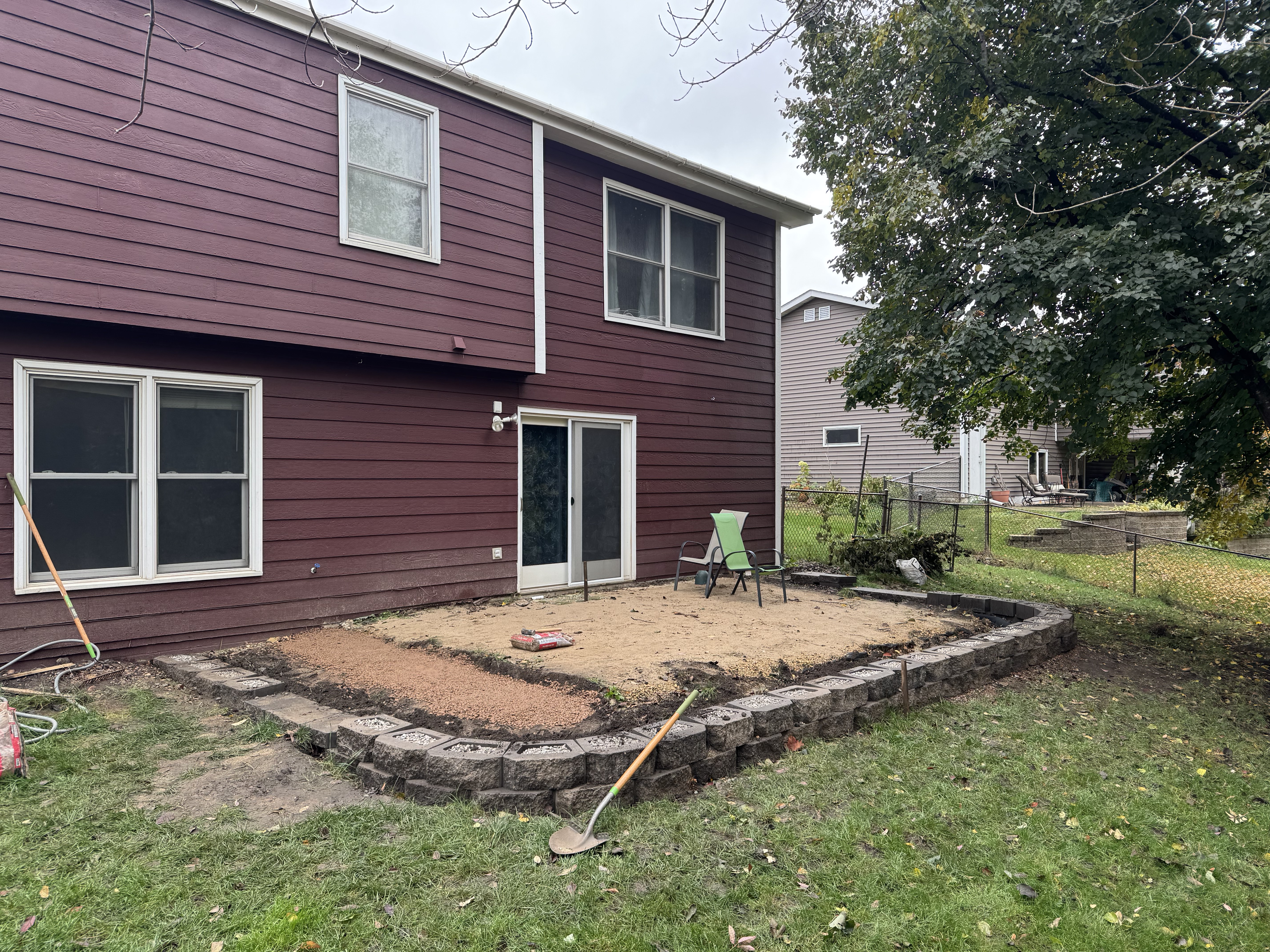
The last couple of nights, I've pulled up a patio chair in the sand and imagined what this place can look like. I mean, the hard stuff is pretty much done. I have all the pavers. The retaining wall is complete. Now I just need to clean the sand again, level it, and set the pavers.
I was having a hard time imagining what a good paver layout would look like since I have two different colors, so I vibe coded a little tool to help me visualize what different patterns might look like.
A few weeks ago, my friend Kelly sent out a survey collecting data points for her Minnebar talk. One question on this survey was: "Think of a piece of code you've written that you're proud of. In a sentence or two, what made it good?"
After a lot of reflection, here was my response:
In middle school, I learned how to write TI-BASIC, and I used it to program small apps to help me with math homework. Simple apps that helped me remember things like the Pythagorean theorem.
What made these apps good was sharing them with my friends and seeing them use them for their own homework and tests. I've heard some even used my Pythagorean theorem app in college.
To me, "good code" is mostly unimportant. What's important is unblocking others from being stuck on the semantics (e.g. memorizing a mathematical equation), allowing them to focus their energy on solving a bigger problem.
I was thinking about my Pythagorean theorem app this evening while staring at my patio, and it dawned on me that I have a device in my pocket at all times which Claude claims is somewhere between 200,000× and over 1,000,000,000× more powerful than that humble TI-83+ Silver Edition.
There are a lot of people who have a lot of opinions about artificial intelligence. I find validity in all of them: it's bad for the environment, it's being crammed down our throats, it's trained on stolen data, using these tools fly in the face of hard-earned engineering skills, etc. etc.
Me? My general stance on all technology is "what can this thing do?"
I want to make things. Useful things. Cool things. Fun things.
You know what's fun?
Having an idea for a single page app at 7pm, then hanging out with your family watching Survivor 50 until about 9:45pm, then jumping into a few Claude Code sessions to whip together the idea in about two hours.
If you visit junk.timbornholdt.com/vibes, you'll see a pretty weird looking landing page of random pages.
I have four tools on there right now:
- A visualizer for my patio (better seen on desktop)
- A syllabus guide to the lo-fi genre
- A page designed to encourage me to try new-to-me PS2 games
- Based off albums that I was into last month (need to update now), a page that gives me more detailed listening notes when exploring similar albums
The coolest part? This is all tied into Github Actions. If I want to make another page like this, I load Claude on my iPhone, tell it what app I want it to build, then let it commit that code to my vibes repo, which automatically gets rsyncd to my junk VPS.
I now have the ability to start out on a walk, come up with a random tool I need built, tell Claude to Ralph Wiggum loop itself until it accomplishes the vision, then see the results for myself right on my phone.
It took me two hours to make this happen. Most of it was spent deploying and securing a brand new VPS.
The future is kinda dope.
I hope all of this will help me finish that damn patio.
(PS: Look at how terrible that SVG logo is that it generated lmao I love it so much)
i ran Claude in a loop for three months, and it created a genz programming language called cursed
🔗 a linked post to
ghuntley.com »
—
originally shared here on
The programming language is called "cursed". It's cursed in its lexical structure, it's cursed in how it was built, it's cursed that this is possible, it's cursed in how cheap this was, and it's cursed through how many times I've sworn at Claude.
Absolutely dying at this.
Christina Wodtke on AI exciting the old guard
🔗 a linked post to
linkedin.com »
—
originally shared here on
The old timers who built the early web are coding with AI like it's 1995.
Think about it: They gave blockchain the sniff test and walked away. Ignored crypto (and yeah, we're not rich now). NFTs got a collective eye roll.
But AI? Different story. The same folks who hand-coded HTML while listening to dial-up modems sing are now vibe-coding with the kids. Building things. Breaking things. Giddy about it.
We Gen X'ers have seen enough gold rushes to know the real thing. This one's got all the usual crap—bad actors, inflated claims, VCs throwing money at anything with "AI" in the pitch deck. Gross behavior all around. Normal for a paradigm shift, but still gross.
The people who helped wire up the internet recognize what's happening. When the folks who've been through every tech cycle since gopher start acting like excited newbies again, that tells you something.
Really feels weird to link to a LinkedIn post, but if it’s good enough for Simon, it’s good enough for me!
It’s not just Gen Xers who feel it. I don’t think I’ve been as excited about any new technology in years.
Playing with LLMs locally is mind-blowingly awesome. There’s not much need to use ChatGPT when I can host my own models on my own machine without fearing what’ll happen to my private info.
AI ambivalence
🔗 a linked post to
nolanlawson.com »
—
originally shared here on
Maybe, like a lot of other middle-aged professionals suddenly finding their careers upended at the peak of their creative power, I will have to adapt or face replacement. Or maybe my best bet is to continue to zig while others are zagging, and to try to keep my coding skills sharp while everyone else is “vibe coding” a monstrosity that I will have to debug when it crashes in production someday.
I enjoyed this piece because I think it represents the feelings I hear from artists. You might not consider computer programming an art form, but if art is humans expressing themselves, then writing code absolutely qualifies.
And like a lot of other artists, many of us "computer people” make money by doing our art for other people. It turns out that for the last fourty years, we could do our art for other people and we'd get paid quite well to do so.
But now that anyone can basically vibe code solutions to basic problems1, a increasing set of non-nerds is able to use computers themselves. That naturally will drive down our value.
I use "value" here in a cold, hard, capitalistic sense. Maybe it's our turn, as artists who care about making efficient, beautiful, artistic computer programs, to worry about how we'll derive value in a world where anyone can vibe code their ideas to life.
-
What's wild is just how fast the bar for what counts as "basic" is raising. ↩
Things I Made Today While (Digital) Gardening and Vibe Coding
I'm beginning the slow process of turning this blog into a digital garden, and on the whole, I'm working on cleaning up the digital messes that have been accumulating for decades.
Over the past year, I spent time almost every day going through my Plex library and my drives which contain nearly every saved file since I've used a computer and deciding what to do with them.
This process has had many fits and starts, which feels correct. In my day job, I don't get many "fits and starts" because I'm being paid to understand a task and deliver it. Pruning a digital garden gives me a chance to be a rookie again, where I can take steps in a direction and learn from my mistakes.
I figured it might be interesting to the IndieWeb to see some ways I'm pruning and using AI to seriously help me.
Previewing Winamp Skins
I have a handful of .wsz files on my drives, and at first glance, I could not remember what a .wsz file even did.
I asked Claude and it helpfully told me that they were Winamp skin files, which were essentially .zip files with a different extension, so I was able to dig around inside to see what they were.
Winamp skins contained a handful of .bmp files that used image spriting, a technique commonly used by devs to optimize memory usage. It's clever, but clever things are often inscrutable twenty years later.
So at first, I went to Claude and asked it to write me an app that took in a .wsz file and showed me what the overall theme looked like. Honestly? Not completely terrible results here for 3 minutes of vibe coding1:
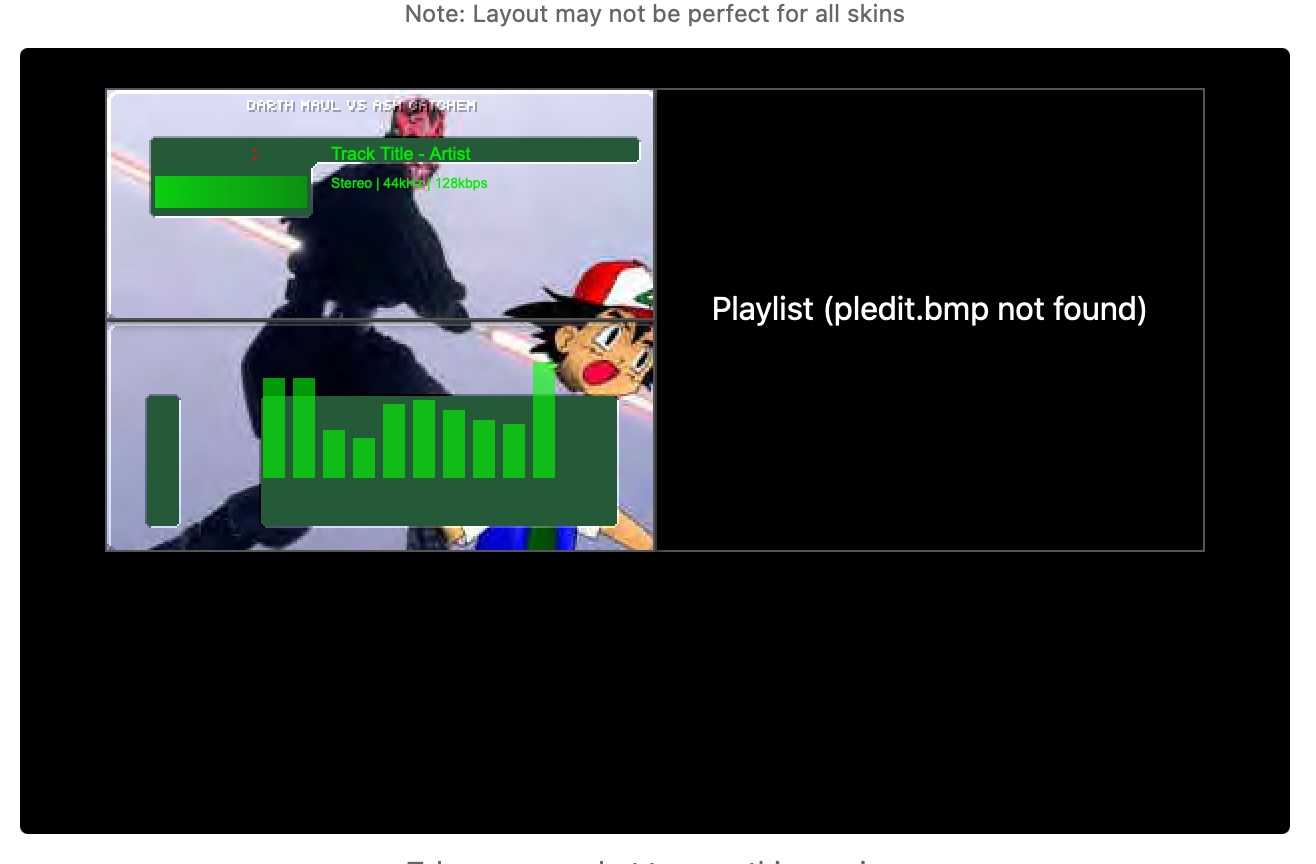
It turned out that the themes I had on my machine were already represented in the Winamp Skin Museum, so thank god "Darth Maul vs. Ash Ketchem" is still being appreciated here in 2025.
Tagging moods for my favorite albums
I've been working on a way to display my music library on my site, and the basic layout I've been vibe coding for the past few days is here:
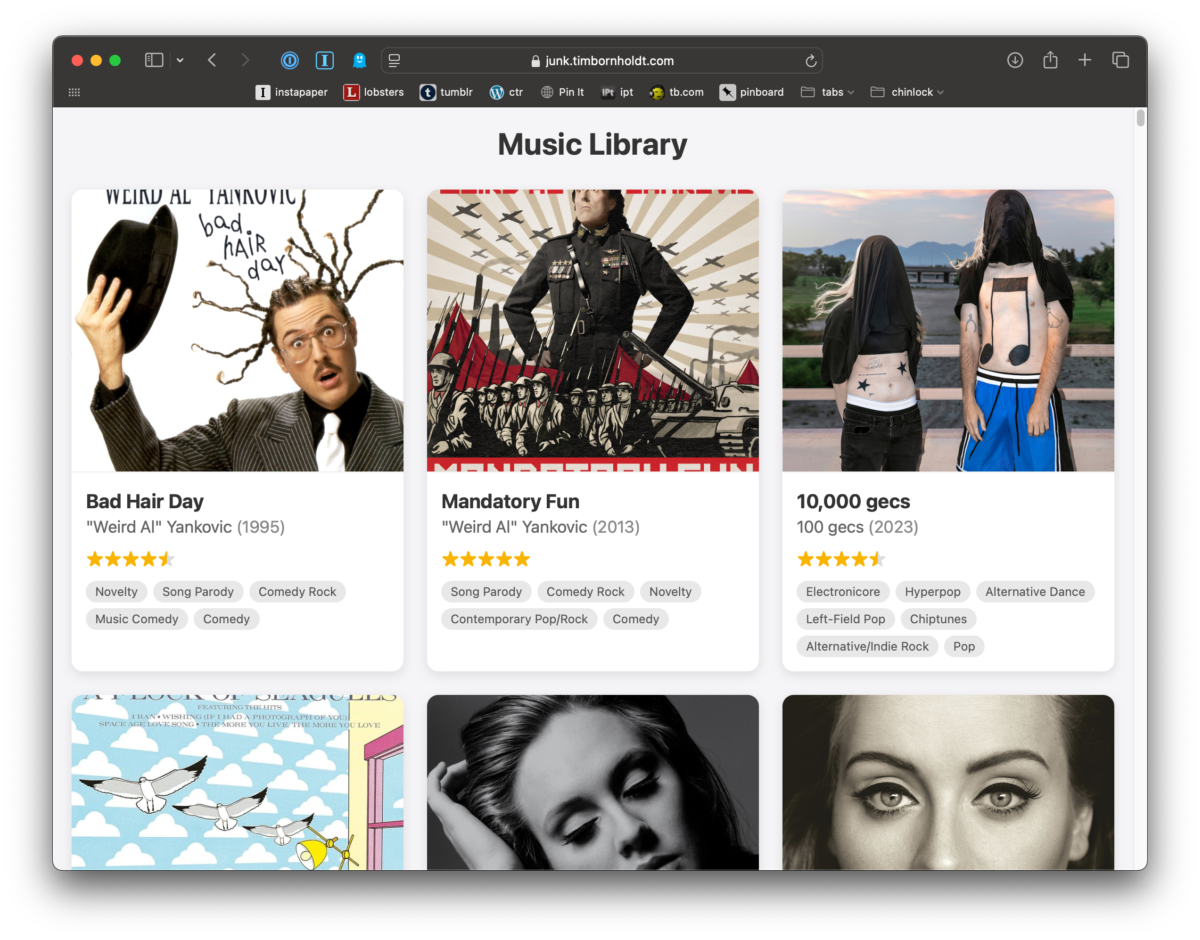
You can see the live version of it here. It's kinda neat.
But as you can see on the screenshot, I show a list of an album's genres and styles and moods.
I am not extremely picky about these, but many of them are missing from services like MusicBrainz, so I decided to use Claude and ChatGPT to help me fill in the blanks.
I've got another 30 or so to go, but the page looks a lot better with something in there. I think I'll use this layout to help me consolidate or improve the tags later, which I guess makes it a win for having this layout in the first place.
Another improvement I'd like to make to this is being able to browse by mood. I'd love to have an interface where I am prompted about my general feeling at the moment and have it surface albums to complement that vibe.
-
I define "vibe coding" as using an LLM to write almost all the code for a project with extremely minimal adjustments on my end. Sometimes, I feel like it's wasteful to vibe code "string change"-sized adjustments, so I will often make those changes in a text editor and, if I need to vibe code something larger, I provide the current file in its entirety and say "here is the most recent version of my code, you can forget anything you've written so far" so it can free up that out-of-date info from its context window. ↩
Refactoring to understand and "vibe coding"
🔗 a linked post to
seangoedecke.com »
—
originally shared here on
If you want to onboard someone onto a new codebase, let them rewrite part of it. They’ll learn a lot from the process, but crucially they’ll become an instant subject-matter expert on the part they rewrote. With a few refactors, you can go from a situation where you’re the only go-to engineer to a situation where multiple engineers on the team can take ownership. That’s the only sustainable way to run a large codebase.
This is exactly what I’ve been doing at work for the last six months, and now I’m the subject matter expert on a small number of essential components of the system.
These sneaky buggers… ?


