stuff tagged with "capitalism"
Disney's Recess - Economics Of Recess
🔗 a linked post to
youtube.com »
—
originally shared here on
My daughter's watching this episode right now, and it makes me wonder... could something like this happen if we all collectively decided not to use social media or AI tools?
they told me the internet was forever
🔗 a linked post to
samsharp.ca »
—
originally shared here on
In thinking about protecting the past, I'm grateful to Brennan Brown for their post, "How are we preparing for the Long Web?," a great introduction to the web-preservation movement that's unfolding right now. I like that the tone of the post is mostly hopeful - it poises us as readers embarking on a project through time, a thought experiment into the future.
Personally, I find frameworks like React to be neat from a developer's perspective and obnoxious from nearly every single other metric.
I'm sure at some point I'll have cause to meaningfully invest time in learning a fancy Javascript front end framework, and maybe I'll eat my own hat. But boy, as the old man in the room, I have a hard time accepting that the benefits of a front end framework outweigh the downsides of increased pipeline complexity, page size, and third party dependency attack vectors.1
I say all that because I feel like React made the web more inhospitable. It's harder to archive. It requires browsers to require even more resources. It's just... greedy.
They point to some stats that highlight just how much has been lost over the past few years, one of the worst ones being that over 66.5% of links published in the last nine years are dead. Nine years. The stats can only be more devastating if we go back twenty. Brown's post hones in on the ways that digital history is disappearing & puts together a great list of the ways that webmasters and archivists can make their sites as future-proof as possible, namely by sticking to HTML/CSS3 & updating one file, not thousands. I won't re-hash Brown's entire post, but I bring it up here as an example of the ways that the decay of the internet is being stalled and how everyday webmasters are fighting back against it.
This post inspired me to go through my own links and do what I can to preserve the contents of them.
So I vibed up a feature that loops through all 700+ of my links and checks to see if they are still alive.
The results? Of the 626 links that were checked, my script couldn't access 83 links.
Of the 81 YouTube videos I've shared, six are broken.
Looking through the list of broken links made me realize I should do some more weeding around here.
Mostly I need to cut the links to topical hot takes. Sure, it was fun to dig on Sony for hiking the price of some Whitney Houston music hours after her death. But I don't need to remember that forever, right?2
The Dumbest Hack of the Year Exposed a Very Real Problem
🔗 a linked post to
wired.com »
—
originally shared here on
In the wee hours of the night last April, someone stopped at roughly 20 street intersections across Silicon Valley and launched an unprecedented cyberattack that would eventually spread to multiple states, embarrassing local officials and prompting them to question their security practices. Authorities suspect the unknown culprit took advantage of weak and publicly available default passwords to wirelessly upload custom recordings that played whenever a pedestrian pressed a crosswalk button.
Instead of the normal recordings telling people to either wait or cross the street, pedestrians heard the spoofed voices of billionaire tech CEOs. A fake Mark Zuckerberg said at one Menlo Park intersection that people would not be able to stop AI from “forcefully” being inserted “into every facet of your conscious experience.” At another, he celebrated “undermining democracy.” At a different intersection, an altered Elon Musk described President Donald Trump as “actually really sweet and tender and loving,” while on a nearby street his faked voice whined about being “so alone.”
It's almost like... maybe we should give our civic employees enough budget and time to implement the bare minimum basic things you need to do when deploying infrastructure like this?
But yes, continue the layoffs and cutting taxes, everybody.
What If We Made Advertising Illegal?
🔗 a linked post to
simone.org »
—
originally shared here on
The modern advertising apparatus exists to bypass rational thought and trigger emotional responses that lead to purchasing decisions. A sophisticated machine designed to short-circuit your agency, normalized to the point of invisibility.
“But it's free speech!”
Bullshit. No one is entitled to yell at you “GET 20% OFF THIS UNDERWEAR YOU GLANCED AT YESTERDAY” with a dopamine megaphone in your bedroom. And to track 90% of your life to know when and how to say it. That's not free speech, that's harassment.
Been thinking about this article for months now.
My mortgage was recently purchased by Rocket Mortgage1. As a result, I now receive mail from them several times a month.
Each envelope looks identical, but the contents are either (a) urgent information related to my mortgage, or (b) an advertisement to take out a HELOC through Rocket Mortgage. Therefore, I have no choice but to at least open every single envelope to see what it is.
-
I don't really get how this process works, and I don't really care. It, also, is a broken system. All of this is a broken system. ↩
The AI Vampire
🔗 a linked post to
steve-yegge.medium.com »
—
originally shared here on
So I guess what I’m trying to say is, the new workday should be three to four hours. For everyone. It may involve 8 hours of hanging out with people. But not doing this crazy vampire thing the whole time. That will kill people.
As an individual developer, you need to fight the vampire yourself, when you’re all alone, with nobody pushing you but the AI itself. I think every single one of us needs to go touch grass, every day. Do something without AI. Close the computer. Go be a human.
I’m convinced that 3 to 4 hours is going to be the sweet spot for the new workday. Give people unlimited tokens, but only let people stare at reports and make decisions for short stretches. Assume that exhaustion is the norm. Building things with AI takes a lot of human energy.
I’m so glad somebody is saying this out loud.
Mess up their metrics. In whatever way you are capable of.
How in the hell could a man enjoy being awakened at 8:30 a.m. by an alarm clock, leap out of bed, dress, force-feed, shit, piss, brush teeth and hair, and fight traffic to get to a place where essentially you made lots of money for somebody else and were asked to be grateful for the opportunity to do so?
The grief when AI writes most of the code
🔗 a linked post to
blog.pragmaticengineer.com »
—
originally shared here on
I’m coming to terms with the high probability that AI will write most of my code which I ship to prod, going forward. It already does it faster, and with similar results to if I’d typed it out. For languages/frameworks I’m less familiar with, it does a better job than me.
It feels like something valuable is being taken away, and suddenly. It took a lot of effort to get good at coding and to learn how to write code that works, to read and understand complex code, and to debug and fix when code doesn’t work as it should.
It’s been a love-hate relationship, to be fair, based on the amount of focus needed to write complex code. Then there’s all the conflicts that time estimates caused: time passes differently when you’re locked in and working on a hard problem.
Now, all that looks like it will be history.
Early in my career, I helped start a company that conducted autonomous vehicle research. As increasingly complex driving tasks were able to be automated, I’d think about how this technology would one day render truck drivers useless. Which quickly turned into wondering when this tech would make me useless.
There’s no sitting still when it comes to software engineering. Every ten years or so, a new breakthrough comes along and requires folks to make a decision: do I evolve my engineering practice to stay up with the modern times, or do I double down on my current practice and focus on the fundamentals?
The choice comes down to what you value. Are you someone who enjoys artisanally crafting code, painstakingly optimizing each line to result in a beautiful tool? Are you someone who smashes things until they make the shape of a tool that helps someone accomplish a task?
When it comes to our economic structure, however, it doesn't matter what you value, it matters what someone is willing to pay you to solve their problem.
Some employers will value bespoke, artisanal ("clean") code, but I bet most will not care about what the code looks like. They will want whoever can quickly smash something into the shape of the tool that gets the job done.
As they say: don't hate the player, hate the game.
Uh Oh! The Infantilization of Failure
🔗 a linked post to
joanwestenberg.com »
—
originally shared here on
When a friend says "oops" after spilling coffee, they're performing a specific social ritual. The diminutive acknowledges fault while signaling that the harm was minor and unintentional. "Oops" calibrates expectations downward: this is small, forgivable, already passing. The word does real work in human relationships. Corporate interfaces borrowed this vocabulary wholesale; and they understood exactly what they were doing. When an app says "Oops!" after failing to process your request, it's attempting to inhabit the friend-who-spilled-coffee role. But the app isn't your friend. The company behind it has a contractual relationship with you, often involving money, and the mismatch creates a specific irritation that's hard to articulate until you notice it.
I worked on an app for a billion dollar corporation. The initial designs called for “Oops!” to be the title of every error message.
I remember feeling uneasy about it, but I haven’t been able to articulate why until reading this article.
Growth fills the hole left by the death of intrinsic purpose. It provides a default answer to "what should I do today?" which is simply "more than I did yesterday." It’s a low-barrier-to-entry faith; you don't need to study texts, you just need to hustle.
Everyone I know is worried about work
🔗 a linked post to
rojospinks.substack.com »
—
originally shared here on
When you accept that the future’s security may not come only in the form of a steady ascent up a pay scale, something shifts. You may not quit your job, but you reorient your time and professional priorities around independent people and relationships, not prestigious companies or brands. You may adjust your lifestyle, outgoings, consumption patterns, and sources of meaning so that they aren’t so reliable on a certain compensation package. You see the value of expanding your abilities and skills beyond merely looking employable online.
At least some of the work here, I think, goes back to what I wrote in November: keeping a foot in both worlds, Here and There. If, like almost all of us, you still need a high-paying job to sustain your life, then think about the idea that it might not be there forever. What are you doing in preparation for that day? What skills are you building that will be useful to others? What lifestyle are you becoming accustomed to in the meantime? And what people are you helping and investing in until that day comes?
The luxury of saying no.
🔗 a linked post to
brilliantcrank.com »
—
originally shared here on
The real threat to creativity isn’t a language model. It’s a workplace that rewards speed over depth, scale over care, automation over meaning. If we’re going to talk about what robs people of agency, let’s start there. Let’s talk about the economic structures that pressure people into using tools badly, or in ways that betray their values. Let’s talk about the lack of time, support, mentorship, and trust. Not the fact that someone ran a prompt through a chatbot to get unstuck. Where is the empathy? Where is your support for people who are being tossed into the pit of AI and instructed to find a way to make it work?
So sure, critique the tools. Call out the harm. But don’t confuse rejection with virtue. And don’t assume that the rest of us are blind just because we’re using the tools you’ve decided are beneath you.
(via Jeffrey)
AI ambivalence
🔗 a linked post to
nolanlawson.com »
—
originally shared here on
Maybe, like a lot of other middle-aged professionals suddenly finding their careers upended at the peak of their creative power, I will have to adapt or face replacement. Or maybe my best bet is to continue to zig while others are zagging, and to try to keep my coding skills sharp while everyone else is “vibe coding” a monstrosity that I will have to debug when it crashes in production someday.
I enjoyed this piece because I think it represents the feelings I hear from artists. You might not consider computer programming an art form, but if art is humans expressing themselves, then writing code absolutely qualifies.
And like a lot of other artists, many of us "computer people” make money by doing our art for other people. It turns out that for the last fourty years, we could do our art for other people and we'd get paid quite well to do so.
But now that anyone can basically vibe code solutions to basic problems1, a increasing set of non-nerds is able to use computers themselves. That naturally will drive down our value.
I use "value" here in a cold, hard, capitalistic sense. Maybe it's our turn, as artists who care about making efficient, beautiful, artistic computer programs, to worry about how we'll derive value in a world where anyone can vibe code their ideas to life.
-
What's wild is just how fast the bar for what counts as "basic" is raising. ↩
Dreaming awake
🔗 a linked post to
aworkinglibrary.com »
—
originally shared here on
In other words, one way to disarm the fascists and colonialists of their psychological weapons is to fix the fucking networks. But this is only part of the challenge. A better network gives us the means to dream together. Of what will we dream?
I also enjoyed this quote embedded in this excellent essay about how to resist being “the product” in a hyper capitalist economy:
With every other extractive and exploitative industry of the past four hundred years, the process of unraveling and resistance was far more complicated. To end the racialized system of capital called “slavery,” for example, you had to violently revolt, riot, petition, boycott, change minds, change laws, all in order to end one of the most lucrative gravy trains the Western world has ever known. To rein in the unprecedented wealth of the robber baron industrialists at the turn of the twentieth century, you had to regulate their businesses, the banks, and the labor laws themselves, and create the electoral majorities needed to do so. But to seriously damage the billionaire empires that have been built on your attention and are now manipulating your democracies? To achieve that right now? All you guys would need to do is look away. And thus give a new meaning to the word woke.
Network effects are powerful, but besides that, the moats surrounding the empires of our modern day billionaires are actually quite easy to bypass.
What Ticketmaster Doesn't Want You To Know: Concerts Were Cheap For Decades
🔗 a linked post to
m.youtube.com »
—
originally shared here on
I’m sure most people are aware of how expensive it is to go out and see shows, but I’m not sure if most people are aware of why.
This video does a great job of explaining how the Ticketmaster + Livenation monopoly works.
We’re quickly approaching election season here in the US. Growing up, the importance of an informed electorate was driven into my brain.
This is the kind of stuff more voters need to be aware of. How do monopolies form? What market conditions lead to consolidation of power, and how do we hold those in power accountable?
Mark Zuckerberg: creators and publishers ‘overestimate the value’ of their work for training AI
🔗 a linked post to
theverge.com »
—
originally shared here on
I think that in any new medium in technology, there are the concepts around fair use and where the boundary is between what you have control over. When you put something out in the world, to what degree do you still get to control it and own it and license it? I think that all these things are basically going to need to get relitigated and rediscussed in the AI era.
When I downloaded Llama 3.2 yesterday, I had to agree to a rather lengthy licensing agreement which constrained how I could use it.
When you sign up for a Instagram or Facebook account, you have to agree to lengthy terms and conditions in which you give up your rights around the content you create.
If you want to push my buttons, all you need to do is something deeply hypocritical. Like, for example, the kind of insipid, hand-wavy remark that billionaires like Mark Zuckerberg make when they want "rules for thee, not for me" treatment.1
There’s another pull quote here which deeply offends me:
“Look, we’re a big company,” he said. “We pay for content when it’s valuable to people. We’re just not going to pay for content when it’s not valuable to people. I think that you’ll probably see a similar dynamic with AI.”
Seriously, the gall of this guy to say “your content isn’t valuable” while raking in billions of dollars serving ads against it.
I keep getting the urge to join Facebook so I can sell some unneeded treasures on marketplace, but this article serves as a reminder that Meta is helmed by an individual who has a truly warped definition of the word “value.”
-
Or filibuster for an entire year into blocking a Supreme Court nomination until the next election takes place because “it’s the will of the people.” Then, four years later, when an election will take place in less than a month, cram your awful nomination through because it’s important to fill those spots as soon as possible. I have tried for a few years now, but I’m not sure I’ll ever be able to forgive that particular instance of hypocrisy. ↩
Why We Can't Have Nice Software
🔗 a linked post to
andrewkelley.me »
—
originally shared here on
The problem with software is that it's too powerful. It creates so much wealth so fast that it's virtually impossible to not distribute it.
Think about it: sure, it takes a while to make useful software. But then you make it, and then it's done. It keeps working with no maintenance whatsoever, and just a trickle of electricity to run it.
Immediately, this poses a problem: how can a small number of people keep all that wealth for themselves, and not let it escape in the dirty, dirty fingers of the general populace?
Such a great article explaining why we can’t have nice things when it comes to software.
There is a good comparison in here between blockchain and LLMs, specifically saying both technologies are the sort of software that never gets completed or perfected.
I think it’s hard to ascribe a quality like “completed” to virtually anything humans build. Homes are always a work in progress. So are highbrow social constructs like self-improvement and interpersonal relationships.
I think it’s less interesting to me to try and determine what makes a technology good or bad. The key question is: does it solve someone’s problem?
You could argue that the blockchain solves problems for guaranteeing the authenticity of an item for a large multinational or something, sure. But I’m yet to be convinced of its ability to instill a better layer of trust in our economy.
LLMs, on the other hand, are showing tremendous value and solving many problems for me, personally.
What we should be focusing on is how to sustainably utilize our technology such that it benefits the most people possible.
And we all have a role to play with that notion in the work we do.
Neither Elon Musk Nor Anybody Else Will Ever Colonize Mars
🔗 a linked post to
defector.com »
—
originally shared here on
In these latter days everybody is familiar with concepts like the carbon footprint, sustainability, and the like. Measures of the ecological cost of the things we do. One of the most irksome problems bedeviling Earth's biosphere at present is the outrageous cost of many aspects of many human lifestyles. Society is gradually and too late awakening to, for example, the reality that there is an inexcusable, untenable cost to shipping coffee beans all around the world from the relatively narrow belt in which they grow so that everybody can have a hot cup o' joe every morning. Or that the planet is being heated and poisoned by people's expectation of cheap steaks and year-round tomatoes and a new iPhone every year, and that as a consequence its water-cycle and weather systems are unraveling. Smearing the natural world flat and pouring toxic waste across it so that every American can drive a huge car from their too-large air-conditioned freestanding single-family home to every single other place they might choose to go turns out to be incompatible with the needs of basically all the other life we've ever detected in the observable universe. Whoops!
This article really lays into Elon at the end, which honestly, as I’m getting older, I feel okay with.
Also: one of my main values in life is balance, which is essentially the goal of sustainability. How can we balance our needs with the needs of our planet?
Like any parasite, our species needs to achieve some sort of symbiosis with our host. You can’t extract so much that you kill it, but you need to live at the same time, so how do you reach that balance?
Is this the slow decline of the Apple “cult”?
🔗 a linked post to
birchtree.me »
—
originally shared here on
I’m sure Apple will continue to be very successful for many years to come and I expect to buy many products in the future as well (after all, Microsoft and Google don’t feel much better). I’ll surely even give some of those products glowing reviews on this very blog. And yet, I do wonder if the Apple enthusiast crowd as we know is in permanent decline.
You don’t need Daring Fireball, Panic, ATP, Birchtree, or anyone else like us to be massively financially successful (just look at Microsoft and Samsung), but I do find it a bit sad to see Apple stroll down the road to being a totally heartless mega corp like the rest. Why does Apple feel it’s worth trashing their relationship with creators and developers so that they can take 30% of the money I pay an up-and-coming creator who is trying to make rent in time each month?
If Homer was trying to start an internet business today, Tim Cook would be the one smashing up his home office and declaring he didn’t get rich by writing a lot of checks1.
I’ve all but checked out on the Apple community these days. I still follow a few choice folks like David Smith and John Siracusa, but the overall tone of most Apple pundits today feels like that of a kid who was bullied in high school and became the bully’s boss.
Here’s my problem: Apple makes the best products out there today, and they know it. They deserve to be rewarded financially for this, but the problem is that they don’t know when to stop.
That mindset tends to be a problem in humans in general. People who are great at saving money tend to be unsure how to spend it when they retire.
I’ve been an Apple supporter since I got my first iPod back in 2003. Whenever I need to get a new electronic item, my first instinct is to grab whatever Apple made and be done with it.
At first, that instinct was pursued with enthusiasm. Now, after twenty years of selfish financial moves, I’m starting to follow that instinct with a funky taste in my mouth, like when you drink a can of pop after not having one in years.
Even if Apple wanted to change their behavior, I’m not sure they even know how to. Just look at how they’ve responded to all the regulations that have been thrown their way.
When they’re told they must allow apps to link to external payment sources, they require you to pay a 5% “Initial Acquisition Fee”.
When they’re told they need to allow for alternative app stores on their platform, they respond with instituting a Core Technology Fee so developers can “utilize the capabilities that we have introduced, including the ability to direct app users to the web to complete purchases at a very competitive rate”.2
Even with a market cap of 3.44 trillion dollars, they still feel the need to charge exceptionally high fees for access to their platforms.3
I guess maybe this is inevitable? Call it enshittification, call it the natural order of things, but I can’t help feeling like we’ve reached peak Apple fandom.
Heh, I suppose this whole blog post could be summarized by this excellent Adam Mastroianni quote:
Notice that, while lots of people are happy to tell you about Golden Ages, nobody ever seems to think one is happening right now. Maybe that’s because the only place a Golden Age can ever happen is in our memory.
-
I couldn’t help but throw in a Simpsons reference, even if the children are wrong. ↩
-
I can’t help but lol at the use of the word “competitive.” How is this competitive? You are comparing one rate you set yourself to another rate you set yourself! Doesn’t the word “competition” imply more than one party being involved? Either way, if we have to get this into the weeds with semantic compliance with a rule, then you know that one side is just being obstinate. ↩
-
Dangit, I never mean to turn these blog posts into rants against capitalism, but here I go again. ↩
The deskilling of web dev is harming the product but, more importantly, it's damaging our health
🔗 a linked post to
baldurbjarnason.com »
—
originally shared here on
Of course you’re having problems keeping up with everything that’s happening in web dev. Of course!
You’re expected to follow half-a-dozen different specialities, each relatively fast-paced and complex in its own right, and you’re supposed to do it without cutting into the hours where you do actual paid web development.
Worse yet, you’re not actually expected to use any of it directly. Instead you’re also supposed to follow the developments of framework abstractions that are layered on top of the foundation specialities, at least doubling the number of complex fields a web dev has to follow and understand, right out of the gate.
This is immense – an expectation so mind-boggling that we need to acknowledge just how remarkable it is that each of us has managed as well as we have.
This entire article is an excellent summary of the state of the software development industry from the perspective of a web developer. I think Baldur hit the nail on the head several times here.
I first learned Javascript from a book I got from the library somewhere around 1999. This predated XMLHttpRequest, debuting with IE5 in 2001, which literally enables every single subsequent Javascript framework out there.
In just the last ten years alone, I’ve worked with React, Typescript, Coffeescript, Vue, Angular, Backbone.js, Ember.js, Next.js, ES6, and maybe another dozen Javascript variants that I can’t recall right now… but I wouldn’t consider myself an expert in any of them.
Like Baldur says in this article, “framework knowledge is perishable.” I don’t want to spend all my time learning a framework which, if history is any indicator, will be obsolete in a few years.
The underlying Javascript knowledge, though, is not ephemeral. I can dig up webpages I built in fifth grade and render them in moments with ease on my modern day Macbook, whereas dashboards built on React from only five years ago can only be brought up if I spend an entire day setting up an environment with a billion dependencies.
I can do that because the vanilla Javascript that worked in IE5 still works great in any modern browser.
I do have to be a realist, though… the jobs out there today do require you to use these frameworks because the software pipeline is way more complex than it was in 2000. Frameworks provide a standarized way of building software within this modern landscape. For the record, I have no problem picking one up in the course of my work and figuring it out.
I wish more organizations would simpilfy rather than move towards increasingly complex ways of writing and delivering software. I feel like so much more value could be realized by paring back the staggering amounts of dependencies that these frameworks use. Codebases would be much thinner, deploy times would be faster, your footprint for potential security threats would be smaller, etc. etc.
Anyway, I also think the way he wraps up this article is grimly astute:
The tech industry will never be a genuinely free market as long as big tech companies are allowed to be as big as they are today.
What we have today is a centrally-planned economy by MBA sociopaths, operated as a looting ground for the rich.
It will never function on normal competitive, supply-and-demand market principles.
Because, even though a healthier market is the only thing that has a hope of a return to the fast-growing tech industry of prior decades, it would also require big tech companies to accept a smaller slice of the overall pie and allow new competitors to grow.
Why do that when you can strangle the market and keep the entire corpse for yourself?
Literally laughed out loud at “centrally-planned economy by MBA sociopaths.”
Why the CrowdStrike bug hit banks hard
🔗 a linked post to
bitsaboutmoney.com »
—
originally shared here on
I personally tried withdrawing cash at three financial institutions in different weight classes, as was told it was absolutely impossible (in size) at all of them, owing to the Falcon issue.
At one, I was told that I couldn’t use the tellers but could use the ATM. Unfortunately, like many customers, I was attempting to take out more cash from the ATM than I ever had before. Fortunately, their system that flags potentially fraudulent behavior will let a customer unflag themselves by responding to an instant communication from the bank. Unfortunately, the subdomain that communication directs them to runs on a server apparently protected by CrowdStrike Falcon.
I have some knowledge of the history of comprehensive failures of financial infrastructure, and so I considered doing the traditional thing when convertibility of deposits is suspended by industry-wide issues: head to the bar.
I’ve ignored the CrowdStrike news primarily because it didn’t directly impact me, and secondarily because I made an assumption that this was yet another example of the joys of late stage capitalism.
I’m glad I read this article, though, because it helped put the crisis in perspective.
While it didn’t impact me, it certainly caused issues for those in my real life. Software truly has reached a point where it can cause massive headaches for large swaths of society.
When a big part of society gets bumped by an outage like this, the ripples of its consequences will surely be felt by everyone at some point down the road.
Second, I gotta stop being so cynical about capitalism. I should stop pretending I’m above it or better than it. Like it or not, it’s the system I have to play in.
It would probably be less stressful for me to accept the game and use it to accomplish my own set of goals.
One of my main goals in life is to build technology that helps make people’s lives better.1 Say what you will about CrowdStrike, but this article reminded me that it’s because of tools like Falcon that we are provided a society in which we all can live better lives.
So instead of sitting here and (a) ignoring the news and (b) complaining about the existence of bad actors in our system, maybe I should instead do my best to help make our system as stable as I can.
-
It’s so important to me that it’s the first thing you see on the main page of this website. ↩
I'm getting rid of my iPhone for a month
Long time readers of this blog may recall that I've been psyching myself up enough to try switching to the Light Phone.
I’m legit embarrassed to admit just how much I’m addicted to my iPhone.
It happened slowly over the course of the last 15 years. Today, I find myself frequently incapable of putting it down, even when it’s actively making me feel terrible.
The biggest expense of always being virtually connected is never feeling connected to the physical moment happening in front of me.
That wasn’t so much of a problem to me when I was sitting in front of my Compaq desktop in the basement of my parent’s house.
Back in those days, I used to hate being away from my computer. The very first thing I’d do when returning from a family vacation was to jump on the computer and catch up on a week of message board posts.
Here in 2024, though, I don’t subject myself to that experience.
The other day, I was playing a Lego game with my son and while he was explaining an aspect of the game to me, I pulled out my phone and went to turn on music. Mid sentence, he stops and says, “Dad, can you put your phone away? It’s distracting me.”
Oof. That’s not how I want my son to remember me.
I’ve tried all the techniques people say can help limit screen time. Grayscale the screen. Delete apps. Block toxic websites. But because none of those tricks are actually working, it’s time to take more drastic measures.
My plan is to move my phone number onto the Light Phone for a month. Just a month.
I'm going to do this during the month of August. That will give me a couple weeks to prepare for it. I am honestly worried about what I’ll be giving up, and so I'm doing what I can to brace myself for that impact.
I’m mostly excited, really. After more than a decade in the comfortable, walled garden of the Apple ecosystem, I think it will be nice to experiment with new tech tools again.
The Light Phone is designed to be as boring and practical as possible. It can make phone calls, send texts, and give driving directions, among a few other things.
But there are certainly some activities that the Light Phone won’t do very well which I am unwilling to give up. So here are those activities, along with how I'm thinking I'll deal with those activities for the time being:
Taking notes and reminders.
A notepad with a pen. ✅
Next.
Reading.
Sometime in the last couple of decades, I stopped reading books.
I’m not exactly sure why. I used to love reading books when I was a kid. I would go to the library and read every book they had on building websites and computer programs. I’d also read every new edition of Animorphs, Goosebumps, and Harry Potter as soon as my library stocked it.
But beginning in high school, I stopped reading books for fun. Reading felt like a burden, something you were assigned as punishment. I resented reading so much, in fact, that I used to pride myself on not buying books for class in college and finding a way through without them.1
If I read books these days, I almost only read non-fiction, which is fine… but I miss reading for fun.
Earlier this year, I helped my wife proctor some tests at her school. I wasn’t allowed to be on the internet, so I brought a book along that a friend recommended called What You Are Looking For Is In The Library. I burned through it in a day, and it got me interested in reading fiction once again.
I think I wanna try getting into a fiction series. The last series I read was the Left Behind books in high school, so uh, yeah… I’m a bit out of the loop with what’s good out there.
If anyone has recommendations, let me know!
Taking pictures.
I used to be really into cameras when I was really into making clips2. When my oldest was born, we thought it made sense to buy a good SLR, so we picked up a Canon Rebel T6i.
I do still grab it out of storage and bring it along to the occasional soccer game or choir performance, and the shots feel better to me than the ones I get with my iPhone. It helps that I have a decent assortment of lenses, but I think it also speaks to the joy you get from using a tool that was intentionally built to complete a task.
Of course, I can’t realistically carry an SLR with me all the time. I need something more practical.
When I sold cameras at Best Buy3, the camera I recommended the most was the Canon SD800 IS, and it was the camera that documented some of the most fun moments of my life. It was small enough to fit in my pocket alongside my iPod.
Even though it fit, I still didn’t carry it with me every day, which makes the pictures I did take with them feel extra special when I browse through them today.
Maybe having a camera on me all the time is less necessary than I’m worried about. I mean, in a normal day for you, how many situations can you envision where you must take a picture of something and can't flag down someone to take one and send it to you?4
So I’m in the market for a camera that’s small like the SD800 was, but perhaps more professional. I remember seeing someone mention the Canon PowerShot G7 X Mark III and I thought the silver one looked kinda dope.
It makes me happy to see Canon keeping these devices up to date. The G7 X can shoot 4k video, and it’s got WiFi and USB-C so it’ll be easy to get media off of it. Most importantly, its size means it can stay in the drawer by the door and leap into service at a moment's notice.
But anyway, what about y’all? Anyone else use something besides their phone to take a picture or a video?
Listening to music.
The whole reason I wanted to make this post is because I wanted to brag about my restoration project with my old fifth generation iPod.
But because of course this is what happens when I brag, I’ve been stuck for a few days trying to debug a hardware failure that is proving exceptionally frustrating to resolve. Chef’s kiss.
So instead of bragging about that, I’ll instead confess that I’m one of those sickos who maintains their own library of MP3s.
I’ve always looked at streaming services with squinty eyes. Maybe it’s because I’m still mad at what they did to our beloved Napster. Maybe it’s because I think it’s important to not give complete control of my cultural history to massive corporations5. Maybe it’s because buying an MP3 version of an album from an artist will give them vastly more money than my combined streams would ever account for. Maybe it’s because I am an aging boomer.
Either way, transitioning away from Apple Music will not be too excruciating for me. I’ll still use it because I have HomePods all over my house, but when I’m not home, I want need a way to bring my music with me.
The Light Phone does have some storage and an MP3 player option, but because of the intentional design, you’re limited to a single playlist and 1gb of tunes. That doesn’t work for me, brother.
I’ll keep y’all posted with my progress on the restoration process. I want to get Rockbox installed on it so I can experience what the home brew community is doing with this old hardware.
In the meantime, if anyone knows how to address issues with an iFlash Solo syncing with an M1 Mac mini, holler at your boy.
I’d like to take this opportunity to express how pathetic I feel that I need to take these extreme steps to reclaim some part of me that I feel like I’ve lost ever since going whole ham on the mobile revolution.
I talk at length about the joy that comes with technology, but I should also recognize the negative impact that tech can make.
We went through an era of unfettered growth from Silicon Valley-powered firms who had nearly no supervision and did everything they could to exploit our political and economic systems for their own gain.
And to be clear, their growth did bestow some incredible tools onto us.
But as much as our society derides subgroups like the Luddites and the Amish for their apparent aversion to technology, there is clearly some merit to how they approach technology. You should adopt technology because it’ll help you, not because everyone else is using it.
Every night around 10:30pm, I find myself lying in bed, entering the casino that is my iPhone. Every app is a different section of the game room floor.
My email app is a slot machine, where I hope I’ll hit the big bucks and get an email saying “yay you’re hired!”, but the odds are better that I’ll see an email saying “lol you owe me money still.”
LinkedIn and Reddit are craps tables, where I sometimes roll an 11 and see a post from a friend who had a successful day at work or a post on /r/AskHistorians that teaches me something interesting (like Did President Andrew Garfield ever eat lasagna?). But more often than not, I roll snake eyes and see something which makes me feel like a failure or living in a dumpster fire of a society.
Even my beloved RSS reader app, filled with feeds that I explicitly opted into, can feel like a game of blackjack. Yeah, I often walk away with at least some money, but I still sometimes leave the table feeling unsure why I’m passionate about anything anymore.
I let this happen to myself. And every time I pull my phone out of my pocket during a family dinner, I rob myself of what makes life worth living in the first place.
Like our Silicon Valley overlords like to say, you can’t stop the march of progress. Technology is rapidly improving, and major advances in our collective understanding of the universe are unveiled at an overwhelming pace.
There’s gotta be a way where we can harness the good parts of technology without entirely succumbing to all of its detriments. The first step, I suppose, is defining what I want to get out of life.
And really, it’s pretty simple:
- Play Legos with my son
- Sing karaoke with my wife
- Watch Rocko’s Modern Life with my daughter
- Make music, work out, and learn new things
- Be able to visit the doctor when I’m not feeling well without going bankrupt
- Build something useful for people
- Not make other people’s existences any worse than they already are
If those are the things that are important to me, then why would I burn precious energy spending time on a device which gives me anxiety attacks on a daily basis?
So yeah, come August, I’m signing off from my iPhone for a bit. It’ll feel good to step out of the casino and focus on building legos, taking walks, shredding on the guitar, singing karaoke, hanging out with friends, and listening to music.
-
At the time, I was extremely anti-book because the book publishing market is an extreme racket, issuing frequent updates to textbooks with minimal tweaks while commanding insane prices. Today, part of me wishes I read the assigned works for most of my liberal arts classes. Maybe I would’ve picked up more useful facts about the Australopithecus or found useful anecdotes from Cold War geopolitical conflicts. ↩
-
This is what we used to call videos before YouTube. We'd record a bunch of segments of a video on someone's dad's camcorder, then use a capture cable to play back the video onto a computer, and then edit it in something like Pinnacle Studio. Wild times, indeed. ↩
-
Which seems to be my point of reference for where to look for all of these problems... I worked at Best Buy from 2005 to 2010, so basically, what were the tech solutions we had for these problems before the iPhone came out? And is there anything from the past 15 years that has improved on that tech? ↩
-
Maybe this is a hypothesis born out of privilege, but let’s call a spade a spade: this entire article and premise is only possible for someone who is drowning in technology and choosing to reduce his consumption. ↩
-
Brennan Lee Mulligan recently had an excellent monologue about this topic, but I don’t have a direct link to it. Just look at Paramount’s recent decision to remove all of MTV and Comedy Central’s backlogs of content as all the proof you need that you should back up what you care about. ↩
The Internet Is About to Get Weird Again
🔗 a linked post to
rollingstone.com »
—
originally shared here on
There’s not going to be some new killer app that displaces Google or Facebook or Twitter with a love-powered alternative. But that’s because there shouldn’t be. There should be lots of different, human-scale alternative experiences on the internet that offer up home-cooked, locally-grown, ethically-sourced, code-to-table alternatives to the factory-farmed junk food of the internet. And they should be weird.
If you missed this one when it was making the rounds seven months ago, Anil Dash did not disappoint with this think piece about the weird internet.
Music Journalism Can't Afford A Hollowed-Out Pitchfork
🔗 a linked post to
defector.com »
—
originally shared here on
It is hard not to see this development as a true indicator that we're nearing the endpoint of robust, meaningful music criticism as a concept. The idea that music journalism has no value is one of the most pervasive thoughts circulating among the suits who control the industry. What those people continue to deprive us of is smart, varied music coverage produced by actual journalists, most of whom now find themselves being squeezed out of an industry that only rewards slavish devotion to the biggest pop stars, or a constant courting of drama, gossip, and violence that is only tangentially related to music.
If there's a better future for music journalism to come, it will perhaps spring from the re-emergence of small-batch music blogs and more localized coverage. But what we're left with now is a corporatized wasteland, and fewer publications than ever equipped to write about music with all the rigor and passion it deserves.
I’m glad Iz mentioned the optimistic part of the situation at the end.
I’m, of course, sad and frustrated by what mega corporations are doing to journalism as a whole (not just music journalism).
But what keeps my hope alive is continuing to support smaller writers who cover their beats with an infectious passion.
I don’t see a future where journalism suddenly becomes a six-figure kind of job, because capitalism is not a system where art (and nuanced, considered discussions of art) is valued enough to justify that sort of business investment.
I suppose that could be seen as bleak, but take it from someone who is currently grappling with the costs associated with doing the thing I love in exchange for a salary: it’s great for the pocket book, but damn near lethal for my soul.
And I suppose by trading my passions in for money, I can use that money to support artists who are out there making stuff that makes me happy.
On a similar note: how do y’all discover new music these days? Are there any good writers or blogs I should be following?
Is Your Phone the Reason You Feel Broke?
🔗 a linked post to
nymag.com »
—
originally shared here on
I won’t argue that smartphones are significantly responsible for America’s sense of economic malaise. What they are is unusually helpful for understanding and interpreting this malaise in common terms. They’re a heightened, sped-up microcosm of the weird, sour vibrancy of the economic moment, little worlds in which participants are both increasingly active and increasingly worried. By most measures, the smartphone economy is booming, and yet it also feels like shit in a way that everyone can feel for themselves, together, no matter what soda they drink.
That’s the thing with creating these cool slot machines that live in our pocket: they’re really fun at first, but once you’re addicted to them, you keep going back even when it’s painful.
That pain hasn’t manifested for me much by way of exorbitant pricing, although I have noticed my subscriptions for things like iCloud storing are increasing.
The way this manifests for me is when my kids look at me and say, “can you snuggle and watch this episode with me without being on your phone?”
I know it’ll hurt, but I gotta make the switch to my Light Phone soon. I’m sick of feeling hopelessly addicted to this dumb piece of glass I’m currently typing on while my kids are playing in the water park in front of me.
What are you getting paid in?
🔗 a linked post to
approachwithalacrity.com »
—
originally shared here on
A long time ago, a manager friend of mine wrote a book to collect his years of wisdom. He never published it, which is a shame because it was full of interesting insights. One that I think a lot about today was the question: “How are you paying your team?”
With this question, my manager friend wanted to point out that you can pay people in lots of currencies. Among other things, you can pay them in quality of life, prestige, status, impact, influence, mentorship, power, autonomy, meaning, great teammates, stability and fun. And in fact most people don’t just want to be paid in money — they want to be paid some mixture of these things.
When I was in college, the phrase “it’s all about the perks” became something I ironically said often when people described their jobs.
I’m realizing as I get older just how true that axiom is.
Effective obfuscation
🔗 a linked post to
citationneeded.news »
—
originally shared here on
Some have fallen into the trap of framing the so-called "AI debate" as a face-off between the effective altruists and the effective accelerationists. Despite the incredibly powerful and wealthy people who are either self-professed members of either camp, or whose ideologies align quite closely, it's important to remember that there are far more than two sides to this story.
Rather than embrace either of these regressive philosophies — both of which are better suited to indulging the wealthy in retroactively justifying their choices than to influencing any important decisionmaking — it would be better to look to the present and the realistic future, and the expertise of those who have been working to improve technology for the better of all rather than just for themselves and the few just like them.
That’s it, I’ll admit it: I’m a Molly White stan.
Effective altruism always felt wrong to me, but leave it to Molly to explain those abstract feelings in such clear and well considered terms.
What If Money Expired?
🔗 a linked post to
noemamag.com »
—
originally shared here on
For most of us today, money is assurance. We live in a culture in which the pursuit of security is paramount. Save money, we are told — for a health crisis, for our kids to go to college, for retirement. But is it possible to have any guarantee, through money or anything else, of our safety in life?
This article explores the idea of money automatically losing value unless you continue to pay tax on it.
For example, let’s say you earn a hundred dollar bill. Every week, you’re required to buy a stamp from the government which lets that bill maintain its full value. Otherwise, come next week, your $100 becomes a $99.90 bill.
This encourages you to spend your money rather than hoard it. It incentivizes earning money through work rather than loaning your money out and earning it through collecting interest.
This feels like a weird concept until you sit back and reflect on what money means to you right now. Money makes me feel more anxious than any other abstract concept because the threats associated without having it feel so dire.
In her new book “The Age of Insecurity,” the activist Astra Taylor writes: “Today, many of the ways we try to make ourselves and our societies more secure — money, property, possessions, police, the military — have paradoxical effects, undermining the very security we seek and accelerating the harm done to the economy, the climate and people’s lives, including our own.”
Astra Taylor, it turns out, is married to Jeff Mangum of Neutral Milk Hotel.
We can have a different web
🔗 a linked post to
citationneeded.news »
—
originally shared here on
Okay, I guess this blog is just turning into a bunch of links about why the internet sucks these days.
But I should stop framing these links as a “here’s why what we have right now sucks” because truthfully… it doesn’t.
Or rather, it doesn’t have to.
I really enjoyed Molly White’s metaphor about gardens1. I’ve been tending to my own garden on this site for more than a decade, and I’ve kept up patches of turf on the web since the mid 90s.
I just like being here. I like having a place where friends and other folks can see what I’m all about and choose to interact with me or not.
A part of this article that stuck out to me was Molly’s observation that the internet started becoming less fun when we all came here to work. I couldn’t agree more.2
Somewhat related here: this past weekend, I decided to finally do something about my IRL piece of land. You see, most of my backyard is now just dirt. My front yard is patches of grass but primarily dominated by weeds.
My back patio is in literal shambles, chunks of broken patio paver strewn around the yard.
The screens on my windows are either broken, bent, or missing altogether.
The cool Govee lights no longer stick to my overhang, so they dangle like a complete eyesore.
It’s frustrating.
This past weekend, I went to the hardware store and spent way too much money on grass seed. It felt incredibly rewarding to do the hard work of ripping up the old junk and trying to build something new.
It felt like a sign for me to log off a bit more often and tend to reality.
But that’s not to say this garden is going away anytime soon. I’ll keep sharing articles like these here because I think it fits nicely with the thesis under which I am about to launch a newsletter: technology is so cool, and we could all use a reminder of that sometimes.
We also could use a friend to help us figure out how to use it right.
Much like I could use a friend to help me figure out how to replace my busted up patio.
-
As an avid anecdotalist, I’m bummed I haven’t been using this metaphor the whole time. I mean, we even use the term “walled garden” to refer to massive platforms like Facebook or TikTok. Get your head in the game, Tim! ↩
-
And as someone who nearly swore off programming altogether during my senior year of high school because building Simpsons websites wasn’t as much fun anymore, I find myself once again disappointed that I didn’t see this one coming. 0-for-2, Tim, you’re slipping! ↩
Happy 20th Anniversary, Gmail. I’m Sorry I’m Leaving You.
🔗 a linked post to
nytimes.com »
—
originally shared here on
I am grateful — genuinely — for what Google and Apple and others did to make digital life easy over the past two decades. But too much ease carries a cost. I was lulled into the belief that I didn’t have to make decisions. Now my digital life is a series of monuments to the cost of combining maximal storage with minimal intention.
I have thousands of photos of my children but few that I’ve set aside to revisit. I have records of virtually every text I’ve sent since I was in college but no idea how to find the ones that meant something. I spent years blasting my thoughts to millions of people on X and Facebook even as I fell behind on correspondence with dear friends. I have stored everything and saved nothing.
This is an example of what AI, in its most optimistic state, could help us with.
We already see companies doing this. In the Apple ecosystem, the Photos widget is perhaps the best piece of software they’ve produced in years.
Every single day, I am presented with a slideshow of a friend who is celebrating their birthday, a photo of my kids from this day in history, or a memory that fits with an upcoming event.
All of that is powered by rudimentary1 AI.
Imagine what could be done when you unleash a tuned large language model on our text histories. On our photos. On our app usage.
AI is only as good as the data it is provided. We’ve been trusting our devices with our most intimidate and vulnerable parts of ourselves for two decades.
This is supposed to be the payoff for the last twenty years of surveillance capitalism, I think?
All those secrets we share, all of those activities we’ve done online for the last twenty years, this will be used to somehow make our lives better?
The optimistic take is that we’ll receive better auto suggestions for text responses to messages that sound more like us. We’ll receive tailored traffic suggestions based on the way we drive. We’ll receive a “long lost” photo of our kid from a random trip to the museum.
The pessimistic take is that we’ll give companies the exact words which will cause us to take action. Our own words will be warped to get us to buy something we’ve convinced ourselves we need.
My hunch is that both takes will be true. We need to be smart enough to know how to use these tools to help ourselves and when to put them down.
I haven’t used Gmail as my primary email for years now2, but this article is giving me more motivation to finally pull the plug and shrink my digital footprint.
This is not something the corporations did to me. This is something I did to myself. But I am looking now for software that insists I make choices rather than whispers that none are needed. I don’t want my digital life to be one shame closet after another. A new metaphor has taken hold for me: I want it to be a garden I tend, snipping back the weeds and nourishing the plants.
My wife and I spent the last week cleaning out our garage. It reached the point where the clutter accumulated so much that you could only park one car in it, strategically aligned so you could squeeze through a narrow pathway and open a door.
As of this morning, we donated ten boxes of items and are able to comfortably move around the space. While there is more to be done, the garage now feels more livable, useful, and enjoyable to be inside.
I was able to clear off my work bench and mount a pendant above it. The pendant is autographed by the entire starting defensive line of the 1998 Minnesota Vikings.
Every time I walk through my garage, I see it hanging there and it makes me so happy.
Our digital lives should be the same way.
My shame closet is a 4 terabyte hard drive containing every school assignment since sixth grade, every personal webpage I’ve ever built, multiple sporadic backups of various websites I am no longer in charge of, and scans of documents that ostensibly may mean something to me some day.
Scrolling through my drive, I’m presented with a completely chaotic list that is too overwhelming to sort through.
Just like how I cleaned out my garage, I aught to do the same to this junk drawer.
I’ll revert to Ezra’s garden metaphor here: keep a small, curated garden that contains the truly important and meaningful digital items to you. Prune the rest.
(Shout out to my friend Dana for sharing this with me. I think she figured out my brand.)
Tech doesn’t make our lives easier. It makes them faster.
🔗 a linked post to
asomo.co »
—
originally shared here on
Because we’re social animals we tend to go along with the trend, and because we live under capitalist acceleration the trend is always one way, because our system only has one gear. We also have the ability to edit our memories, so can find ways to convince ourselves that this was all our own choice. That very same adaptability, though, prevents us from using the new tech to save time, because – under a system with a growth fetish – we’ll be expected to adapt to a new normal in which we have to do more stuff and get more stuff in the same amount of time.
The dark irony then, is that it is the introduction of the new tech that inspires the subsequent irritation at its absence. Twenty years ago nobody fidgeted in agitation if they had to wait ten minutes for a taxi. Now you’ll check your phone incessantly if the Uber is running three minutes later than you expected. And god forbid the driver cancels, because you’ve probably algorithmically planned everything down to the last minute. We increasingly live a ‘just in time’ life because, at a systemic level, there’s pressure to pack in as much stuff as possible at both a consumption and production level. We’re just as dissatisfied, only busier.
The more I dig into the reasons behind my anxiety and depression, I keep coming back to some form of “it’s the system, maaaan.”
And that thought often leads me down two paths:
The first path is wallowing in anger around our horrible healthcare system, our completely corrupt political system, and our inability to have a rational conversation around solutions to all these problems (often with people whom I actually deeply care about).
The second path is spinning around solutions for these problems. How can I tone down the heat in conversations with my loved ones? How can I push back against a culture hellbent on incessant and mindless consumption?
How do we all just slow down?
The ‘Enshittification’ of TikTok
🔗 a linked post to
wired.com »
—
originally shared here on
Here is how platforms die: First, they are good to their users; then they abuse their users to make things better for their business customers; finally, they abuse those business customers to claw back all the value for themselves. Then, they die.
I call this enshittification, and it is a seemingly inevitable consequence arising from the combination of the ease of changing how a platform allocates value, combined with the nature of a "two-sided market," where a platform sits between buyers and sellers, hold each hostage to the other, raking off an ever-larger share of the value that passes between them.
If you’ve spent much time in the same tech bubbles as me this past year, you’ve probably come across this article already.
At a bare minimum, I’m sure you’ve seen the phrase “enshittification.”
Once you understand the concept, you do start to see the pattern unfold around you constantly. 1
While there are countless examples of this natural platform decay within our virtual world, what about the physical world?
Is enshittification simply human nature, an inescapable fate for any collaborative endeavor above a certain size?
And if enshittification is not inevitable, what are the forces that lead to it, and how can we combat them when building our own communities?
-
Case in point: the Conde Nast-owned WIRED website on which this article was published. I’m using a Shortcut on my iPad to post this article, and while sitting idle at the top of the post, I've seen three levels of pop ups appear which cover the article content. I haven’t even scrolled the page yet! ↩
Every Billable Hour is Amateur Hour
🔗 a linked post to
daedtech.com »
—
originally shared here on
If, on the other hand, you view freelancing as a path to real business ownership, your first step is to recognize that the billable hour is a binkie that keeps you in amateur purgatory for the entire time you rely on it. A kind of Hotel California with timesheets.
And that’s really my only call to action — the recognition as the first step.
I’m not suggesting you fire all of your hourly clients or do anything dramatic. I’m not even suggesting any immediate change. Rather, I’m just suggesting that you change your viewpoint.
If you want to be a professional business owner, you need to become an expert in delivering outcomes that add value. And you’ll never achieve that without enough reps to flat price your work and enough skin in the game to feel it when you get it wrong.
I found it difficult to do “value-based pricing” when running my agency.
But I think it took a little time away to really understand my value. It was never about programming stuff. It was about making something that could turn $1 into $2.
And knowing what to spend that $1 on.
Anti-AI sentiment gets big applause at SXSW 2024 as moviemaker dubs AI cheerleading as ‘terrifying bullsh**’
🔗 a linked post to
techcrunch.com »
—
originally shared here on
I gotta find the video from this and watch it myself, because essentially every single thing mentioned in this article is what I wanna build a podcast around.
Let’s start with this:
As Kwan first explained, modern capitalism only worked because we compelled people to work, rather than forced them to do so.
“We had to change the story we told ourselves and say that ‘your value is your job,” he told the audience. “You are only worth what you can do, and we are no longer beings with an inherent worth. And this is why it’s so hard to find fulfillment in this current system. The system works best when you’re not fulfilled.”
Boy, this cuts to the heart of the depressive conversations I’ve had with myself this past year.
Finding a job sucks because you have to basically find a way to prove to someone that you are worth something. It can be empowering to some, sure, but I am finding the whole process to be extremely demoralizing and dehumanizing.
“Are you trying to use [AI] to create the world you want to live in? Are you trying to use it to increase value in your life and focus on the things that you really care about? Or are you just trying to, like, make some money for the billionaires, you know?” Scheinert asked the audience. “And if someone tells you, there’s no side effect. It’s totally great, ‘get on board’ — I just want to go on the record and say that’s terrifying bullshit. That’s not true. And we should be talking really deeply about how to carefully, carefully deploy this stuff,” he said.
I’ve literally said the words, “I don’t want to make rich people richer” no fewer than a hundred times since January.
There is so much to unpack around this article, but I think I’m sharing it now as a stand in for a thesis around the podcast I am going to start in the next month.
We need to be having this conversation more often and with as many people as possible. Let’s do our best right now at the precipice of these new technologies to make them useful for ourselves, and not just perpetuate the worst parts of our current systems.
Poorly Drawn Lines - Your Hottest Take
🔗 a linked post to
poorlydrawnlines.com »
—
originally shared here on
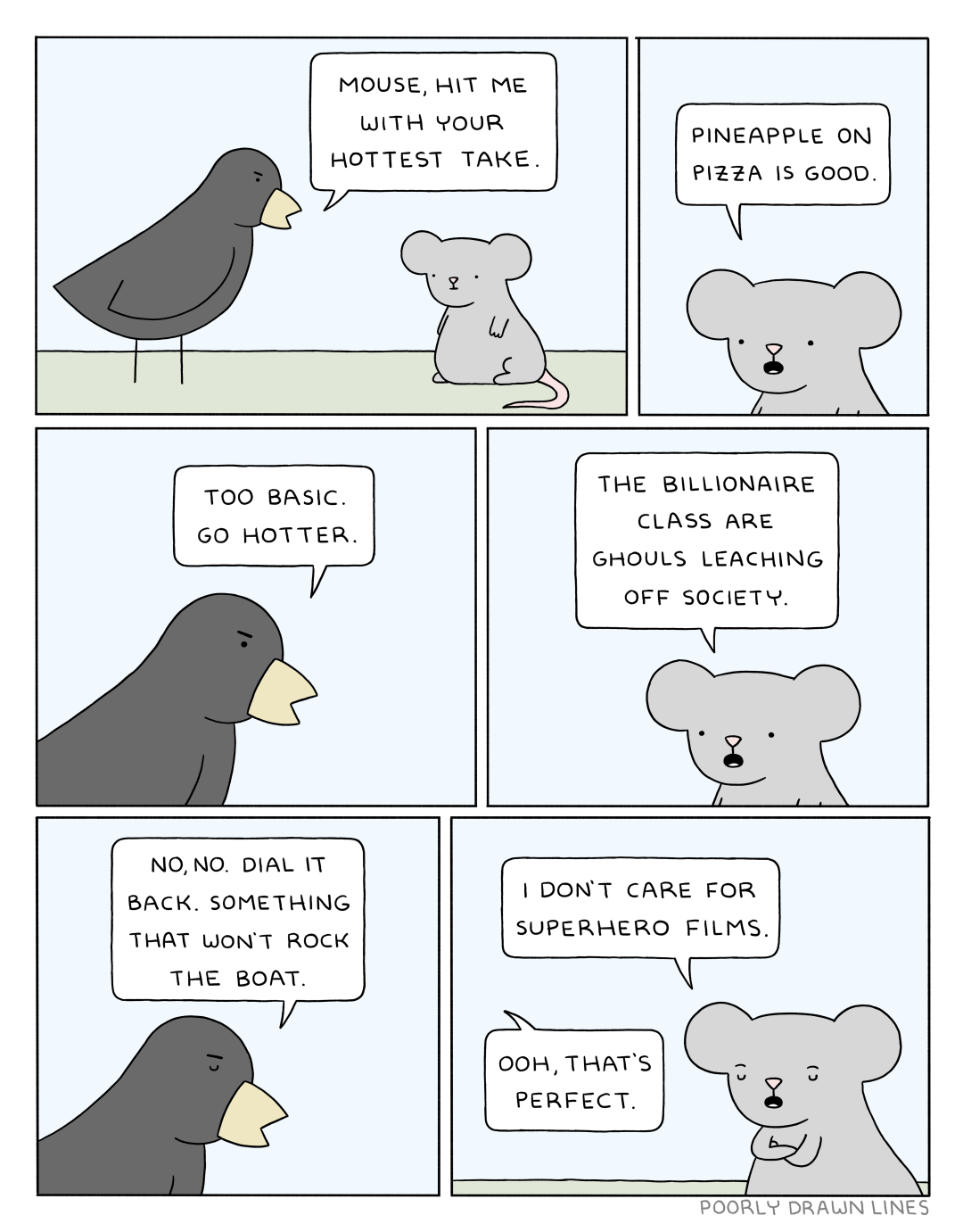
I love the hottest take. ?
(For what it's worth: I am starting to come around on pineapple on pizza, especially if it's part of a really spicy pizza.
A couple years back, I tried to watch all the MCU movies in release order. I gave up after Winter Soldier. It was just too much. I'm glad superhero movies exist, but they're not my cup of tea these days.)
Should we abolish busyness?
🔗 a linked post to
tomgreenwood.substack.com »
—
originally shared here on
In my explorations of “sustainable business”, I'm often wondering what these two words really mean. I've previously shared some ponderings about the meaning of the word “sustainability”, but what about the word business?
It turns out that it is exactly what it sounds like. The word business originates from Northumbria where the old English word “bisignes” meant care, anxiety or occupation. This evolved into “busyness”, meaning a state of being occupied or engaged. In other words, a state of being busy.
This puts a whole new perspective on the term sustainable business and makes it feel like even more of an oxymoron. If sustainability is the ability to sustain something over the long term, then sustainable business would be to stay busy indefinitely.
Is that viable?
And more importantly, is that what we really want?
As always, Tom’s on point with this essay.
I’m working hard to reduce my wants. Sounds a bit like an oxymoron (no pun intended here), but we’ve all been so conditioned to chase after the shiny thing that we hardly ever stop to ask if the shiny thing is worth coveting.
And it’s really hard to not want to go after the shiny new thing. Getting laid off made it easy to not insta-buy a Vision Pro, but the hype leading up to its release sure got me intrigued.
I’m glad I didn’t, in retrospect, because the reviews aren’t exactly lighting the world on fire.
But this is just one of many examples I can give about being bit by the conspicuous consumption bug.
Another thought: nothing drives me more batty about a job than when you need to track your hours.
The hardest part for me is the obligatory feeling to maximize the time you are claiming you worked.
Let’s say I write down that I spent 8 hours building your website. One of those hours included a meeting where we spent half of it talking about how our weekends went. Ethically speaking, is it wrong for me to charge for an hour of that time, or should I actually say I worked 7.5 hours on your website that day?
Of course, writing this down, it feels silly. Everybody writes down 8 hours.
But if everybody does it, then why do we do it? What gain do we get by tracking our hours? Shouldn’t the final output matter more than how much effort went into building the thing? Is time a useful representation of effort?
I dunno… every time I read Tom’s posts, it feels like there should be a better way to orchestrate our economies. It’s probably time we figure out what symphonies we should be playing before we burn our planet to the ground in the name of growth.
Is materialism really such a bad thing?
🔗 a linked post to
tomgreenwood.substack.com »
—
originally shared here on
The French priest Pierre Teilhard de Chardin famously said that “We are not human beings having a spiritual experience. We are spiritual beings having a human experience”. In other words, our minds and souls are having a material experience here on Earth. You would imagine that a healthy society would therefore cherish both sides of this duality - the non-physical and the physical. The strange thing about our modern culture though is that we have rejected almost all concept of spirituality and, according to Watts, we have also forgotten the value of the material world, leaving us with nothing that we truly value.
I just finished bringing 12 full boxes of baby clothes outside for donation.
Twelve boxes of mostly mediocre fabrics stitched together to be worn, what, ten times at the most? And in some cases, never worn at all.
Twelve boxes that contained thousands of dollars worth of labor to purchase them initially, not to mention the thousands of hours of labor to stitch them together in the first place.
And while placing every single item inside those twelve boxes, I hardly felt nostalgic or wasted any time lamenting the loss of anything I was discarding.
I kept thinking of a quote that says, “Look around you. All that stuff used to be money. All that money used to be time.”
And it made me think about my anxiety surrounding my job search. Needing to get myself back into the work force, just so I can keep consuming more stuff?
I think a lot of my anxiety stems from moments where I’m unable to make sense of a given situation (or, at the very least, make peace with it).
This is the system we’re in. There’s only so much I can change about it.
My kids got so much stuff for Christmas this year. Thousands of dollars of toys, books, clothes, games.
And yet, they don’t really care about any of it.
Their Barbie dream house? It’s in shambles, with stickers peeling off the walls and various marker doodles covering the floors.
Their PAW Patrol Lookout? Shoved in the corner along with two complete sets of each of the 7 (wait, 8? wait, no, they added a few more?) characters with vehicles in various states of destruction.
The best I can hope for is that they get a few hours of enjoyment from these toys.
Because someday soon, probably within the next two years, I’ll have to grab twelve more cardboard boxes out of the garage and start placing all of those toys into them.
And there is very little about this situation that makes sense to me.
4,000 of my Closest Friends
🔗 a linked post to
catandgirl.com »
—
originally shared here on
I’ve never wanted to promote myself.
I’ve never wanted to argue with people on the internet.
I’ve never wanted to sue anyone.
I want to make my little thing and put it out in the world and hope that sometimes it means something to somebody else.
Without exploiting anyone.
And without being exploited.
If that’s possible.
Sometimes, when I use LLMs, it feels like I’m consulting the wisdom of literally everyone who came before me.
And the vast compendium of human experiences is undoubtedly complex, contradictory, painful, hilarious, and profound.
The copyright and ethics issues surrounding AI are interesting to me because they feel as those we are forcing software engineers and mathematicians to codify things that we still do not understand about human knowledge.
If humans don’t have a definitive answer to the trolly problem, how can we expect a large language model to solve it?
How do you define fair use? Or how do you value knowledge?
I really feel for the humans who just wanted to create things on the internet for nothing but the joy of creating and sharing.
I also think the value we collectively receive when given a tool that can produce pretty accurate answers to any of our questions is absurdly high.
Anyway, check out this really great comic, and continue to support interesting individuals on the internet.
Bureaucratic Leverage
🔗 a linked post to
moderndescartes.com »
—
originally shared here on
Why do we hate bureaucracy?
Taken literally, a bureaucracy is just an organization tasked with ensuring some outcome. In the public sector, OSHA ensures worker safety, FDA ensures drug safety, EPA ensures environmental protection; in the private sector, HR ensures legal compliance, IT ensures trade secrets and data privacy, and so on. Yet even if people agree with the outcome, they often disagree with the implementation. Bureaucracies have an endless talent for finding wasteful and ineffective solutions.
Bureaucracies are ineffective due to a lack of accountability. If a bureaucrat imposes a wasteful policy, what are the consequences? Well, as long as they are achieving their desired outcome, they are doing their job, regardless of the pain they inflict on others. They can wield legal, technical, or financial penalties to force compliance. And paradoxically, when bureaucrats fail to achieve their desired outcome, they often get a bigger budget or a bigger stick to wield, rather than being fired for incompetence. The inability to recognize failure goes hand in hand with the inability to recognize success: competent and ambitious people avoid working for bureaucracies because their efforts go unrewarded. Bureaucracies end up staffed with middling managers, and we have learned to hate them.
I don’t know how to solve this problem in the public sector, but I think it’s solvable in the private sector, because there is theoretically a CEO who is incentivized to maximize the overall effectiveness of the company; they just need the right tactics. The solution is simple: hold bureaucracy accountable by forcing them to do the actual work.
I feel like there’s a counter argument to be made in here about the role of competition in the work produced for external entities to do.
In a functioning capitalistic system, you have several competing entrepreneurs who are testing all kinds of novel ideas against the rules established by the government to ensure a safe, fair playing field.
The role of a bureaucracy is not to get to the end goal faster. The role of bureaucracy is to make sure we get to the end goal without taking harmful shortcuts.
Regardless, there is something to be said about being thoughtful in imposing burdensome policies, and I think this concept of bureaucratic leverage is an interesting way to consider the role of the public sector in optimizing our systems.
The Internet Isn't Meant To Be So Small
🔗 a linked post to
defector.com »
—
originally shared here on
It is worth remembering that the internet wasn't supposed to be like this. It wasn't supposed to be six boring men with too much money creating spaces that no one likes but everyone is forced to use because those men have driven every other form of online existence into the ground. The internet was supposed to have pockets, to have enchanting forests you could stumble into and dark ravines you knew better than to enter. The internet was supposed to be a place of opportunity, not just for profit but for surprise and connection and delight.
One of my first attempts at building a website occurred in the Enchanted Forest section of GeoCities.
Goodbye to Netflix DVDs, The Last Good Tech Company
🔗 a linked post to
vice.com »
—
originally shared here on
Netflix didn’t care what was inside the envelopes, so the only thing that mattered was that we, the customers, were getting what we wanted. Now, Netflix’s entire business is to know what’s inside, to make you think everything you want is inside, and to keep you distracted long enough so you never see the big world outside. Netflix went from being content-agnostic, a truly unbiased platform, if you will, to being content-obsessed, preferring to show you only its own content, and always its own content first.
A similar transition has happened at every major tech company, even the social media companies in which Netflix is often grouped as a major tech company emblematic of Silicon Valley. They all do extensive content moderation even as they claim to just be platforms, because they can no longer declare ignorance or ambivalence about what’s inside. And they, too, want you to look away as rarely as possible. They have all rallied around the cause of engagement. Finding ways to maximize it, to retain it, to increase it.
This feels similar to the post I made last week about how you should have a website.
What drew me to the internet in my youth was how raw, honest, and authentic it was. It wasn’t about monetization strategies. It wasn’t about engagement metrics. It was about making cool stuff with other dorks that cared about the same things as me for fun.
I watched so many movies with my Netflix DVD subscription back in the day. Now, with vastly more selection available at the touch of my fingers, I find myself getting to the end of my day, turning on my TV, and rewatching something that I’ve already watched before because I'm just so burned out on these terrible walled garden content platforms that only want to serve me the digital equivalent of junk food.
I know that hosting websites isn’t free. But maybe all this scale and reach is just not really needed. Maybe we just need to keep building the internet we want to see instead of relying on big tech to prescribe it for us.
Oh, and the reason I used this particular pull quote is because it’s true... Name any website, app, or SaaS tool out there, and there is undoubtedly an entire team dedicated to figuring out how to exploit it to make as much money as possible.
I really despise this game. It has always made me feel uncomfortable that we’re just cool with it. There has to be a better way to connect each other and derive meaning and value from those connections.
Because the solution of stealing everyone’s attention and addicting us to these worthless platforms can’t possibly be the yard in which we park this train.
Will AI eliminate business?
🔗 a linked post to
open.substack.com »
—
originally shared here on
We also have an opportunity here to stop and ask ourselves what it truly means to be human, and what really matters to us in our own lives and work. Do we want to sit around being fed by robots or do we want to experience life and contribute to society in ways that are uniquely human, meaningful and rewarding?
I think we all know the answer to that question and so we need to explore how we can build lives that are rooted in the essence of what it means to be human and that people wouldn't want to replace with AI, even if it was technically possible.
When I look at the things I’ve used ChatGPT for in the past year, it tends to be one of these two categories:
- A reference for something I’d like to know (e.g. the etymology of a phrase, learning a new skill, generate ideas for a project, etc.)
- Doing stuff I don’t want to do myself (e.g. summarize meeting notes, write boilerplate code, debug tech problems, draw an icon)
I think most of us knowledge workers have stuff at our work that we don’t like to do, but it’s often that stuff which actually provides the value for the business.
What happens to an economy when businesses can use AI to derive that value that, to this date, only humans could provide?
And what happens to humans when we don’t have to perform meanial tasks anymore? How do we find meaning? How do we care for ourselves and each other?
The Disappearing Art Of Maintenance
🔗 a linked post to
noemamag.com »
—
originally shared here on
Whatever comes next must take responsibility for that legacy, while also articulating something new and perhaps even bolder than what came before. There is a useful lesson drably concealed in the MTA’s maintenance facility in Queens: What we inherit comes with responsibility. Vintage machines are owed our best efforts, and our ingenuity in keeping them running should at least be equal to our ingenuity in forging them.
The work of maintenance is ultimately a way of parsing and knowing a thing and deciding, over and over, what it’s worth. “Maintenance should be seen as a noble craft,” said Rossmann, the boot-strapping repair man who learned the secrets of the iPhone’s circuits. “It should be seen as something that teaches people not just how to repair, but how to think.”
This article reinforced one of my core tenets of software engineering: the simpler, the better.
It also supplies an important distinction between repair and maintenance. Repair is when you fix something that’s broken. Maintenance is about making something last.
The article calls for finding a way to better incentivize acts of maintenance in our economic system, and the more I reflect on that, the more I find it reasonable.
Building new stuff is cool and often necessary, but finding a way to make our old stuff last longer is equally cool.
Not just with our bridges and train cars and iPhones, but with our elderly too.
The super-rich ‘preppers’ planning to save themselves from the apocalypse
🔗 a linked post to
theguardian.com »
—
originally shared here on
What I came to realise was that these men are actually the losers. The billionaires who called me out to the desert to evaluate their bunker strategies are not the victors of the economic game so much as the victims of its perversely limited rules. More than anything, they have succumbed to a mindset where “winning” means earning enough money to insulate themselves from the damage they are creating by earning money in that way. It’s as if they want to build a car that goes fast enough to escape from its own exhaust.
Yet this Silicon Valley escapism – let’s call it The Mindset – encourages its adherents to believe that the winners can somehow leave the rest of us behind.
Humans got to where we are by a mix of individuals driven by a bootstrapper mentality and groups driven by a sense of cooperation.
I’d rather take my chances in gen pop than go at it alone in solitary confinement… but to each their own.
Masnick's Impossibility Theorem: Content Moderation At Scale Is Impossible To Do Well
🔗 a linked post to
techdirt.com »
—
originally shared here on
More specifically, it will always end up frustrating very large segments of the population and will always fail to accurately represent the “proper” level of moderation of anyone.
The argument made in this theorem that you can be 99.9% right and still be a colossal failure at scale is beautiful.
"Someone bought the thing you liked and killed it" is the defining experience of the 21st century.
Hope Beyond Rugged Individualism
🔗 a linked post to
explorewhatworks.com »
—
originally shared here on
Rugged individualism is still deeply enmeshed in American culture.
And its myth is one of our biggest exports to the rest of the world.
What could happen if we replaced the philosophy of rugged individualism with a philosophy of rugged cooperation? What if we swapped out the scripts we’ve learned in an individualist culture with the curiosity and care of a collaborative culture?
And how would your business or career shift if you approached it not as your best way to climb to the top in a flawed system but as a laboratory for experimenting with ruggedly cooperative systems?
The venture capitalist’s dilemma
🔗 a linked post to
newsletter.mollywhite.net »
—
originally shared here on
A fantastic takedown of the venture capitalists behind the Silicon Valley Bank collapse, written by the fantastic Molly White (of Web3 is Going Just Great fame).
When it became apparent to this small group of very powerful, very wealthy individuals that Silicon Valley Bank — the bank used by much of the Silicon Valley startup ecosystem — was on shaky footing, they had a choice to make. They could remain calm, urge the founders of companies they’d invested in to do the same, and hope the bank could weather the storm. Or, they could all pull their money out, urge their founders to do so also, and hope that they or their companies were not the ones left standing in the teller line when the liquidity dried up.
Faced with the choice between the more communal, cooperative choice and the self-serving, every-man-for-himself choice destined to end in a bank run, it should be no surprise which option they picked. As the Titanic sank, they were the ones pushing people out of the lifeboats.
As someone heavily involved with startups of all shapes and sizes for the past decade, I’ve been exposed to all sorts of investors.
The ones who make me cringe and run the other direction as fast as possible are those who are in it for a 10x return and nothing more.
This relentless pursuit of profit is the epitome of everything I hate about the startup scene.
It makes people act in such a selfish manner, thinking only of themselves and their own pocketbooks rather than their fellow human being.
In all the ventures I am apart of, I insist that the following criteria are met:
- The solution that is being worked on solves a problem that will materially and objectively leave the world in a better place.
- There is a clear market of people willing to pay for this solution, and ideally the people who are paying for it are actually the end user of the product or service.
- All shareholders are interested in more than just an ROI from the venture.
- The end user is aware of what data they are giving up (or what data is being derived) from their use of the solution.
If the problem being solved by a team is simply “how can I turn my cash into 10x my cash”, then that team and their investors should feel ashamed.
Look around. All that clutter used to be money. All that money used to be time.
Army Veteran Went Into ‘Combat Mode’ to Disarm the Club Q Gunman
🔗 a linked post to
nytimes.com »
—
originally shared here on
This profile in the New York Times about the former Army major who happened to be at the drag show where a gunman showed up and opened fire, killing 5 people, is just heartbreaking:
As he held the man down and slammed the pistol down on his skull, Mr. Fierro started barking orders. He yelled for another club patron, using a string of expletives, to grab the rifle then told the patron to start kicking the gunman in the face. A drag dancer was passing by, and Mr. Fierro said he ordered her to stomp the attacker with her high heels. The whole time, Mr. Fierro said, he kept pummeling the shooter with the pistol while screaming obscenities.
The man is certainly a hero, I’ll tell you that for free.
But to the bigger picture here, yeah, thoughts and prayers. Nothing could have prevented this. Let’s put burly, ex-army guys in every classroom. Don’t tread on me and all that.
Blockchain-based systems are not what they say they are
🔗 a linked post to
blog.mollywhite.net »
—
originally shared here on
One extremely common phenomenon when discussing issues surrounding blockchain-based technologies is that proponents will often switch between discussing the theoretical implementations of these ecosystems and discussing the ecosystems we have today as it suits their argument.
For example, if you bring up the question of whether the major centralized exchanges could each decide based on instructions from an oppressive government to freeze exchange of tokens belonging to a dissident, you’ll be told that that’s no problem in their theoretical world where a Bitcoin is a Bitcoin and if an exchange won’t accept yours, you can easily find an exchange that will.
But then if you bring up the question of how these ecosystems will handle someone who decides they want to make an NFT out of child sexual abuse material, they will usually point to solutions predicated on the enormously centralized nature of NFT marketplaces that we’ve ended up with in practice: delist the NFT from OpenSea or a handful of other exchanges so that the vast majority of people trading NFTs never see it, and maybe send a takedown request if there is a centralized service like AWS that is hosting the actual file.
I wanted to link to this article because I find it applicable on two levels.
First, if you take it at face value, there are a ton of great points (like the one I quoted above) which illustrate the often hypocritical problems associated with a blockchain-powered world.
But what’s more interesting to me is how many of these arguments can apply to any of our broader systems at large. Politics, capitalism, globalism, religion… the list could go on and on, and all entries on that list could be tried against the spirit of all the arguments in this post.
What I like about blockchain? It’s the next evolution of building a just and equitable system for all. It’s just funny to me how we can analyze that system in real time to point out the ancient flaws that were unintentionally baked into it.
How This All Happened
🔗 a linked post to
collaborativefund.com »
—
originally shared here on
You can scoff at linking the rise of Trump to income inequality alone. And you should. These things are always layers of complexity deep. But it’s a key part of what drives people to think, “I don’t live in the world I expected. That pisses me off. So screw this. And screw you! I’m going to fight for something totally different, because this – whatever it is – isn’t working.”
Take that mentality and raise it to the power of Facebook, Instagram, and cable news – where people are more keenly aware of how other people live than ever before.
A compelling theory of how we got to where we are (economically-speaking), and a great reminder that no matter how much we think we’re better than [insert subgroup here], we’re all basically the same.
Three Theories for Why You Have No Time
🔗 a linked post to
theatlantic.com »
—
originally shared here on
The history of American housework suggests that both sides have a point. Americans tend to use new productivity and technology to buy a better life rather than to enjoy more downtime in inferior conditions. And when material concerns are mostly met, Americans fixate on their status and class, and that of their children, and work tirelessly to preserve and grow it.
But most Americans don’t have the economic or political power to negotiate a better deal for themselves. Their working hours and income are shaped by higher powers, like bosses, federal laws, and societal expectations.
To solve the problems of overwork and time starvation, we have to recognize both that individuals have the agency to make small changes to improve their lives and that, without broader changes to our laws and norms and social expectations, no amount of overwork will ever be enough.
The BuzzFeedification of Mental Health
🔗 a linked post to
mentalhellth.xyz »
—
originally shared here on
Two parts of this article really spoke to me:
The more capitalism wants us to feel scrambled so that we are isolated, automatonized, and susceptible to replacing our own needs with the needs of capital, the more quickly capitalism needs to sell us an ever-wider array of identities to feel secure and logical within.
It does feel tough, as a millennial with a school-aged child, to navigate all of the various identities that “youths” cling onto these days.
“A successful contemporary politics has stakes in defining the rhythmic flow between schizophrenic and identificatory impulses,” he writes. “Hopefully, alternative rhythms can challenge, or at least syncopate, the accelerating rhythm of late capitalism.”
What he’s saying is that we need to stop taking the stripping of our identities and the selling of new ones to us as a given, and start to create our own, at our own pace, in our own way.
I went for a walk around Lough Eske this afternoon, and I was thinking about the identity I want to create for myself.
Identity has been something that is of keen interest to me lately, especially after leaving JMG.
I feel like since taking a step back from the persona of “app developer / entrepreneur”, I’ve been able to be more curious and exploratory.
It’s why my headline on LinkedIn is “anecdotalist.” It’s a touch douchey, for sure, but it feels like the closest I can get to how I feel.
Anyway, read this article and think about how it applies to the beliefs that you hold most closely. Whether that’s Christian, an intellectual, a parent, or whatever. Take some time to reflect on why you feel like you have to be ”something”.
Remote Losers
🔗 a linked post to
drorpoleg.com »
—
originally shared here on
Competition legitimizes the winners. A job candidate chosen after interviewing and testing 1000 candidates is considered more legitimate and assumed to be more qualified than someone who was hired without an elaborate and intense process.
But that's not how it works, according to two studies from researchers at Oxford and The University of Gothenburg. In Does the cream rise to the top?, Thomas Noe and Dawei Fang try to determine whether the winners of highly competitive, high-stakes contests are talented or merely lucky.
My high school football coach always said that luck is when preparation meets opportunity.
If that’s the case, putting yourself in a position to get more opportunities is really the best way to win in a remote market.
40 Life Lessons from 40 Years
🔗 a linked post to
theminimalists.com »
—
originally shared here on
I always get suckered in by these types of posts (certainly they’ve been sprinkled throughout the archives of this blog).
This one is exceptionally well done. There are simply too many to choose a pull quote from, but I’ll share the two reasons why I wanted to post about this article.
First, it’s heavy on the minimalism. It’s hard to participate in our society and not strive to be a maximalist. Capitalism is all about growth, after all, and if you aren’t expanding your footprint on this planet, what’s the point, right?
I’ve been working on being content lately. That contentment comes in several forms, like being content to spend time with my kids, being content to live in a smaller house than my neighbors, being content to drive an older car.
This post gives a lot of good snippets to keep in mind while maintaining the pursuit to think through what truly matters and what truly makes you happy.
Which leads me to my second reason: labeling my spiritual beliefs. This post contains a lot of axioms which seem to gel nicely with Buddhism.
I would not call myself a Buddhist. Frankly, I’m not sure what I’d call myself. But lately, the tenets of Buddhism have been appealing to me, and again, there are a lot of thoughts around how to deal with pain and suffering within this collection.
The Tyranny of Time
🔗 a linked post to
noemamag.com »
—
originally shared here on
Capitalism did not create clock time or vice versa, but the scientific and religious division of time into identical units established a useful infrastructure for capitalism to coordinate the exploitation and conversion of bodies, labor and goods into value.
Clock time, the British sociologist Barbara Adam has argued, connected time to money. “Time could become commodified, compressed and controlled,” she wrote in her book “Time.” “These economic practices could then be globalized and imposed as the norm the world over.”
One thing that often bothered me while working at JMG was our tendency to boil down what we do to basically selling other people’s time (developers, designers, and so forth).
I suppose that’s what capitalism actually is at the end of the day, but it doesn’t mean I feel real good about doing it.
The Lesson to Unlearn
🔗 a linked post to
paulgraham.com »
—
originally shared here on
For example, I had avoided working for big companies. But if you'd asked why, I'd have said it was because they were bogus, or bureaucratic. Or just yuck. I never understood how much of my dislike of big companies was due to the fact that you win by hacking bad tests.
I've always considered curiosity to be my biggest asset, using it to really understand how things worked.
I never put two-and-two together, though, that the reason I wanted to understand how things worked was to "win" at it.
Paul Graham's theory here is just one revelation after another for me.
Here is another juicy nugget:
Instead of looking at all the different kinds of work people do and thinking of them vaguely as more or less appealing, you can now ask a very specific question that will sort them in an interesting way: to what extent do you win at this kind of work by hacking bad tests?
The Cold War Over Hacking McDonald’s Ice Cream Machines
🔗 a linked post to
wired.com »
—
originally shared here on
Of all the mysteries and injustices of the McDonald’s ice cream machine, the one that Jeremy O’Sullivan insists you understand first is its secret passcode.
Press the cone icon on the screen of the Taylor C602 digital ice cream machine, he explains, then tap the buttons that show a snowflake and a milkshake to set the digits on the screen to 5, then 2, then 3, then 1. After that precise series of no fewer than 16 button presses, a menu magically unlocks. Only with this cheat code can you access the machine’s vital signs: everything from the viscosity setting for its milk and sugar ingredients to the temperature of the glycol flowing through its heating element to the meanings of its many sphinxlike error messages.
It's Quitting Season
🔗 a linked post to
nytimes.com »
—
originally shared here on
Powering through is often passive.
What you're doing is avoiding the harder thing, which is confronting the uncertainty of change. You're protecting yourself from the fear of regret.
Worse, by continuing to barrel through towards an inevitable dead end, you're cheating yourself out of all the opportunities quitting might bring.
Your Lifestyle Has Already Been Designed
🔗 a linked post to
raptitude.com »
—
originally shared here on
We’ve been led into a culture that has been engineered to leave us tired, hungry for indulgence, willing to pay a lot for convenience and entertainment, and most importantly, vaguely dissatisfied with our lives so that we continue wanting things we don’t have. We buy so much because it always seems like something is still missing.
What it’s Like to be a Billionaire’s Butler
🔗 a linked post to
gq.com »
—
originally shared here on
While it’s easy to assume that anyone who willingly becomes a butler must harbor a notion of his own inferiority, none of the butlers I met were slavish doormats or even particularly humble. From Ford, who thought Claudia Schiffer’s lifestyle beneath him, to Govender, the self-described "ultimate servant," to Bonell, who’s bringing five-star service to the newly moneyed East, all have healthy egos buttressed by a belief that their way is the best possible way. A happy butler is a Buddhist monk in tails, taking pleasure in the duty itself. Serving, but never servile.
The illusion of certainty
🔗 a linked post to
app.spectator.co.uk »
—
originally shared here on
If you engage engineers, you don’t know what you are going to get. You may be unlucky and get nothing. Or their solution may be so outlandish that it is hard to compare with other competing solutions. On average, though, what you get will be more valuable than the gains produced by some tedious restructuring enshrined in a fat PowerPoint deck.
Learning About Work Ethic From My High School Driving Instructor
🔗 a linked post to
theatlantic.com »
—
originally shared here on
Of course most people are not car mechanics or airline pilots. Most people have jobs where being a "moral idiot," as Crocker puts it, won't kill anyone. Should we really demand that the guy who checks ticket stubs at the movie theater hones his craft?
Well, yes. No job is too low to not warrant care, because no job exists in isolation. Carelessness ripples. It adds friction to the working of the world. To phone it in or run out the clock, regardless of how alone and impotent you might feel in your work, is to commit an especially tragic -- for being so preventable -- brand of public sin.
The Day the Music Burned
🔗 a linked post to
nytimes.com »
—
originally shared here on
This is a tremendous piece of reporting by Jody Rosen. I have never had many kind words for the big record labels, but this just takes my distain to a whole new level.
As mentioned in the article, I understand how costly it is to maintain an archive of content as large as this. It’s not economical, and it is likely never to be a profit center.
But one could argue that if your entire business model is to leech the intellectual property of artists, you would at least have a moral imperative to keep that IP in as pristine of a condition that you could.
Of course, though, we are talking about the music industry. Why do something altruistic and beneficial to society with the gobs and gobs of money they make when, instead, they can hire more lawyers?
Here’s a small list of artists mentioned in the article, just to leave you with a taste of what we, as a society, have collectively lost:
Virtually all of Buddy Holly’s masters were lost in the fire. Most of John Coltrane’s Impulse masters were lost, as were masters for treasured Impulse releases by Ellington, Count Basie, Coleman Hawkins, Dizzy Gillespie, Max Roach, Art Blakey, Sonny Rollins, Charles Mingus, Ornette Coleman, Alice Coltrane, Sun Ra, Albert Ayler, Pharoah Sanders and other jazz greats. Also apparently destroyed were the masters for dozens of canonical hit singles, including Bill Haley and His Comets’ “Rock Around the Clock,” Jackie Brenston and His Delta Cats’ “Rocket 88,” Bo Diddley’s “Bo Diddley/I’m A Man,” Etta James’s “At Last,” the Kingsmen’s “Louie Louie” and the Impressions’ “People Get Ready.”
The list of destroyed single and album masters takes in titles by dozens of legendary artists, a genre-spanning who’s who of 20th- and 21st-century popular music. It includes recordings by Benny Goodman, Cab Calloway, the Andrews Sisters, the Ink Spots, the Mills Brothers, Lionel Hampton, Ray Charles, Sister Rosetta Tharpe, Clara Ward, Sammy Davis Jr., Les Paul, Fats Domino, Big Mama Thornton, Burl Ives, the Weavers, Kitty Wells, Ernest Tubb, Lefty Frizzell, Loretta Lynn, George Jones, Merle Haggard, Bobby (Blue) Bland, B.B. King, Ike Turner, the Four Tops, Quincy Jones, Burt Bacharach, Joan Baez, Neil Diamond, Sonny and Cher, the Mamas and the Papas, Joni Mitchell, Captain Beefheart, Cat Stevens, the Carpenters, Gladys Knight and the Pips, Al Green, the Flying Burrito Brothers, Elton John, Lynyrd Skynyrd, Eric Clapton, Jimmy Buffett, the Eagles, Don Henley, Aerosmith, Steely Dan, Iggy Pop, Rufus and Chaka Khan, Barry White, Patti LaBelle, Yoko Ono, Tom Petty and the Heartbreakers, the Police, Sting, George Strait, Steve Earle, R.E.M., Janet Jackson, Eric B. and Rakim, New Edition, Bobby Brown, Guns N’ Roses, Queen Latifah, Mary J. Blige, Sonic Youth, No Doubt, Nine Inch Nails, Snoop Dogg, Nirvana, Soundgarden, Hole, Beck, Sheryl Crow, Tupac Shakur, Eminem, 50 Cent and the Roots.
RailsConf 2019 - Opening Keynote by David Heinemeier Hansson
🔗 a linked post to
youtube.com »
—
originally shared here on
I've never heard any of DHH's RailsConf keynote speeches before, so I guess I kind of expected it to be more about the state of Rails and where things are going.
In a way, I suppose this is that. But really, it's a personal manifesto about the intrinsic value of software, human worth, and capitalism.
This was mind bending and well worth the watch.
Seth Godin on The Tim Ferriss Show
🔗 a linked post to
tim.blog »
—
originally shared here on
There were a ton of valuable takeaways from this episode of The Tim Ferriss Show featuring an interview with Seth Godin.
That concept of "be a professional, not authentic" was quite eye opening. I had orthopedic surgery not too long ago, and it truly would've been a bummer if she decided she didn't feel like cutting my knee open that day.
I've had my own existential qualms about selling apps because, at the end of the day, does anyone really need an app? However, much like scope creep, you can find a way to spin it into a positive for everyone involved. It’s okay to sell people something you think they don’t actually need, because they actually do need it. Be empathetic and sell to what people think they need.
You get better by serving your smallest viable audience. If you keep trying to make things work for folks who don't fit that niche, you are just doing a disservice to those who do fit your niche.
If you run a company, this is required listening.