stuff tagged with "joy"
There’s a distinctive signature to authentic people: they prefer meaningful conversations with a few over shallow exchanges with many. Their love is demonstrated rather than declared. Their words and actions align, even when no one’s watching. They bring a quality of presence that makes you feel truly seen, and carry a sense of peace and joy that doesn’t depend on external validation.
When life gives you two feet of snow, make a snow fort with your family

Is there anything more punk than spending your snowy Sunday listening to The Rezillos, piling up a mountain of snow, and digging a big hole into it, just because it's fun and makes you happy?
Yeah, I'm really proud of this igloo, we kicked butt on it.
Next time, we'll make the roof higher and the room bigger to accommodate two adults and two kids.
The Guilt of Feeling Joy
🔗 a linked post to
nikitagill.substack.com »
—
originally shared here on
Being in a complete state of sadness for perpetuity because there is unhappiness in the world or because you are supposed to be grieving makes for a hopeless existence. And hopeless is not a state that helps you build anything. The act of resistance, true resistance comes from joy. Joy is necessary to keep movements going, the celebration of even the smallest of victories – you cannot build anything from apathy. Joy, compassion, kindness, love and hope all live in the same bright blue sky that is needed after and before storms. During the brutal, painful Partition of India, my grandfather held onto a book he loved and turned to it for fortitude. My grandmother dreamt of the roses she would grow one day. Joy is an act of revolution, it is what keeps us going in times of deep pain.
Still churning my way through a deep Instapaper backlog and came across this article that was posted shortly after the last presidential election. It feels prescient considering what's going down in my home state right now.
I find a lot of inspiration in the Mr. Rogers’ “look for the helpers” quote. I would add that it’s equally essential to look for the joy.
I can't imagine a deeper pit of hell than being concerned about how the things that bring you joy will be perceived.
Code is a joy
🔗 a linked post to
aramzs.xyz »
—
originally shared here on
The thing is, each cycle, it happens again. New artists, new art, new weapons, new masters, new ways to crush joy into little boxes that can serve the status quo.
This time around, let us use the joy of creation to bury them. This time around, let's break the cycle the only possible way: by working for everyone, by bringing everyone along. By avoiding the fist, ignoring the invisible hand, and instead linking arms with each other to rise above.
With joy.
Jon Batiste — The Quest for Originality and How to Get Unstuck
🔗 a linked post to
youtube.com »
—
originally shared here on
This is an episode of the Tim Ferriss show that I will undoubtedly revisit many times for years to come.
The best part is toward the end, where Jon asks Tim a question like, “What are the 5 things that you would possess if everything else was wiped away, and the only knowledge or inspiration or experience that you could draw from were of those five? Instead of the pursuit of more broad vision and connectivity, how can you go as deep as you can within a handful of things that are for you and leave the rest?”
After Tim answers the question, he flips it around and asks Jon, who in turn says, “Can I answer you with my piano?”
Another big takeaway from this episode for me was this mantra:
I feel good
I feel free
I feel fine just being me
Jon Batiste Hears Chappell Roan For The First Time
🔗 a linked post to
youtu.be »
—
originally shared here on
Watching Jon Batiste improvise over a song he’s never heard before is magical. If you need a shot of pure joy in the arm today, give this a watch.
December 2024 Observations
I feel like I am still trying to figure out who I am. I feel like I can get along with anybody, but in order to do so, I have to contort myself into the shape I think is most acceptable to the other person. There aren't very many places where I feel like I don't need to contort. The internet promises to be that place, but now that the internet effectively has an infinite memory, I feel like any minor mistake I make will haunt me forever, which has a depressingly chilling effect on me.
My brand for the past few years was "neurotic, scared nerd." My brand going forward is "kind, confident, and fair nerd."
I wore my Windows 95 ugly sweater through the skyway and six different people told me how much they loved it. I think a big part of my purpose in life is to find ways to spread joy, even if it's by doing something as dumb as wearing the most bad ass Christmas sweater ever.
I got my son to try eating pizza. This is huge; he does not like pizza and refuses to even try. This is completely my fault, I've been horrible at encouraging my kids to be brave and adventurous with trying new foods. I, admittedly, am not exactly adventurous in that department either. My son told me he needed strength to be brave to try it, so I helped him bring all of his stuffed animals and cars downstairs into the kitchen, and we blased Sara Bareilles's Brave over the HomePod. And guess what? He put a piece of pizza in his mouth and kept it in there for a few seconds! Later that night, to much less fanfare, I bravely tried an Airhead. I didn't like it, but I tried it. It's cool to face scary situations together, even if that fear comes in various forms of high fructose corn syrup.
I have this idea to build a mini website which functions as my music library. I have a very specific vibe for a design (bad ass 70s-looking lounge area but with 2025 technology). There would be this record table console with records mounted on the wall such that you could see their faces1, and flanked on either side are the spines of records with the names of the albums on there. Clicking on a record would put it in the record player (maybe having it display some streaming widget dingus in view) along with why I like this record (interesting stories I learned about the production of the record, meaningful memories associated with it, vibes I get from it, recommended similar albums, etm.)
There's a fun AI project that I'm working on right now, but I am finding it so difficult to drum up the motivation to work on it. You know why? Because getting computers to do anything useful is so, so, so painful.
I watched this video called Why creating is crucial to human existence and it highlights the fact that what we do everyday is who we are. So in that spirit, I started a 100 day sit up challenge this month, because I wanna be the kind of guy who does stuff like that. I'm only a month into this challenge and I'm already able to knock out 100 sit ups without stopping in a little under 3 minutes.
The formula for discipline is (1) Create rules and standards for yourself; (2) Never break these promises to yourself; (3) Keep these promises at all costs (so start small!); (4) Build up slowly to a disciplined lifestyle; (5) Be on guard for at least a year.
For years now, I've had this recurring nightmare where I am being ushered out on stage in front of a huge crowd for a theatrical performance. I do not know the lines or the blocking or the choreography, and I feel this massive wave of embarassment and shame. This past month, I went to see a musical at my wife’s school, and I was unexpectedly asked to go on stage as a character. I had exactly zero idea what the show was, nor did I know the lines or blocking or choreography.2 Sometimes, life literally presents an opportunity to directly face your nightmares head on, and that rules.3
Direct passage from my journal from a year ago: "It's hard to write publicly about the things I am suffering with because it always seems like I look back on it in a couple of years and realize how silly it was to be stressed out about it."
I tend to avoid the trance style of EDM. It amplifies my anxiety because of how logical it is; I find myself hyperfocused on the technical aspects of the music, completely ignoring how it makes me feel.
The first big snowfall of the year rules when you have kids. The road coming back from the small sledding hill in our neighborhood was still covered in ice and snow, so I put the kids in their sleds and pulled them behind me. It was hard. My heart was pounding. My legs kept slipping on the slick road. But it was easy to continue, because I kept thinking: "why do you work out, if not for this?"
Running is more meaningful to me lately. I've been using it more as a meditative period in my day, a moment to disconnect from technology and notice as much as I can in my neighborhood.4 Ten years ago, I would've been mortified if I didn't push my hardest every single time. Now, I will often stop in the middle of a run and stare at the fog traveling across the pond, or watch the color of the sky subtly change as the sun comes up.
“Finns det hjärterum, så finns det stjärterum” is Swedish for "If there’s heart room, there’s butt room."
I love learning new slang. This month, I learned two new phrases: sksksksk and ijbol.
Christmas Eve felt particularly bittersweet for me this year. It feels like my parents are getting closer to downsizing their home, so I tried my hardest to soak up the ambiance. And when you're in a "soak up this moment" mindset, it seems like there's never enough time to do it.
"It's time to stop researching and start living."
Before the sermon on Christmas Eve, my pastor said his words don't matter. What matters is what you hear. Sometimes, the thing you take away from a story is not what the artist intended, but that is okay.
The most nutritional part of a potato is its peel. Apple peels are also nutritionally important. Nothing of note is lost in a carrot peel.
Movies I watched:
Knocked Up (2007)
- Glad I watched it? Yeah. I got 30% of the way through it and decided “I’m good here.” It's okay for your tastes to change as you do.
- Will I watch it again? Nah.
Enough Said (2013)
- Glad I watched it? Yeah. I heard Julia Louis-Dreyfus say on a podcast that she loved working with James Gandolfini, and it was cute to watch them interact on the big screen.
- Will I watch it again? Nah. I didn't even finish it.
Yes Man (2008)
- Glad I watched it? Yeah. I remember watching it in college and thinking it was a nice sentiment. It definitely hits harder at 37.
- Will I watch it again? Nah. Wait, am I supposed to say "yes"?
That Christmas (2024)
- Glad I watched it? Yeah. It was a cute movie, the kids loved it. It's nice to see some traditional ideas playing out in our modern time.
- Will I watch it again? Yeah, I'd watch this again next year.
Mallrats (1995)
- Glad I watched it? Meh. It was cool to see Eden Prairie Center in the 90s, but if I'm being honest, I've never "got" most of Kevin Smith's movies. I thought maybe I would now that I'm in my late 30s, but I think it's that I'm not a Gen-Xer.
- Will I watch it again? Nah.
Youth in Revolt (2009)
- Glad I watched it? Yeah. I'm a little embarassed to admit that I identify with Michael Cera in most of the movies that he is in. I like how he created a character to embody when he wants to feel confident.
- Will I watch it again? Nah.
Rudolph the Red-Nosed Reindeer (1964)
- Glad I watched it? Yeah. I don't think I've ever watched the whole thing from start to end.
- Will I watch it again? Begrudgingly, I'm sure I will. This wasn't my favorite claymation Christmas movie.
Dear Santa (2024)
- Glad I watched it? Yeah, this movie ruled. The kid actors were quite talented, and obviously Jack Black killed it.
- Will I watch it again? Absolutely.
Arthur Christmas (2011)
- Glad I watched it? Yeah. I snuggled and watched it with my kid on Christmas Day. It's an adorable Christmas movie.
- Will I watch it again? Absolutely.
National Lampoon's Christmas Vacation (1989)
- Glad I watched it? Yeah. I forget how much slapstick is in that movie.
- Will I watch it again? Probably? I feel like that movie is slightly before my time, and because it wasn't on repeat at my house growing up, I don't have the same nostalgic feelings I get from other Christmas movies like Home Alone or Muppet Christmas Carol.
Home Alone (1990)
- Glad I watched it? Obviously.
- Will I watch it again? Obviously.
The Muppet Christmas Carol (1992)
- Glad I watched it? Yes. It made me want to watch Muppet Treasure Island again, too.
- Will I watch it again? Obviously.
-
These would be my "current vibes," or albums which I have in a dedicated collection that I play as my default. ↩
-
This is embedded in the script for the show. It's supposed to be like a "work/shoot" in wrestling where the real life beef between the actors playing these wrestlers becomes part of the show. Again, I knew none of this until after the show was over. ↩
-
I'm glad my nightmares contain public performance anxiety and not, like, a fear of falling from a plane without a parachute. ↩
-
Well, as meditative as I can be while ensuring I am not flattened in an intersection by an SUV. ↩
You will always struggle with not feeling productive until you accept that your own joy can be something you produce.
November 2024 Observations
Is part of my problem with focus due to my brain's constant reevaluation of priorities? Like, if my immediate priority is to fix the foam gravestones that broke last Halloween, then my next step is to go to Menards... which feels like way too much effort compared to the payoff. So I decide it makes more sense to build up a list of things I need from Menards and wait until that list becomes high value enough to execute on it. Meanwhile, the foam gravestones sit in my garage, losing value every day that Halloween approaches. Instead, what if I just finished the task without trying to get the maximal payoff?
One of our most important evolutionarily significant traits is our ability to recognize patterns. Here's my question: do we overindex on the importance of pattern matching simply because we're good at it?
One of the coolest parts of mindfulness and awareness is seeing it manifest in everyday occurrences. For example: the other day, I was out on a walk and decided to listen carefully to the noises I heard. As a car drove past me, it felt like I could hear the pistons firing inside the engine.
My Anxiety Attack Mitigation playlist was assembled as a way to... well, mitigate anxiety attacks.1 I realized while listening to it this month that the way this works is to induce joy and confidence. Are anxiety and joy two sides of the same coin?
A growth mindset is easy to achieve when I'm surrounded by people who give me energy, and a scarcity mindset is easy to achieve when I'm left alone with my thoughts for too long.
There's something magical about watching grown men play a game of football in the misty rain. We're meant to be outside on a rainy day. It's rejuvenating.
When I make statements like "I want to solve problems that are worth solving," I think what I actually mean is "I want to contribute to solving problems which are only solvable through collective action."
There's so much to be afraid of. There's so much to celebrate. All you can do is keep your chin up and keep pushing forward.
I have a simple litmus test for the efficacy of Siri: "Hey Siri, shuffle playlist 'pump up'." In the initial launch of Voice Control on iOS 4, this started the music app and began playback within a second or two. Anecdotally, over the last 15 years, it feels like this test has gotten progressively slower. This latest Apple Intelligence-powered release of Siri is roughly 1.5x slower than the previous iteration of Siri.2
I came home from an early chilly walk to write this post and saw my son awake in the living room chair watching his tablet. I told him he shouldn't be on screens so much today (we've been on screens a lot this Thanksgiving weekend), and he responds by turning on the TV, starting a YouTube video, and dancing along with it. I love this little guy.
I had a Czech lager the other day that was incredible, and it made me wonder if my Czech relatives would have enjoyed it as well. I bet they'd be proud of me right now. I think I'll be pretty proud of my descendants, too.
The common theme of my journal entries from November are issues with confidence and focus. If anyone has any tips on improving either of those general areas of my life, I'm all ears.
A major roadblock to fully enjoying life is a vague fear that I'm constantly being taken advantage of. I'll spend $40 less on a concert ticket because it feels like I'm rebelling against Ticketmaster, but all that act of rebellion gets me is a subpar artistic experience. I should start factoring in that $40 as the cost of maximizing joy and being more fully present.3
A video I watched about blindfolded speed runs of Super Mario 64 introduced me to the concept of "beat counting." Basically, you listen along to the beat of the song in the level, and then you time out your movements according to the beat. Wild!4
Another video I watched explained the point of poetry, which is to drop you into a certain experience made for you to contemplate and reflect. It's a simple concept and immediately transferable to any art form... but again, it's my predilection for trying to understand the rules of any given system which hamstrings me from fully appreciating art.
This Marcus Aurelius quote resonated with me this month: “If you are distressed by anything external, the pain is not due to the thing itself but to your estimate of it. And this you have the power to revoke at any moment.” Maybe this quote can help me with confidence?
I spend too much time stressing about whether I'd be able to survive in any era prior to the one I'm living in. Like, would I have survived in the colonial era? Or in the pharaoh times? Or in the Paleolithic era?5
I know I'm only able to focus on one thing at a time, but it's rare that I'm able to choose what that one thing is. If my wife asks me to bring the Christmas decorations out from under the house, I'll come across my box of cables that's on the opposite side of the crawl space from the Christmas decorations. 45 minutes later, I'm sitting buried in a bunch of piles of cables, none of which are any more "sorted through", and I still haven't gotten the Christmas decorations out.
When I was a younger, I remember learning about the concept of a golden birthday and wondering what I would do for mine (which was 30). I thought maybe a grown-up gift to get was a new car. I can't believe that at age 37, I bought myself a new car for my birthday. As much as "adulting" and "growing up" sucks, it also unequivocally rules.6
I've been playing around with a new mantra this past week: "win this moment." Whenever it's popped into my head, it's worked for me. Struggling at mile 3 of a cold jog? Win this moment. The boy wants to explain something to you about Rainbow Friends? Win this moment. A unit test keeps failing with an inscrutable error message? Win this moment. Walking through the kitchen and tempted by a cookie? Win this moment.
I've decided I'm going to watch through all of the movies in my movie collection. I did this with my music collection and it took me 5 years to complete it, so I'm not sure how long this is gonna take lol. My rating system consists of two binary questions: "am I glad I watched this?" and "will I ever watch this again?". I'm thinking I might build a sub webpage here to track the movies I'm watching with this system.
I never understood the concept of expressing love through cooking until I watched my mother-in-law make an entire Thanksgiving dinner this year. I've always viewed cooking as a utilitarian pursuit with a goal of filling bellies. I get now that you can put in an insane amount of effort into something simply for the satisfaction of smiling faces, as well as the joy you get from providing a space to assemble your loved ones in a single room in the midst of our chaotic lives.
-
It's well documented that my naming technique is pretty literal. ↩
-
Shouldn't technology only ever make life better? Apple themselves used to disallow any commits to the Safari codebase if they introduced speed regressions. Why does the tech industry constantly prioritize the flighty whims of shareholders over the needs of the end users? ↩
-
While also finding alternative ways to support artists I appreciate while also sticking it to entities designed to exploit them. ↩
-
Can we also talk about how cool it is that people can beat Super Mario 64 blindfolded as fast as people can do it without blindfolds? Humans rock. ↩
-
This presumes humans would have existed then lol ↩
-
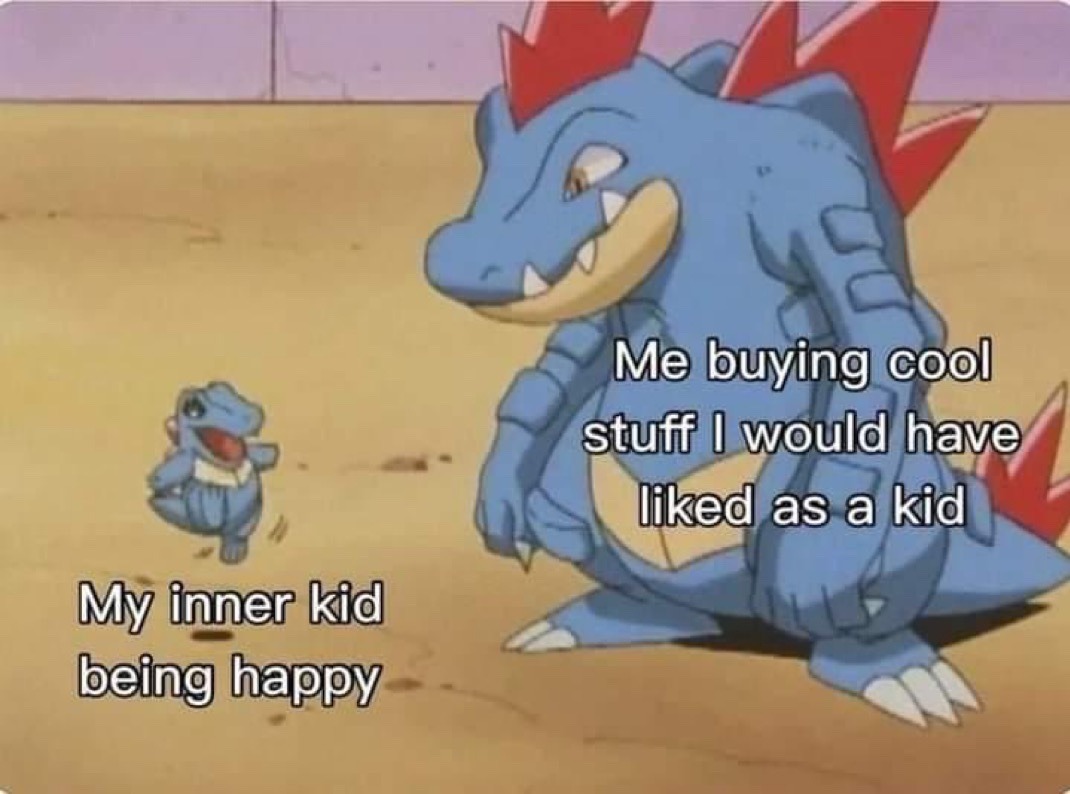
See also this meme I found on Tumblr. ↩
A Guide To Finding Joy In Life
🔗 a linked post to
goodness-exchange.com »
—
originally shared here on
For a miracle to happen in your life all that is needed is your belief that the universe has acted on your behalf and for your welfare.
So, begin by keeping a journal where you note down all such instances in your life. This is stuff that you previously dismissed as a coincidence or perhaps did not notice at all.
For example, you remember an old friend you have lost touch with and determine to call him. And you receive an email from him later the same day. You forgot to make a reservation for the dinner with your husband’s boss and it turns out that he had an emergency, and the dinner has to be rescheduled. You go to your favorite restaurant and the dish you like is not available. The waiter suggests a substitute and you love it.
Constantly look, look, look for signs that the universe is dancing with you. You see a rainbow after a rain squall and your spirit lifts. You are trying to enter a busy highway and a driver slows down and flashes his light to let you know you can merge in. The latch on your screen door is not working and you make a mental note to get it fixed. The next day it is functioning perfectly again.
Record all of this in your journal. You will have a dozen or more examples each day.
For the last decade or so, I’ve operated under the assumption that the universe was indifferent.1
I like this reframe a lot. Maybe the universe is indifferent, but that’s all the more reason to be grateful when things work out in your favor.
-
Yes, I’m aware that this is basically a Don Draper quote. ↩
Finding Fulfillment
🔗 a linked post to
longform.asmartbear.com »
—
originally shared here on
It is possible to be empowered to work how you want (Autonomy), to be leveraging your skills and expertise (Mastery), and to be proud of your role in a cause (Purpose / Why), and yet still dislike every day of your existence. More than contentment (ikigai), you need Joy.
Not only is this possible, it is common. There’s the classic example of the startup founder who wakes up six years into the journey, realizing she’s been surreptitiously brought to a boil, burned out, dreading each day, drinking too much “to turn my brain off so I can sleep” but actually because she’s deeply unhappy.
What I enjoyed about this article was the Venn diagram showing you need to find something at the intersection of joy, skill, and need. If you only intersect two of the three, you will fall into a specific trap.
For instance, if you have joy and need but not skill, you are falling for “indulgent failure”. Or if you want the recipe for classic burn out, take skill and need but leave out joy.
One of the best secrets of a happy life is the art of extracting comfort and sweetness from every circumstance.
If we are all going to be destroyed by an atomic bomb, let that bomb when it comes find us doing sensible and human things—praying, working, teaching, reading, listening to music, bathing the children, playing tennis, chatting to our friends over a pint and a game of darts—not huddled together like frightened sheep and thinking about bombs.
Rebellion, freedom, and passion
🔗 a linked post to
albertogalca.com »
—
originally shared here on
The last vial contains a flame within. It tells you to wake up each day with the bright eyes of the child you still are, even if he is hidden somewhere inside you. To do things with love. To live believing that everything is possible, even though deep down you know the odds are against you. To keep playing and to keep doing new things, because there is nothing braver than doing something a thousand times, even if you do it wrong a thousand and one times.
Nerves, Joy, and Deep Procrastination
I’ve consumed a few pieces of content recently which all seem to converge around a central theme.
A good friend recommended I read the book Hope and Help for your Nerves, a book originally written in the 1960s by Dr. Claire Weekes, because it provides a simple framework for beating the cycle of anxiety once and for all.
I found myself occasionally wincing at some of its dated references1, but mostly, I found myself unable to put the book down.
Every time she starts a new chapter, she introduces a new character who is undergoing some form of nervous breakdown, and I find myself completely captivated because I can 100% see myself in the vast majority of these people.2
So what is this simple framework for taming anxiety once and for all?
- Facing (confronting anxiety instead of avoiding it)
- Accepting (being okay with the situation without adding resistance)
- Floating (pretending you’re on a cloud, allowing feelings and sensations to come and go without resistance)
- Letting Time Pass (understanding that recovery takes time)
Today, I’m supposed to be camping with my family, but I woke up feeling horrible, so I stayed back while my wife and kids took off.
After taking a nap, I decided that it was the perfect day to work through my YouTube “Watch Later” backlog.
Near the top of my list was a TEDx talk from Olympian Deena Kastor where she shared her technique for introducing joy into the things we dread the most.
This was the "chaser" to the "shot" provided by Dr. Weekes.
I used to find it easy to introduce joy into my life. I loved running my own business and deciding that we’d spend every single lunch playing Super Smash Bros. for the N64.
It saddens me to admit that for the last few years, I’ve found it increasingly difficult to do stuff like that. Being silly feels challenging, even when it involves playing a game at the playground with my kids. If I’m being honest, it sometimes feels like I’m not worthy of feeling joy or happiness.
Deena shared how she used to hate her Sunday morning long runs because, well, have you ever had to get up at 4am to run 15 miles with a group of people who are physiologically already faster than you?3
She later realized that by giving into the dread, she was admitting defeat even before taking the first step of the run.
After she decided to put on her favorite outfit, eat her favorite breakfast, and find other ways to inject joy into the situation, those long runs became her favorite part of her job. And it made her realize that she could infuse joy into all areas of her life, which ultimately made her life more filled with joy.
Another video on my Watch Later list was from Cal Newport about dopamine sickness.
Cal invents a lot of terms, but I do not want him to stop because these terms seem to always click with me.
One of those terms is “dopamine sickness”, which is when your brain is unable to focus for long periods of time because you’ve spent so much time feeding it quick hits of dopamine whenever you’re bored.
He also coined “deep procrastination”, which is when you are physically unable to do your job, even when you’re under deadlines or other types of pressure.
I said in my original link to this video that his solutions to these problems are “infuriatingly simple”, because to be honest, all of the advice that I’m seeing in all of these pieces is blindingly obvious with the gift of hindsight.
It all seems to boil down to “be an adult.”
And I define “being an adult” as “have a vision for what it is you want to do, and then focus all your efforts on achieving that vision.”
So between those three pieces of media, I feel like I’ve got a good strategy for finally making solid progress on my anxiety and depression issues.
First, I need to be crystal clear on my vision. Who do I want to be? What do I want to do?
When I’m clear on that, I need to figure out what aspects of that vision give me fear. Then, I need to find trusted advisors to help me devise a game plan to address those fears. And when some of those fears inevitably materialize, I need to have confidence that I’ll be able to work through them.
I need to be more rigid about building systems for myself and sticking to them. There are an endless amount of productivity hacks out there, but I need to start simple: time box my calendar at the beginning of the week and hold to those boxes. Include all the boxes necessary to feel like I’m making progress both personally and professionally.
Whenever I get frustrated about a problem, I need to infuse joy into the situation. I need to simplify the problem and take the tiniest of steps towards solving it.
Finally, I need to be more intentional about how I use technology. Intention is tough to define without a vision, which is why I need that vision first. Getting rid of my iPhone is probably a helpful step in defining that direction.
I believe those are the steps I need to take in order to start seeing a decrease in my general anxiety levels and an increase in my happiness with life levels.
After 34 Years, Someone Finally Beat Tetris
🔗 a linked post to
m.youtube.com »
—
originally shared here on
An internet friend sent this to me when it happened, saying, “this seems like something you’d watch.”
This was so delightful. I love these nerdy, competitive communities who all rally around joy.
This joy was noticeable when Fractal was live streaming his reaction to when Scuti got the crash. He didn’t look mad or disappointed. He looked proud, excited, and happy for his competitor.
Supremely feel good nerdy content right here.
Joy Training: Rethink Your Approach to Performance
🔗 a linked post to
m.youtube.com »
—
originally shared here on
I am a big fan of Deena Kastor. She’s an Olympic bronze medalist and former U.S. record holder for the marathon.
Deena shared her approach for injecting joy into miserable situations in her TEDx talk, which is certainly something I can empathize with as a former marathoner myself.
Doing wind sprints up the hill behind Coffman Union doesn’t sound like much fun, but when you’re doing it with others and trying to make each other laugh while you do it, it’s an experience you’ll never forget.
WeblogPoMo 2024 - Song 16: The Go! Team - Get It Together
🔗 a linked post to
youtube.com »
—
originally shared here on
You try listening to this song and not getting a little nostalgic or happy.
Why Houses Don’t Look Like Houses Anymore
🔗 a linked post to
thenation.com »
—
originally shared here on
I’ve owned my own home for close to five years now, and I’m slowly coming around to the idea of making major changes to it in order to make it feel like it is mine.
During the pandemic, we poured a patio in the front of our house and spent nearly every day sitting on it.
In fact, that patio led to the formation of several enduring relationships with my neighbors.
I find it tough to shake the renter’s mindset, where I can’t do anything to affect the “resale value” of my home because… well, maybe the next owner won’t buy it because of the deep purple walls in the basement.
But the more I lean into tweaking what we have, the more I feel comfortable, productive, and happy. I’m incredibly grateful to have property which I can modify however I see fit to improve the wary of life for my family and myself.
This article also made me reflect on how toxic it can be to covet other people’s homes:
We should always remember that the purpose of a home is for living and that decoration, for many, is a form of self-expression. Media literacy, which has improved with regard to beauty and fashion content, lags when it comes to architecture and interior design. Changing that begins with realizing that most homes don’t actually look like hotel lobbies or real estate listings. They, rather joyfully, look like homes—dust bunnies and all.
Claude and ChatGPT for ad-hoc sidequests
🔗 a linked post to
simonwillison.net »
—
originally shared here on
I’m an unabashed fan of Simon Willison’s blog. Some of his posts admittedly go over my head, but I needed to share this post because it gets across the point I have been trying to articulate myself about AI and how I use it.
In the post, Simon talks about wanting to get a polygon object created that represents the boundary of Adirondack Park, the largest park in the United States (which occupies a fifth of the whole state!).
That part in and of itself is nerdy and a fun read, but this section here made my neck hurt from nodding aggressively in agreement:
Isn’t this a bit trivial? Yes it is, and that’s the point. This was a five minute sidequest. Writing about it here took ten times longer than the exercise itself.
I take on LLM-assisted sidequests like this one dozens of times a week. Many of them are substantially larger and more useful. They are having a very material impact on my work: I can get more done and solve much more interesting problems, because I’m not wasting valuable cycles figuring out ogr2ogr invocations or mucking around with polygon libraries.
Not to mention that I find working this way fun! It feels like science fiction every time I do it. Our AI-assisted future is here right now and I’m still finding it weird, fascinating and deeply entertaining.
Frequent readers of this blog know that a big part of the work I’ve been doing since being laid off is in reflecting on what brings me joy and happiness.
Work over the last twelve years of my life represented a small portion of something that used to bring me a ton of joy (building websites and apps). But somewhere along the way, building websites was no longer enjoyable to me.
I used to love learning new frameworks, expanding the arsenal of tools in my toolbox to solve an ever expanding set of problems. But spending my free time developing a new skill with a new tool began to feel like I was working but not getting paid.
And that notion really doesn’t sit well with me. I still love figuring out how computers work. It’s just nice to do so without the added pressure of building something to make someone else happy.
Which brings me to the “side quest” concept Simon describes in this post, which is something I find myself doing nearly every day with ChatGPT.
When I was going through my album artwork on Plex, my first instinct was to go to ChatGPT and have it help me parse through Plex’s internal thumbnail database to build me a view which shows all the artwork on a single webpage.
It took me maybe 10 minutes of iterating with ChatGPT, and now I know more about the internal workings of Plex’s internal media caching database than I ever would have before.
Before ChatGPT, I would’ve had to spend several hours pouring over open source code or out of date documentation. In other words: I would’ve given up after the first Google search.
It feels like another application of Morovec’s paradox. Like Gary Casparov observed with chess bots, it feels like the winning approach here is one where LLMs and humans work in tandem.
Simon ends his post with this:
One of the greatest misconceptions concerning LLMs is the idea that they are easy to use. They really aren’t: getting great results out of them requires a great deal of experience and hard-fought intuition, combined with deep domain knowledge of the problem you are applying them to. I use these things every day. They help me take on much more interesting and ambitious problems than I could otherwise. I would miss them terribly if they were no longer available to me.
I could not agree more.
I find it hard to explain to people how to use LLMs without more than an hour of sitting down and going through a bunch of examples of how they work.
These tools are insanely cool and insanely powerful when you bring your own knowledge to them.
They simply parrot back what it believes to be the most statistically correct response to whatever prompt was provided.
I haven’t been able to come up with a good analogy for that sentiment yet, because the closest I can come up with is “it’s like a really good personal assistant”, which feels like the same analogy the tech industry always uses to market any new tool.
You wouldn’t just send a personal assistant off to go do your job for you. A great assistant is there to compile data, to make suggestions, to be a sounding board, but at the end of the day, you are the one accountable for the final output.
If you copy and paste ChatGPT’s responses into a court brief and it contains made up cases, that’s on you.
If you deploy code that contains glaring vulnerabilities, that’s on you.
Maybe I shouldn’t be lamenting that I lost my joy of learning new things about computers, because I sure have been filled with joy learning how to best use LLMs these past couple years.
If you can use open source, you can build hardware
🔗 a linked post to
redeem-tomorrow.com »
—
originally shared here on
I’ve been dreaming of building my own electronics since I was a kid. I spent so many afternoons at Radio Shack, and even tried my hand at the occasional kit, with limited success. Every few years in adulthood, I’ve given it another try, observing a steady downward trend in difficulty.
I’m telling you: we’re at a special moment here. The labor savings of open source, the composability, the fun: all of it has come to hardware. You can build things that solve real problems for yourself. I first imagined my heat pump devices over a year ago, and I have been frustrated they didn’t exist every day since.
Now my dreams are real, and the largest energy consumer in the house can be automated and remotely controlled.
That’s amazing.
As soon as I gain employment again, the very first thing I’m buying is a 3D printer, and I’m gonna start building stuff.
I don’t quite know what yet.
But I’ll find something.
Why Can't Programmers Agree on Anything?
🔗 a linked post to
jesseduffield.com »
—
originally shared here on
Programmers disagree on various topics, for various reasons. Personally, I wouldn’t have it any other way. I wouldn’t want to live in a world where all of these software topics are settled and boring. Debates about programming are interesting and intellectually stimulating, and unlike debates about, say, politics, you’re unlikely to lose any friends when you express your functional-programming hesitancy.
Maybe, at the end of the day, that’s the real reason there’s so much disagreement among devs: because it’s so fun.
I should print this out and give it to my wife. This is exactly why I enjoy arguing about dumb stuff.
It’s rarely about winning. Being correct is fun. Arguing over semantics and picking nits over asinine details lets you sharpen your beliefs by pitting them against someone else’s.
It also signals that you truly care about the thing. It’s probably the most common way I show I love something.1
-
I recognize this makes me insufferable to consume most forms of media with. When I notice the little details in a show where they took shortcuts and were lazy, I can’t help but call them out. Sorry, Shanny. ↩
eternal woodstock
🔗 a linked post to
bnet.substack.com »
—
originally shared here on
As people keep trying to make Twitter 2 happen, we are now in a period that I'm calling Eternal Woodstock — every few weeks, users flock en masse to new platforms, rolling around in the mud, getting high on Like-dopamine, hoping that they can keep the transgressive, off-kilter meme magic going just a little longer, even though social-media culture already been fully hollowed out and commercialized.
I haven’t signed up for any of the new Twitter clones. I do have a Mastodon account that I created back before Twitter got terrible, but besides a futile one week attempt to get into it, it too has sat dormant.
Maybe this is just part of progressing through life, progressing through society and culture.
It’s something I’ve noticed now with having kids: as a kid, you are extremely tuned into social status. Everyone else listens to the ZOMBIES 3 soundtrack? Now you have to be into it. Your little brother likes it now? Now you have to be too good for it.
But for that brief moment, you feel like you’re ahead of the game. You’re a tastemaker.
The times where I’ve genuinely been the happiest in my life have been when I’ve done something just for myself. If it makes those around me impressed or weirded out or indifferent, it was of zero consequence to me.
The short list of things I can think of that fit that bill: this blog (which has existed in some shape since I was in sixth grade), making clips for television production class, learning something new, 90s/00s pro wrestling, running, and playing the guitar.
It’s only when I start to look around at others when I start to get depressed.
And maybe that’s a key insight into why I feel like I feel right now. I don’t have a job at the moment. At my age, your social status is determined by things like the vacations you go on, the home you have, and the title you hold.
But really, none of that stuff matters. What matters is the stuff that brings you joy.
It just so happens that those things, in fact, do bring me joy. The vacations I’ve gone on in the past 12 months have been the happiest I’ve been in ages. I spent all morning deep cleaning several rooms in my house, and it feels incredible.1 Building software and solving problems for people is what makes me happy, not being a director of this or a chief whatever.
I guess what I’m trying to say is: I should stop feeling guilty about not posting a whole lot on social media.
My home is this website. People can come here if they wanna hang out.
Sure, I’ll poke my head up and see what’s going on with others around me on occasion, but I don’t need to feel compelled to chase the feelings that come alongside taste-making.
Those feelings are like capturing lightning in a bottle, and ultimately lead me to my deepest forms of depression.
-
Even though I know the kids are gonna mess it up in roughly 4 minutes, that’s okay. It’s their house, too. ↩
Restoring IBM Model M Keyboard with Destroyed Cable + USB mod
🔗 a linked post to
youtube.com »
—
originally shared here on
There is not much in this world more satisfying to me than watching an Odd Tinkering video.
My website as a home
🔗 a linked post to
nicochilla.com »
—
originally shared here on
I’d like to use “home” as the operative analogy for my own website.
With any analogy, you choose which properties of the subject to apply to the object of comparison, and which to ignore. What I find significant about homes in this context is that they don’t exist primarily for display: rather, they’re designed around the habits and values of their occupants.
Analogously, I want to use my website to order and document my own activity, and to interact with things and people that I care about.
Still, a website and a home are importantly different in that the former is intended for public exposure, whereas the latter is grounded in private life. But maybe we can relate the public nature of websites to a public dimension of homes: hosting visitors.
Typically we don’t show our house guests everything — we keep many things private and clean up before they arrive. Moreover, we’ve made prior decisions about our furniture and decor with future guests in mind. So homes can certainly be curated for the public eye; but crucially, they maintain their function as living spaces.
I find it generative to consider websites as a similar conjunction of public and private activity: by thinking about how visitors will receive the things that I publish, I’m compelled to produce more and refine the things that I make. At the same time, the website remains my space and is subservient to no other end.
The joy I get from tweaking my personal site and sharing links like this to it seems to be the exact same joy that my kids get out of meticulously organizing their playhouses.

The Job Hunt Chronicles: Month 1: Discovering My Path
I was laid off from my job on January 2. It did come as a bit of a shock, and for the first time in my life, I've been really struggling to figure out who I am and what I'm looking for.
As a way to keep pushing myself forward and holding myself accountable, I'm going to start publicly documenting this process as a way to process my thoughts out loud, keep my friends and network aware of my activities, and start some conversations that'll help me take my next step forward.
"What are you looking for?"
If I could summarize the past month in a single question, that would be it.
In the 58 conversations I've had in the past month with friends, recruiters, industry peers, networking events, partners, and job interviewers, I've been asked that question literally every single time.
And 58 times later, I think I'm starting to get closer to an answer.
Here's what I'm looking for:
- A team of kind, smart, and hard-working people
- A mission that the team rallies around which helps improve as many lives as possible
- A leadership role to help drive an engineering team towards fulfilling that mission
- Doing all of this while continuing to experiment with LLMs and other AI technologies
- Connecting with as many people as possible to explore the impact of AI on who we are as humans
- Something that includes medical benefits to support my family
It doesn't matter much to me what the title is. Some roles I've applied and begun interviewing for include "Director of Engineering," "Software Architect," "AI/ML Lead," and "Founding Engineer".
If you know of any opportunities that you think would fit a nerdy kid who has a big heart and enjoys exploring practical applications of artificial intelligence, please send them my way!
Activities I've done
Here's a list of the activities I've pursued between January 2 (the day I got laid off) and February 3 (today):
- Friends: 11
- Recruiters: 11
- Industry Peers: 19
- Networking Events: 6
- Interviews: 8
- Partner Chats: 3
- Total: 58
Here are my loose definitions for these categories:
- Friends: People I have a deeper relationship with and whose primary interest isn't necessarily in discussing the job search.
- Recruiters: People who have a vested interest in pairing me up with a job. These could become friends at some point, but my primary purpose in engaging with them was to talk shop.
- Industry Peers: People who work in the industry and want to make a connection to expand each other's networks. Again, these folks could become friends at some point.
- Networking Events: Events geared towards either making connections or learning something new with a bunch of other people.
- Interviews: Discussions with people who have a possible role that I can fill.
- Partner Chats: I do still have an entrepreneurial bone in my body, so these are discussions with those I am working on building a business with.
As you can see so far, most of my time has been with folks in the industry, making connections, trying to explore what opportunties are out there.
I'm hoping that I start to see more growth in the "interviews" column by this time next month. ?
Things I've learned
Alright, so back in the day, I used to do these blog posts where I'd accumulate a bunch of random thoughts over a period of time and then list them out in bullets. I'm gonna do something similar here, so here are some things I've learned in the past month:
?? Personal growth insights
Safe spaces rule.
Every classroom in my daughter's school has had a "safe space", an area of the room that kids can go to when they're overwhelmed or stressed out. It gives them a place to calm down and process their emotions.
My daughter recreated one in her room. Beneath her lofted bed, she's created this fortress of solitude. It consists of a beanbag chair, a little lamp, some stuffed animals, a sound machine, books, crafts, and affirmations scotch taped to blanket walls.
When I took my first virtual therapy call, I did it from that safe space.
Our house isn't big enough for me to build a room with one, but once I get employment again, I'll begin finding a way to add one on. It's important to have a space you can retreat to where you feel safe.
Anxiety is an asset.
There's a reason we feel anxiety: it helps us stay safe from threats.
But when you're abundantly safe in nearly every sense of the word, anxiety itself becomes a threat.
I've been dealing with runaway anxiety issues for decades now, which is a big part of the reason I don't feel comfortable spinning up my own business at the moment. The last time I did that ended with a similar series of rolling anxiety attacks.
But as a professional software architect, anxiety is actually pretty useful. Being able to envision possible threats against the system allows you to create mitigations that will keep it safe and efficient.
Of course, you gotta be careful to not let your applied anxiety run away from you. Easier said than done.
"It'll all work out. Even if it doesn't, it all works out."
My lifelong pal Cody's mom is a paragon of confidence and chillness.
I went for a walk with Cody a week into being laid off, and we got to talking about her parents.
She shared that her mom often says that quote, which is what gives her that confidence.
I need more of that in my life.
Gravity Falls is an amazing television show.
You all should look it up on Disney+ and burn through it in a weekend.
It's one of those shows that slowly builds to a gigantic payoff at the end.
The finale hit me with all the feelings.
Plus, it's a good show to bond over with your seven year old daughter.
Journaling really helps with perspective.
I've journaled every day since getting laid off. Reading back through them, I'm seeing patterns into what activities contribute to good days versus bad days.
Good days include some sort of vigorous workout, a conversation or two with a good pal, and tons of encouraging self talk.
Bad days include skipping the workout and sitting by yourself with your horrible, negative self talk.
Journaling is proof that life still goes on even if I don't have a job.
It's also proof that I'm at least taking some advantage of not having the responsibility of a job. (Not nearly enough, though.)
What helps my depression is a clear vision.
I've realized this month that it's when I've taken the path of least resistance when I've ended up the most miserable.
When I was a senior in high school and needed to decide what to do with my life, I picked a school (the U of M) and a degree (computer engineering) that were convenient because of proximity and my interest in computers.
My first semester of college was a complete shock.
For the first time in my academic career, I hated school.
The classes absolutely drained me. My "intensive precalculus" class sounded about as fun as you'd imagine. I mean, yeah, there are some people out there who enjoy math, but it's a rare breed who would say that they derive pleasure from "intense math."
My calculus-based physics class was a kick in the teeth. I've always been told I'm smart, but memorizing and deploying specific formulas on demand was not my strong suit. It made me feel dumb.
It felt like I was there because I had to be there, not because I wanted to be there.
And how ludicrous is that? I spent $12,000 per semester out of some perceived obligation to do so.
When I failed miserably out of engineering school, I sat down in Coffman Memorial Union and scrolled through the class directory, looking for something that looked interesting to me.
I ended up landing on a class called Broadcast Television Production, which gave me so much energy.
It required me to become a journalism major, so I switched over to that.
That path led me to an internship at WCCO, which was one of the most enjoyable professional experiences in my life. I mean, I got to hang out with hard working creatives that perfectly blended their surly dispositions with a passion for making engaging videos.
Now that I'm in my mid-thirties, I feel like I no longer am obliged to follow any specific path. The only thing holding me in place is myself.
For the past six months, I've felt like I've been stuck in this fog of uncertainty and depression. I've felt useless, a drain on myself and those around me.
This fog has led me down some dark paths where I've said some really nasty things to myself, kicking myself for being a loser, a failure, an idiot.
But really, my problem was that I just lost sight of who I am and what I want to be.
So while I'm still squinting to see my way through the fog, I'm using some of my other senses instead.
I'm using my ears to listen to my friends and network who are serving as voices to pull me out.
I'm using my nose to sniff out opportunities and make new friends.
And perhaps the most important of all: I'm using my heart to decide what will make me feel fulfilled and useful.
All of that stuff is helping me form the vision for what the next few years of my life looks like.
The two resources I have to offer those who may be in a similar situation would be my pal Kurt Schmidt who is currently in the final stages of a book that helps you formulate your 10 year vision, and my idol Arnold Schwarzenegger's new book Be Useful.
I cannot recommend the audiobook version of his book enough. Hearing Arnold say things like "rest is for babies, and relaxation is for retired people" hits so much better with his accent.
The messages shared in children's programming are important to hear as adults too.
I've been hanging with my kids a lot this month, and my son is super into Paw Patrol and Blue's Clues.
In the "Big City Adventure" musical movie, you follow Josh (yeah, there's been several new "Steve" characters since the show debuted in my childhood) as he tries to achieve his dream of performing on Broadway.
Are the songs simple and annoyingly catchy? Definitely. But you know what? Sometimes, it's important for us, as adults, to believe that "happiness is magic" and "you can do anything that you wanna do."
Paw Patrol is another one of those shows where, as an adult, it's easy to complain about their reductive storylines and fantastical premises.
But on the other hand, I have a vivid memory of discussing the Green Ranger's transformation into the White Ranger on the bus as a first grader.
These stories serve as lessons for teamwork, cooperation, sharing, and the importance of spreading joy and helping those in need.
These are traits that come easier to some than others, but they're crucial if we want to have a thriving society that lifts all of us up as humans.
Plus, sometimes, it's just fun to get invested in silly, simple characters and storylines.
So while I'm still gonna watch RuPaul's Drag Race or FUBAR when the kids go to bed, don't sleep on the shows that your kids are into. If you can drop your "I'm too good for this" mentality, you might just remember how simple life can be if you reduce it to its basic concepts.
How does one build confidence without cultivating hubris?
Is it just staying humble?
Asking for a friend.
...okay, I'm asking for myself.
Brain pathways are forged through the tall grass.
My therapist gave me this analogy as a way to help me visualize how to deal with changing your perspectives.
When a pathway is stomped through the tall grass, it's easy to walk down it.
But sometimes, those pathways no longer serve us. We still choose to walk down them, though, because it's easy.
If you want to forge newer and more helpful pathways, you gotta do the hard work of stamping out new pathways.
Eventually, if you keep doing the work, you'll discover that the old pathways become overgrown, and the one you stamped out for yourself is now the easy path.
I think this metaphor works for so many areas of our lives, like getting into shape or improving our own self talk.
If I'm so smart, why can't I beat depression?
I wrote that question in my journal, and I think it's because depression might not be something you beat. It's something you experience when you have achieved so much and aren't confident in what's next.
You "beat" depression by choosing to take a step towards your vision every single day.
You "beat" depression by spending less time with your brain and more time with your heart.
You "beat" depression by engaging in creative pursuits that make you happy. Just you. Nobody else.
?? Professional insights
AI is so much fun to experiment with!
One of the goals I set for myself this winter was to clean out the crawlspace we have under our steps.
As any homeowner knows, it's easy to accumulate stuff over the years. The item that left the biggest footprint? Several totes filled with baby clothes.
It doesn't seem like we're on the path toward baby number 3 at all, so we figured it was a good opportunity to purge it all.
I ended up donating 12 boxes of clothes.
While I carefully placed each item into one of those boxes, I dutifully tallied each one so I could calculate the fair market value in order to write the donation off on my taxes.
Now, this is something I've done for years. I find some spreadsheet on the internet that helps calculate it, then I manually add the items to the sheet to end up with the value.
This time, I decided to try to use AI to help me figure this out.
I live streamed the whole process, which you can check out here.
I learned two things during this experiment: first, OCR tools aren't that great at reading tally marks (but honestly, they did better than I expected). Second, while we're still a fair ways away from being able to hand off tasks like these to AI bots, it's impressive how far GPT-4 was able to get from my basic prompting.
Can AI really take away the "soul sucking" parts of our jobs?
There are a lot of mechanical tasks that our brains are wired to be good at: counting, pattern recognition, and so forth.
These tasks are often the crappiest parts of our jobs, right? It's the monotonous, soul-sucking parts of our work. And we even call it soul sucking because it often feels like stuff that gets in the way from pursuing better, more fulfilling things.
So what does that leave us with? If the soul sucking parts of our jobs are automated away, what does it mean then for us to be human?
Maybe the future here isn't that AI will kill us all. Maybe it will force us, for the first time in the existence of our species, to truly deal with what it means to value a human life.
It will free us up to pursue creative pursuits. To keep digging deeper on our humanity. To ask new questions about what that actually means, and then allow us to pursue it together with machines helping us do some of that hard work for us.
Maybe something I can look into is figuring out how to use AI to help us understand our brains better. Like, can AI help us figure out the chemical imbalances that lead to severe depression? And if it can, can it help us synthesize treatments to keep our brains in perfect balance all the time? And if it can, does that prevent us from being human, or does it make us more human?
"Happiness is to write code that does great things for other people."
Before getting laid off, I bought tickets to Code Freeze at the University of Minnesota. The annual event focused this year on artificial intelligence, so it would've been foolish not to go.
I am so glad I did.
The event kicked off with a keynote from Andreas Sjöström, a long time industry leader, who shared a story of a paper he wrote when he was young.
His teacher asked him to define happiness, and he came up with "happiness is to write code that does great things for other people."
Really, when he said that, it felt like someone suddenly turned the focus knob from "blurry" to "sharp."
Writing software is challenging work filled with constant struggle, but once you get things working right, it's magical.
We, as engineers, often lose sight of that magic because we get so invested in discovering the secrets to the magic.
Sometimes, it's nice to just sit back and appreciate the opportunity and privilege we have to deliver technology that brings not only joy to others, but empowers them to go forth and do great things.
"An architect's crystal ball is being connected to others."
The other networking event I attended that brought so much joy is the AppliedAI meetup.
This month's meeting featured Jim Wilt, a distinguished software architect, as he discussed AI's role in an organization's architecture strategy.
The thing that struck me at this particular event was how dang smart everyone there was. All forms of intelligence were explored. Some folks were really keyed into the emotional side of intelligence, while others were approaching things from an analytical lens.
All of us were working together to gain some insights into how we can better use these amazing tools we've been given.
That spirit was wrapped up in a story Jim was saying about the importance of collaboration.
In isolation, you're only as smart as yourself. When connected to others, you are able to make deeper and more accurate insights into what might work for your own situation or problem.
The key takeaway? "An architect's crystal ball is being connected to others."
If we're going to answer the tough ethical and societal problems that surround these new AI tools, the only way we'll figure it out is together.
What's next for me
Certainly, my next month will involve more meetings, more interviews, and more digging into this vision.
I commit that by this time next month, I'll be back with a more clear vision of what I want my life to be. That way, when one of you wonderful people asks me "what are you looking for," I can provide a hyper-focused answer.
As always, a huge thanks to those who have reached out and offered their support. Like I said above, being connected to others is really what makes all the difference.
If you would like to help, here's how:
- If you know of a full time (32-40 hr/week) job opportunity where I can help architect a complex software system, explore how AI can fit into an organization, or lead a team of nerds towards building an awesome product, please send it my way.
- If you have insights or articles that speak to how AI might force us to define our humanity, please send those my way.
Until next month, stay in touch!
On Craft
🔗 a linked post to
drcathicks.com »
—
originally shared here on
Grandpa loved craft. He didn't put it that way but other people did. My dad said grandpa was a craftsman. I didn’t understand what this meant until one day when we were visiting. We sat down at a restaurant table and it wobbled. We ignored it. But Grandpa dropped as quickly and efficiently as a seal, vanishing underneath the table to fix the cheap, badly-screwed leg with a coin for a screwdriver.
He fixed things often and silently. Grandpa just cared about things working. He had an instinct for not just broken things but soon to be broken things. He would point out risky work, bad decision making in the form of shoddy materials or shifting angles. He was offended by the trace measures left in the world that signified short-term planning. So I learned that this too had something to do with craft. He had a visual vocabulary that amazed me. I think about how he could see these details. He saw choices and constraints and tensions and frictions where I just saw chairs. He saw effort where most people just saw end products.
I’ve got a few posts in mind that I’ll get cracking on soon about my recent malaice and regression towards a mid-life crisis, but this post helped me keep one thing in perspective.
As someone commented on Lobsters, caring is at the root of a craft. How else could you possibly spend your life?
How to Find Joy in Climate Action
🔗 a linked post to
youtube.com »
—
originally shared here on
I have a habit of listening to podcasts and jotting down reminders to check out stuff that the hosts recommend, and then never ultimately getting back to consume that content.
I stumbled upon this video today while spelunking through my reminders app, and I felt like it was fitting considering (a) an upcoming thing that I’m really excited to share soon, and (b) it helps tie together the two most recent posts on this blog.
The part that made me go “ah, damn” was when she mentioned that most people who go through this exercise end up with some form of communication as their climate action.
After completing the exercise, the two things I wrote down were:
Do the podcast idea, build your network of “doers” in various climate fields, leverage the network to institute policy change and inspire others into action.
Do the podcast idea, discover a company doing something cool in climate (terrible pun), join that company.
The other thing Ayana warns in this video is to not start with your solution in mind, but dang, that’s just not fair, is it?
Either way, going through this venn diagram exercise gave me a lot to think about, and I’m quite curious to hear what you think if you end up doing this as well.
Expectations Debt
🔗 a linked post to
collabfund.com »
—
originally shared here on
Expectations are like a debt that must be repaid before you get any joy out of what you’re doing.
Saturday Morning Breakfast Cereal - Being
🔗 a linked post to
smbc-comics.com »
—
originally shared here on
I spent 6 hours drawing Pokémon today and it never occurred to me for a second that anyone else might be better or worse.
Even if it had, I would’ve been excited for them, not sad for myself.
Damn, now this is the philosophy I want to have.
We don’t stop playing because we grow old… We grow old because we stop playing.
Humans Need Play
🔗 a linked post to
allenpike.com »
—
originally shared here on
Under pressure, our free time – our entertainment time, our recovery time – tends to devolve into mindlessness. You know, scrolling social media. Re-watching the same show repeatedly. Numbing and zoning out. Nobody has the energy to learn how to play Axis & Allies after working for 12 hours.
Similarly, at work, people under pressure tend to simplify. We spend less time engaging socially, having fun, and experimenting. We crack down into Serious Business Mode.
While this can be a reasonable adaptation to get through a rough patch, it’s unsustainable. As we get burnt out, it gets even harder to play, reinforcing the cycle. All work and no play makes Jack something something.
Humans need play.
Three Theories for Why You Have No Time
🔗 a linked post to
theatlantic.com »
—
originally shared here on
The history of American housework suggests that both sides have a point. Americans tend to use new productivity and technology to buy a better life rather than to enjoy more downtime in inferior conditions. And when material concerns are mostly met, Americans fixate on their status and class, and that of their children, and work tirelessly to preserve and grow it.
But most Americans don’t have the economic or political power to negotiate a better deal for themselves. Their working hours and income are shaped by higher powers, like bosses, federal laws, and societal expectations.
To solve the problems of overwork and time starvation, we have to recognize both that individuals have the agency to make small changes to improve their lives and that, without broader changes to our laws and norms and social expectations, no amount of overwork will ever be enough.
As You Know, Jeff, Every Time I Stare Into The Abyss It Stares Back At Me
🔗 a linked post to
defector.com »
—
originally shared here on
This is not meant to be a happy story about the need to get out of the bubble of like-minded coastal elites; I think it’s totally OK, recommended even, to stay far far away from people who think you are going to hell. But I guess I think it’s also OK to touch the hot stove occasionally if you want to, to pretend that this time you won’t let it hurt you.
40 Life Lessons from 40 Years
🔗 a linked post to
theminimalists.com »
—
originally shared here on
I always get suckered in by these types of posts (certainly they’ve been sprinkled throughout the archives of this blog).
This one is exceptionally well done. There are simply too many to choose a pull quote from, but I’ll share the two reasons why I wanted to post about this article.
First, it’s heavy on the minimalism. It’s hard to participate in our society and not strive to be a maximalist. Capitalism is all about growth, after all, and if you aren’t expanding your footprint on this planet, what’s the point, right?
I’ve been working on being content lately. That contentment comes in several forms, like being content to spend time with my kids, being content to live in a smaller house than my neighbors, being content to drive an older car.
This post gives a lot of good snippets to keep in mind while maintaining the pursuit to think through what truly matters and what truly makes you happy.
Which leads me to my second reason: labeling my spiritual beliefs. This post contains a lot of axioms which seem to gel nicely with Buddhism.
I would not call myself a Buddhist. Frankly, I’m not sure what I’d call myself. But lately, the tenets of Buddhism have been appealing to me, and again, there are a lot of thoughts around how to deal with pain and suffering within this collection.
What a Hobby Feels Like
🔗 a linked post to
annehelen.substack.com »
—
originally shared here on
I grew up in a place, and a time, where hobbies — activities that had no place on your resume, no function in getting you into a better school — were still commonplace. Amongst the bourgeois American middle class, it’s becoming increasingly clear that Old Millennials were the last to experience this attitude towards activities and leisure. My partner spent his junior high and high school years at a competitive prep school on the Main Line in Philly, and has only recently come to realize that he had no hobbies, and no sense of what he actually liked to do, just what he needed to do in order to shape himself for school, then college, then work. Every hobby, for him, is an adult hobby — and thus all the more difficult to discover and adopt.
Hobbies are tough, especially hobbies that take up large chunks of a day (such as training for a marathon) or an actual entire day (such as getting season tickets to a sporting event).
I've got a few things that I'm thinking of getting into this year. First, tinkering with physical things. I am gonna try to restore some of my older broken tech that is laying dormant in my basement.
Second, flying. I want to get a discovery flight and possibly get my pilot's license.
Both of these things will take up "time", but frankly, after giving up most of my social media, I have a lot of free time in the evenings that gets eaten up with television. I'm ready to start trying some new things and being curious again.
Still Killer: Deryck Whibley On Sum 41’s “Fat Lip” 20 Years Later
🔗 a linked post to
stereogum.com »
—
originally shared here on
“I think I still feel the same way about it that I did in the very beginning,” Whibley says. “The day that I get sick of playing a song that everyone knows and everyone goes crazy when we play it, and everyone starts jumping around and everyone sings it, I should just quit because I’m so fucking jaded. It’s the greatest feeling in the world. I’ve never understood that. I don’t get Radiohead, even though I love Radiohead, why they don’t play their big songs.”
I respect the hell out of that pull quote, it’s how more of us should feel about things that make other people happy.
It’s hard to express what this song meant to me back in 2001 as an impressionable sixth grader. I’m definitely not an edgy, punk skater kid (nor have I ever been), but this song is still in my regular rotation because it gives me so much life.
Stop Keeping Score
🔗 a linked post to
theatlantic.com »
—
originally shared here on
Instead of checking items off a list, the Buddha suggests shining a light on yourself and others. “Dwell as a lamp unto yourself,” he advised his disciple Ananda. He meant that happiness comes from the illumination of your greatest virtues, thus showing the way for other people, and making visible to yourself your true purpose.
The Weirdly Enduring Appeal of Weird Al Yankovic
🔗 a linked post to
nytimes.com »
—
originally shared here on
Michael Schur, the creator of “The Good Place” and co-creator of “Parks and Recreation,” remembers the force of Weird Al’s 1992 parody of Nirvana.
“ ‘Smells Like Teen Spirit’ comes out, and it’s like the perfect voice for all the simmering anger of an entire generation of kids,” Schur said. “That song is vicious and angry and aggressive but also laconic and disaffected and scary. And it was immediately a gigantic thing in American culture. Then Weird Al does ‘Smells Like Nirvana’ and completely deflates it — the importance and seriousness and angst. That’s a service he has always provided: to remind people that rock is about grittiness and authenticity and finding your voice and relating to an audience, but it’s also fundamentally absurd. Being a rock star is stupid. We as a culture are genuflecting at the altar of these rock stars, and Weird Al comes out with this crazy curly hair and an accordion, and he just blows it all into smithereens by singing about Spam. It’s wonderful.”
Schur paused. He said there were heated debates, sometimes, in comedy writing rooms, about the merits of Weird Al’s work — some cynics argue that his jokes aren’t actually great, that people overrate them because they’re nostalgic for their childhoods. But Schur insisted that, regardless of what you think about this lyric or that lyric, Weird Al represented the deep egalitarian spirit of our culture.
“It’s a truly American thing, to be like: Get over yourself,” Schur said. “Everybody get over yourselves. Madonna, get over yourself. Kurt Cobain, get over yourself. Eminem, get over yourself. No one gets to be that important in America.”
This whole piece is a must-read, especially if, like me, you grew up listening to (and subsequently memorizing) Weird Al's entire discography.