stuff tagged with "anxiety"
Verify You Are Human
🔗 a linked post to
scottsmitelli.com »
—
originally shared here on
What I did learn that day, though, was a form of anxious self-criticism that still follows me to this day. It seems like every time I lay out an article of clothing to wear, I ask myself—sometimes consciously, oftentimes not—“What smartass comment would Jay make about this?” And if I feel like my imaginary Jay might have a point, I don’t wear that thing.
But the thing is, Jay wasn’t any kind of authority. He was just a kid, same as me, but with a penchant for turning simple observations into disparaging remarks. Jay was an asshole, and he is a person I haven’t seen or spoken to in at least 22 years. I don’t know why I still let his words, and more importantly his views, influence my behavior. I couldn’t tell you how many other Jay-like people have planted similar seeds of neuroticism and self-censorship in my head.
One of my earliest CD purchases in middle school was Monsters of Rap.1 I must've listened to the first disk a hundred times. I was particularly captivated by Sir Mix-A-Lot's Baby Got Back.2
I listened to it so much that I memorized all the lyrics. And anytime I heard that song, it was a personal challenge to try and match Mix word-for-word.
At a stag dance in high school, the DJ dropped Baby Got Back, and I got so happy. I started rapping along with the track while busting my best moves.
Halfway through the song, a friend of mine (let's call him Greyson) looked at me and said, "dude, stop rapping. Nobody cares that you know the words, it's just annoying."
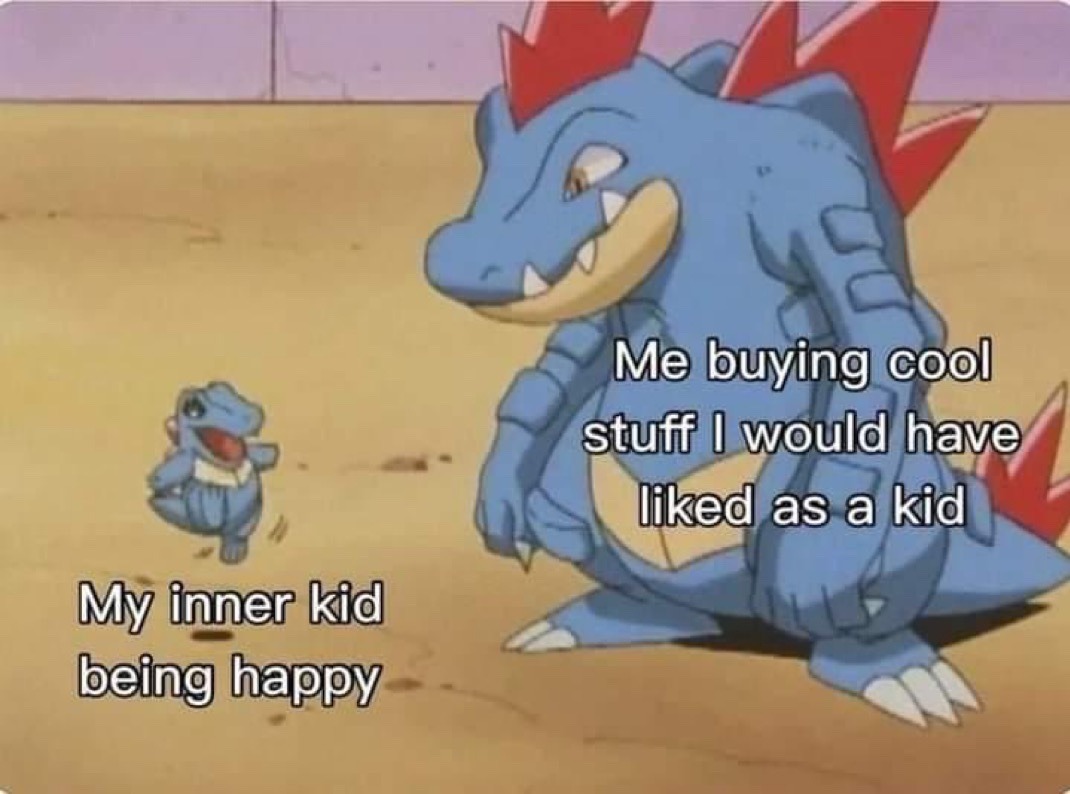
Now that I'm a dad, I catch myself occasionally acting the same way as Greyson and Jay, policing the joy that's emanating from my kids because of whatever big feelings I'm feeling.
Those are the moments I most often wish I could take back, and the first I go back and repair the next morning.
Sitting here in my late 30s, I now realize it's my job to decide what external sources of validation I want to bake into my own inner monologue.
It's also my job as a parent to help my kids come to the same realization.
-
Just like Monster Ballads, it was the late-night commercials during NewsRadio re-runs that sold me on it. ↩
-
Funny side story: my daughter was almost born to Nikki Minaj's Anaconda. Kinda awkward to be in between labor pushes, and the silence in the room is broken up by repeating choruses of "shake that big fat ass." ↩
You are the sky. Everything else — it's just the weather.
Brian Eno’s Remedy for Burnout and Despair
🔗 a linked post to
themarginalian.org »
—
originally shared here on
This whole article is the encouragement I know I'll need to be brought back to at some point. Some great passages from Brian Eno in here:
One thing experience shows us over and over, if we pay enough attention, is that the way out of such suffering, out of the abyss of self-concern with our mattering project, is always unselfing. Eno describes the cycle:
"It goes like this: me thinking, “What’s it all for?/ What’s the bloody point?/ I haven’t done anything I like and I don’t have a clue what to do next/ I’m a completely empty shell.” This lasts two days or so… Then I suddenly notice — apropos of something very minor, like the way a plane crosses the sky, or the smell of trees, or the light in the early evening, or remembering one of my brother’s jokes — that I am thoroughly enjoying myself and completely, utterly glad to be alive. Not one of the questions I asked myself has been answered. Instead, like all good philosophical questions, they’ve just ceased to matter."
(Hat tip to my buddy Scott for the link!)
You are afraid of surrender because you don't want to lose control. But you never had control; all you had was anxiety.
Trick questions
🔗 a linked post to
haleynahman.substack.com »
—
originally shared here on
I often forget my anxiety isn’t caused by a lack of answers to my swirl of questions, but the swirl itself. I frequently operate as if one more Google search will solve everything, circling around and around the internet, mercifully sedated by information I probably don’t need and will forget next week. Sometimes, I really do find the answer I’m looking for, and then I’ll stop, smug and satisfied. The problem with feeding the beast is it’s not the same as killing it. Soon enough, I’m hungry again.
In addition to being a great resource on how to feel like you've got enough, this article taught me a new term:
In Lauren Oyler’s essay about anxiety last week, she referenced a late 19th century diagnosis known as Americanitis, which described “the high-strung, nervous, active temperament of the American people.” Whether incited by advances in technology (causing loss of sleep, excessive worry) or capitalism (causing long work days, fast pace of life), the result was, according to experts of the time, a rattled population unable to relax. A black mirror of the American dream, Americanitis took the same ideas favored by patriots and recast them as depressing. Here is the land of possibilities—so vast in scale you’ll forever be unsatisfied!
Are we all suffering from Americanitis?
Everything that you’re feeling right now, name it love. Whether it’s fear, or sadness — everything that you’re feeling, name it love.
When I was young, I thought that nervousness and fear would disappear over time. But I realized that not only does it not disappear, it gets even worse. The only thing that changed is, now I accept it. I know it’s going to be there. I know how to deal with it. Now, with experience, I know I’m gonna be scared when the fight is coming; I know I’m not going to sleep well the week of the fight, but I accept it. [Early on in my career] I would freak out, sleeping only four hours the night before a fight. I put more pressure on myself, because I thought I wouldn’t be able to perform my best because of lack of sleep. But now I know it’s normal. I accept it. It’s a suffering process that I have to go through before a fight. But it’s still as bad as it was; the only difference is that I accept it now.
The Guilt of Feeling Joy
🔗 a linked post to
nikitagill.substack.com »
—
originally shared here on
Being in a complete state of sadness for perpetuity because there is unhappiness in the world or because you are supposed to be grieving makes for a hopeless existence. And hopeless is not a state that helps you build anything. The act of resistance, true resistance comes from joy. Joy is necessary to keep movements going, the celebration of even the smallest of victories – you cannot build anything from apathy. Joy, compassion, kindness, love and hope all live in the same bright blue sky that is needed after and before storms. During the brutal, painful Partition of India, my grandfather held onto a book he loved and turned to it for fortitude. My grandmother dreamt of the roses she would grow one day. Joy is an act of revolution, it is what keeps us going in times of deep pain.
Still churning my way through a deep Instapaper backlog and came across this article that was posted shortly after the last presidential election. It feels prescient considering what's going down in my home state right now.
I find a lot of inspiration in the Mr. Rogers’ “look for the helpers” quote. I would add that it’s equally essential to look for the joy.
The Art of Protecting Your Peace
🔗 a linked post to
time.com »
—
originally shared here on
How you care about issues that move you is what counts. Sometimes your lack of peace is a false economy. Recognize that your stress and anger isn’t changing anything around you; it’s only changing things within you. As you get angrier, more worried, more agitated, you become bothered. If you are always bothered, you are always angry, which will lead to you being stressed out and eventually getting sick, exhausted, and overwhelmed. And at that point of total burnout, you can’t make even a little difference anymore.
The reality is that you don’t have to be completely outraged and reactive to make a difference. In some cases, it can take that spark of outrage for you to realize how much you care and move into action. But once you do, put your hands on your heart or take deep breaths, get off social media or go for a walk (or all of the above), and remember the impact you can make without giving up all of your peace. The art of underreacting is to move from outrage to making a real difference while still taking care of ourselves.
Simply becoming aware of how vital our peace is to feeling good makes it easier to prioritize it.. When we aren’t aware, it’s harder to be gentle: We spend all our energy trying to change others or being unwilling to accept something that is happening (even though it’s happening whether we overreact or not).
Underreacting isn’t a sign of support for something you don’t support. It’s not faking your feelings. It’s how you move through something more gently. It’s how you decide how you want to respond. It’s how you protect and nourish yourself.
Generally good advice in here for, I don’t know, :gestures wildly at life:.
The greatest weapon against stress is our ability to choose one thought over another.
Your magic's real, so why aren't you using it? You could have the world for yourself You don't ever have to worry about losing it The magic inside of you is infinite
I have a very simple rule that serves me well: Don’t think too much about your life after dinnertime. Thinking too much at the end of the day is a recipe for despair. Everything looks better in the light of the morning. Cliché, maybe, but it works.
Overthinking is the biggest waste of human energy. Trust yourself, make a decision, and gain more experience. There is no such thing as perfect. You cannot think your way into perfection, just take action.
November 2024 Observations
Is part of my problem with focus due to my brain's constant reevaluation of priorities? Like, if my immediate priority is to fix the foam gravestones that broke last Halloween, then my next step is to go to Menards... which feels like way too much effort compared to the payoff. So I decide it makes more sense to build up a list of things I need from Menards and wait until that list becomes high value enough to execute on it. Meanwhile, the foam gravestones sit in my garage, losing value every day that Halloween approaches. Instead, what if I just finished the task without trying to get the maximal payoff?
One of our most important evolutionarily significant traits is our ability to recognize patterns. Here's my question: do we overindex on the importance of pattern matching simply because we're good at it?
One of the coolest parts of mindfulness and awareness is seeing it manifest in everyday occurrences. For example: the other day, I was out on a walk and decided to listen carefully to the noises I heard. As a car drove past me, it felt like I could hear the pistons firing inside the engine.
My Anxiety Attack Mitigation playlist was assembled as a way to... well, mitigate anxiety attacks.1 I realized while listening to it this month that the way this works is to induce joy and confidence. Are anxiety and joy two sides of the same coin?
A growth mindset is easy to achieve when I'm surrounded by people who give me energy, and a scarcity mindset is easy to achieve when I'm left alone with my thoughts for too long.
There's something magical about watching grown men play a game of football in the misty rain. We're meant to be outside on a rainy day. It's rejuvenating.
When I make statements like "I want to solve problems that are worth solving," I think what I actually mean is "I want to contribute to solving problems which are only solvable through collective action."
There's so much to be afraid of. There's so much to celebrate. All you can do is keep your chin up and keep pushing forward.
I have a simple litmus test for the efficacy of Siri: "Hey Siri, shuffle playlist 'pump up'." In the initial launch of Voice Control on iOS 4, this started the music app and began playback within a second or two. Anecdotally, over the last 15 years, it feels like this test has gotten progressively slower. This latest Apple Intelligence-powered release of Siri is roughly 1.5x slower than the previous iteration of Siri.2
I came home from an early chilly walk to write this post and saw my son awake in the living room chair watching his tablet. I told him he shouldn't be on screens so much today (we've been on screens a lot this Thanksgiving weekend), and he responds by turning on the TV, starting a YouTube video, and dancing along with it. I love this little guy.
I had a Czech lager the other day that was incredible, and it made me wonder if my Czech relatives would have enjoyed it as well. I bet they'd be proud of me right now. I think I'll be pretty proud of my descendants, too.
The common theme of my journal entries from November are issues with confidence and focus. If anyone has any tips on improving either of those general areas of my life, I'm all ears.
A major roadblock to fully enjoying life is a vague fear that I'm constantly being taken advantage of. I'll spend $40 less on a concert ticket because it feels like I'm rebelling against Ticketmaster, but all that act of rebellion gets me is a subpar artistic experience. I should start factoring in that $40 as the cost of maximizing joy and being more fully present.3
A video I watched about blindfolded speed runs of Super Mario 64 introduced me to the concept of "beat counting." Basically, you listen along to the beat of the song in the level, and then you time out your movements according to the beat. Wild!4
Another video I watched explained the point of poetry, which is to drop you into a certain experience made for you to contemplate and reflect. It's a simple concept and immediately transferable to any art form... but again, it's my predilection for trying to understand the rules of any given system which hamstrings me from fully appreciating art.
This Marcus Aurelius quote resonated with me this month: “If you are distressed by anything external, the pain is not due to the thing itself but to your estimate of it. And this you have the power to revoke at any moment.” Maybe this quote can help me with confidence?
I spend too much time stressing about whether I'd be able to survive in any era prior to the one I'm living in. Like, would I have survived in the colonial era? Or in the pharaoh times? Or in the Paleolithic era?5
I know I'm only able to focus on one thing at a time, but it's rare that I'm able to choose what that one thing is. If my wife asks me to bring the Christmas decorations out from under the house, I'll come across my box of cables that's on the opposite side of the crawl space from the Christmas decorations. 45 minutes later, I'm sitting buried in a bunch of piles of cables, none of which are any more "sorted through", and I still haven't gotten the Christmas decorations out.
When I was a younger, I remember learning about the concept of a golden birthday and wondering what I would do for mine (which was 30). I thought maybe a grown-up gift to get was a new car. I can't believe that at age 37, I bought myself a new car for my birthday. As much as "adulting" and "growing up" sucks, it also unequivocally rules.6
I've been playing around with a new mantra this past week: "win this moment." Whenever it's popped into my head, it's worked for me. Struggling at mile 3 of a cold jog? Win this moment. The boy wants to explain something to you about Rainbow Friends? Win this moment. A unit test keeps failing with an inscrutable error message? Win this moment. Walking through the kitchen and tempted by a cookie? Win this moment.
I've decided I'm going to watch through all of the movies in my movie collection. I did this with my music collection and it took me 5 years to complete it, so I'm not sure how long this is gonna take lol. My rating system consists of two binary questions: "am I glad I watched this?" and "will I ever watch this again?". I'm thinking I might build a sub webpage here to track the movies I'm watching with this system.
I never understood the concept of expressing love through cooking until I watched my mother-in-law make an entire Thanksgiving dinner this year. I've always viewed cooking as a utilitarian pursuit with a goal of filling bellies. I get now that you can put in an insane amount of effort into something simply for the satisfaction of smiling faces, as well as the joy you get from providing a space to assemble your loved ones in a single room in the midst of our chaotic lives.
-
It's well documented that my naming technique is pretty literal. ↩
-
Shouldn't technology only ever make life better? Apple themselves used to disallow any commits to the Safari codebase if they introduced speed regressions. Why does the tech industry constantly prioritize the flighty whims of shareholders over the needs of the end users? ↩
-
While also finding alternative ways to support artists I appreciate while also sticking it to entities designed to exploit them. ↩
-
Can we also talk about how cool it is that people can beat Super Mario 64 blindfolded as fast as people can do it without blindfolds? Humans rock. ↩
-
This presumes humans would have existed then lol ↩
-
See also this meme I found on Tumblr. ↩
If you are distressed by anything external, the pain is not due to the thing itself but to your estimate of it. And this you have the power to revoke at any moment.
How to relax
🔗 a linked post to
buttondown.com »
—
originally shared here on
We don’t relax when we can trust the people around us. Maybe we can relax when we prove ourselves worthy of trust. At least in the small things.
We can do the small things. We can live in small moments. We can find hope and love in the people around us. We can stand watch for them, and in turn, they will stand watch for us.
This past year continues to be one where I am peppered by realizations that are only obvious by taking the time to, um, realize them.
One of them is that I take for granted all of the various chores that my wife does around the house.
I’m a lazy person, I’ll admit it. I’d rather spend 100 energy units thinking up a way out of doing a chore than the 3 energy units it actually takes to just do the chore.
And it’s awful to have realizations like this one because, unless you’re an unempathetic jabroni, you feel instantly guilty for being such an untrustworthy person.
I’ve been trying extra hard to build up better habits around my chores. But I think this quote from Mike Monteiro hits me hard because I feel such strong anxiety when I’m procrastinating.
Maybe I need this in my quote rotation as a reminder that beating that particular form of anxiety is the easiest one to defeat. All you gotta do is do something.
How to talk to the worst parts of yourself
🔗 a linked post to
m.youtube.com »
—
originally shared here on
I finished this video and felt the same way I felt reading Hope and Help for your Nerves: seen.
When I talk to myself, there are times that I say unpleasant things to myself. I’ve spent the better part of 20 years trying to completely silence those thoughts.
When I started listening to them and welcoming them, my depression and anxiety improved almost immediately.
If you feel like you say mean crap to yourself and are looking for a way to stop, start with the advice that Karen Faith gives in this TEDx talk. It’s pretty much spot on, with what I’ve experienced.
Nerves, Joy, and Deep Procrastination
I’ve consumed a few pieces of content recently which all seem to converge around a central theme.
A good friend recommended I read the book Hope and Help for your Nerves, a book originally written in the 1960s by Dr. Claire Weekes, because it provides a simple framework for beating the cycle of anxiety once and for all.
I found myself occasionally wincing at some of its dated references1, but mostly, I found myself unable to put the book down.
Every time she starts a new chapter, she introduces a new character who is undergoing some form of nervous breakdown, and I find myself completely captivated because I can 100% see myself in the vast majority of these people.2
So what is this simple framework for taming anxiety once and for all?
- Facing (confronting anxiety instead of avoiding it)
- Accepting (being okay with the situation without adding resistance)
- Floating (pretending you’re on a cloud, allowing feelings and sensations to come and go without resistance)
- Letting Time Pass (understanding that recovery takes time)
Today, I’m supposed to be camping with my family, but I woke up feeling horrible, so I stayed back while my wife and kids took off.
After taking a nap, I decided that it was the perfect day to work through my YouTube “Watch Later” backlog.
Near the top of my list was a TEDx talk from Olympian Deena Kastor where she shared her technique for introducing joy into the things we dread the most.
This was the "chaser" to the "shot" provided by Dr. Weekes.
I used to find it easy to introduce joy into my life. I loved running my own business and deciding that we’d spend every single lunch playing Super Smash Bros. for the N64.
It saddens me to admit that for the last few years, I’ve found it increasingly difficult to do stuff like that. Being silly feels challenging, even when it involves playing a game at the playground with my kids. If I’m being honest, it sometimes feels like I’m not worthy of feeling joy or happiness.
Deena shared how she used to hate her Sunday morning long runs because, well, have you ever had to get up at 4am to run 15 miles with a group of people who are physiologically already faster than you?3
She later realized that by giving into the dread, she was admitting defeat even before taking the first step of the run.
After she decided to put on her favorite outfit, eat her favorite breakfast, and find other ways to inject joy into the situation, those long runs became her favorite part of her job. And it made her realize that she could infuse joy into all areas of her life, which ultimately made her life more filled with joy.
Another video on my Watch Later list was from Cal Newport about dopamine sickness.
Cal invents a lot of terms, but I do not want him to stop because these terms seem to always click with me.
One of those terms is “dopamine sickness”, which is when your brain is unable to focus for long periods of time because you’ve spent so much time feeding it quick hits of dopamine whenever you’re bored.
He also coined “deep procrastination”, which is when you are physically unable to do your job, even when you’re under deadlines or other types of pressure.
I said in my original link to this video that his solutions to these problems are “infuriatingly simple”, because to be honest, all of the advice that I’m seeing in all of these pieces is blindingly obvious with the gift of hindsight.
It all seems to boil down to “be an adult.”
And I define “being an adult” as “have a vision for what it is you want to do, and then focus all your efforts on achieving that vision.”
So between those three pieces of media, I feel like I’ve got a good strategy for finally making solid progress on my anxiety and depression issues.
First, I need to be crystal clear on my vision. Who do I want to be? What do I want to do?
When I’m clear on that, I need to figure out what aspects of that vision give me fear. Then, I need to find trusted advisors to help me devise a game plan to address those fears. And when some of those fears inevitably materialize, I need to have confidence that I’ll be able to work through them.
I need to be more rigid about building systems for myself and sticking to them. There are an endless amount of productivity hacks out there, but I need to start simple: time box my calendar at the beginning of the week and hold to those boxes. Include all the boxes necessary to feel like I’m making progress both personally and professionally.
Whenever I get frustrated about a problem, I need to infuse joy into the situation. I need to simplify the problem and take the tiniest of steps towards solving it.
Finally, I need to be more intentional about how I use technology. Intention is tough to define without a vision, which is why I need that vision first. Getting rid of my iPhone is probably a helpful step in defining that direction.
I believe those are the steps I need to take in order to start seeing a decrease in my general anxiety levels and an increase in my happiness with life levels.
Why Can’t I Motivate Myself To Work?
🔗 a linked post to
youtu.be »
—
originally shared here on
Leave it to Cal Newport to show up in my algorithm and give terminology to part of the struggle I’ve faced for several years now: deep procrastination.
Deep procrastination is when you’re physically unable to work up the motivation to do work that needs to be done. Even with external pressures like deadlines, your body is unable to find the drive to do the thing.
This is different from depression because deep procrastinators were still able to feel joy in other areas of their lives, but not work.
He also mentions dopamine sickness, an effect from being constantly rewarded by quick hits of dopamine for an extended period of time.
If you are dopamine sick, you are unable to focus for long periods of time because your brain is literally wired for short term wins, not for deep, difficult thinking.
His solutions to both of these problems are infuriatingly simple: use an organizational system to handle doing these tasks, make hard tasks easier, use time boxing, remember your vision for your life and aim your work toward that.
In the video, Cal says, “we appreciate hard things when we know why we’re doing them.” It reminds of the episode of Bluey called “Ragdoll” where Bandit agrees to buy the kids ice cream only if they are able to physically put his body into the car to drive them to the ice cream place.
After a series of mighty struggles, Bluey is finally able to take a lick of an ice cream cone and is instantly greeted with a moment of euphoria, made possible only after all that hard work.
There are several pieces of content that I’ve consumed today which are all colliding into one potential blog post about how I’m deciding to be done with my crippling anxiety. Maybe after this video, I’ll pull out my laptop and start some deeper writing.
Why Being Bored Is Wonderful!
🔗 a linked post to
goodness-exchange.com »
—
originally shared here on
Visualize what I am about to share with you. Take a glass beaker with clear water in it. Throw in some gravel and stir vigorously. It becomes cloudy but, in a few minutes, the gravel settles down and the water becomes clear again.
Now put in a handful of sand and stir again. It takes longer but the sand finally settles down and the water becomes clear once more.
Now put in some gooey mud and stir. It could take weeks before that muck gets to the bottom, and you have clear water again.
And what happens if you stir this mixture every day?
You never have clear water in your beaker.
That is the situation we are in. All the stuff we let into our brain clouds and disturbs our mind.
In the old days there were fewer distractions, and we could return fairly easily to a state of relative calm. These days there are many disturbances causing influences and they take forever to settle down. And, we have been brainwashed into liking the gooey mud, so we keep stirring the water and it never becomes clear.
I am very excited to see if I can get my beaker to have clear water when I ditch my iPhone soon.
I'm getting rid of my iPhone for a month
Long time readers of this blog may recall that I've been psyching myself up enough to try switching to the Light Phone.
I’m legit embarrassed to admit just how much I’m addicted to my iPhone.
It happened slowly over the course of the last 15 years. Today, I find myself frequently incapable of putting it down, even when it’s actively making me feel terrible.
The biggest expense of always being virtually connected is never feeling connected to the physical moment happening in front of me.
That wasn’t so much of a problem to me when I was sitting in front of my Compaq desktop in the basement of my parent’s house.
Back in those days, I used to hate being away from my computer. The very first thing I’d do when returning from a family vacation was to jump on the computer and catch up on a week of message board posts.
Here in 2024, though, I don’t subject myself to that experience.
The other day, I was playing a Lego game with my son and while he was explaining an aspect of the game to me, I pulled out my phone and went to turn on music. Mid sentence, he stops and says, “Dad, can you put your phone away? It’s distracting me.”
Oof. That’s not how I want my son to remember me.
I’ve tried all the techniques people say can help limit screen time. Grayscale the screen. Delete apps. Block toxic websites. But because none of those tricks are actually working, it’s time to take more drastic measures.
My plan is to move my phone number onto the Light Phone for a month. Just a month.
I'm going to do this during the month of August. That will give me a couple weeks to prepare for it. I am honestly worried about what I’ll be giving up, and so I'm doing what I can to brace myself for that impact.
I’m mostly excited, really. After more than a decade in the comfortable, walled garden of the Apple ecosystem, I think it will be nice to experiment with new tech tools again.
The Light Phone is designed to be as boring and practical as possible. It can make phone calls, send texts, and give driving directions, among a few other things.
But there are certainly some activities that the Light Phone won’t do very well which I am unwilling to give up. So here are those activities, along with how I'm thinking I'll deal with those activities for the time being:
Taking notes and reminders.
A notepad with a pen. ✅
Next.
Reading.
Sometime in the last couple of decades, I stopped reading books.
I’m not exactly sure why. I used to love reading books when I was a kid. I would go to the library and read every book they had on building websites and computer programs. I’d also read every new edition of Animorphs, Goosebumps, and Harry Potter as soon as my library stocked it.
But beginning in high school, I stopped reading books for fun. Reading felt like a burden, something you were assigned as punishment. I resented reading so much, in fact, that I used to pride myself on not buying books for class in college and finding a way through without them.1
If I read books these days, I almost only read non-fiction, which is fine… but I miss reading for fun.
Earlier this year, I helped my wife proctor some tests at her school. I wasn’t allowed to be on the internet, so I brought a book along that a friend recommended called What You Are Looking For Is In The Library. I burned through it in a day, and it got me interested in reading fiction once again.
I think I wanna try getting into a fiction series. The last series I read was the Left Behind books in high school, so uh, yeah… I’m a bit out of the loop with what’s good out there.
If anyone has recommendations, let me know!
Taking pictures.
I used to be really into cameras when I was really into making clips2. When my oldest was born, we thought it made sense to buy a good SLR, so we picked up a Canon Rebel T6i.
I do still grab it out of storage and bring it along to the occasional soccer game or choir performance, and the shots feel better to me than the ones I get with my iPhone. It helps that I have a decent assortment of lenses, but I think it also speaks to the joy you get from using a tool that was intentionally built to complete a task.
Of course, I can’t realistically carry an SLR with me all the time. I need something more practical.
When I sold cameras at Best Buy3, the camera I recommended the most was the Canon SD800 IS, and it was the camera that documented some of the most fun moments of my life. It was small enough to fit in my pocket alongside my iPod.
Even though it fit, I still didn’t carry it with me every day, which makes the pictures I did take with them feel extra special when I browse through them today.
Maybe having a camera on me all the time is less necessary than I’m worried about. I mean, in a normal day for you, how many situations can you envision where you must take a picture of something and can't flag down someone to take one and send it to you?4
So I’m in the market for a camera that’s small like the SD800 was, but perhaps more professional. I remember seeing someone mention the Canon PowerShot G7 X Mark III and I thought the silver one looked kinda dope.
It makes me happy to see Canon keeping these devices up to date. The G7 X can shoot 4k video, and it’s got WiFi and USB-C so it’ll be easy to get media off of it. Most importantly, its size means it can stay in the drawer by the door and leap into service at a moment's notice.
But anyway, what about y’all? Anyone else use something besides their phone to take a picture or a video?
Listening to music.
The whole reason I wanted to make this post is because I wanted to brag about my restoration project with my old fifth generation iPod.
But because of course this is what happens when I brag, I’ve been stuck for a few days trying to debug a hardware failure that is proving exceptionally frustrating to resolve. Chef’s kiss.
So instead of bragging about that, I’ll instead confess that I’m one of those sickos who maintains their own library of MP3s.
I’ve always looked at streaming services with squinty eyes. Maybe it’s because I’m still mad at what they did to our beloved Napster. Maybe it’s because I think it’s important to not give complete control of my cultural history to massive corporations5. Maybe it’s because buying an MP3 version of an album from an artist will give them vastly more money than my combined streams would ever account for. Maybe it’s because I am an aging boomer.
Either way, transitioning away from Apple Music will not be too excruciating for me. I’ll still use it because I have HomePods all over my house, but when I’m not home, I want need a way to bring my music with me.
The Light Phone does have some storage and an MP3 player option, but because of the intentional design, you’re limited to a single playlist and 1gb of tunes. That doesn’t work for me, brother.
I’ll keep y’all posted with my progress on the restoration process. I want to get Rockbox installed on it so I can experience what the home brew community is doing with this old hardware.
In the meantime, if anyone knows how to address issues with an iFlash Solo syncing with an M1 Mac mini, holler at your boy.
I’d like to take this opportunity to express how pathetic I feel that I need to take these extreme steps to reclaim some part of me that I feel like I’ve lost ever since going whole ham on the mobile revolution.
I talk at length about the joy that comes with technology, but I should also recognize the negative impact that tech can make.
We went through an era of unfettered growth from Silicon Valley-powered firms who had nearly no supervision and did everything they could to exploit our political and economic systems for their own gain.
And to be clear, their growth did bestow some incredible tools onto us.
But as much as our society derides subgroups like the Luddites and the Amish for their apparent aversion to technology, there is clearly some merit to how they approach technology. You should adopt technology because it’ll help you, not because everyone else is using it.
Every night around 10:30pm, I find myself lying in bed, entering the casino that is my iPhone. Every app is a different section of the game room floor.
My email app is a slot machine, where I hope I’ll hit the big bucks and get an email saying “yay you’re hired!”, but the odds are better that I’ll see an email saying “lol you owe me money still.”
LinkedIn and Reddit are craps tables, where I sometimes roll an 11 and see a post from a friend who had a successful day at work or a post on /r/AskHistorians that teaches me something interesting (like Did President Andrew Garfield ever eat lasagna?). But more often than not, I roll snake eyes and see something which makes me feel like a failure or living in a dumpster fire of a society.
Even my beloved RSS reader app, filled with feeds that I explicitly opted into, can feel like a game of blackjack. Yeah, I often walk away with at least some money, but I still sometimes leave the table feeling unsure why I’m passionate about anything anymore.
I let this happen to myself. And every time I pull my phone out of my pocket during a family dinner, I rob myself of what makes life worth living in the first place.
Like our Silicon Valley overlords like to say, you can’t stop the march of progress. Technology is rapidly improving, and major advances in our collective understanding of the universe are unveiled at an overwhelming pace.
There’s gotta be a way where we can harness the good parts of technology without entirely succumbing to all of its detriments. The first step, I suppose, is defining what I want to get out of life.
And really, it’s pretty simple:
- Play Legos with my son
- Sing karaoke with my wife
- Watch Rocko’s Modern Life with my daughter
- Make music, work out, and learn new things
- Be able to visit the doctor when I’m not feeling well without going bankrupt
- Build something useful for people
- Not make other people’s existences any worse than they already are
If those are the things that are important to me, then why would I burn precious energy spending time on a device which gives me anxiety attacks on a daily basis?
So yeah, come August, I’m signing off from my iPhone for a bit. It’ll feel good to step out of the casino and focus on building legos, taking walks, shredding on the guitar, singing karaoke, hanging out with friends, and listening to music.
-
At the time, I was extremely anti-book because the book publishing market is an extreme racket, issuing frequent updates to textbooks with minimal tweaks while commanding insane prices. Today, part of me wishes I read the assigned works for most of my liberal arts classes. Maybe I would’ve picked up more useful facts about the Australopithecus or found useful anecdotes from Cold War geopolitical conflicts. ↩
-
This is what we used to call videos before YouTube. We'd record a bunch of segments of a video on someone's dad's camcorder, then use a capture cable to play back the video onto a computer, and then edit it in something like Pinnacle Studio. Wild times, indeed. ↩
-
Which seems to be my point of reference for where to look for all of these problems... I worked at Best Buy from 2005 to 2010, so basically, what were the tech solutions we had for these problems before the iPhone came out? And is there anything from the past 15 years that has improved on that tech? ↩
-
Maybe this is a hypothesis born out of privilege, but let’s call a spade a spade: this entire article and premise is only possible for someone who is drowning in technology and choosing to reduce his consumption. ↩
-
Brennan Lee Mulligan recently had an excellent monologue about this topic, but I don’t have a direct link to it. Just look at Paramount’s recent decision to remove all of MTV and Comedy Central’s backlogs of content as all the proof you need that you should back up what you care about. ↩
Comfortable with the struggle
🔗 a linked post to
rachsmith.com »
—
originally shared here on
I’ve known developers who’ve put up with the struggle with the expectation that one day it will go away: one day they’ll be an expert and never have to struggle again. This day never arrives, and so they bail out of the field.
Unfortunately, I don’t think the struggle ever goes away. I’ve been doing this professionally for 14 years now and I still have to deal with the struggle almost every work day.
If you can be comfortable with the struggle and build up your tolerance for it. If you’re able to sit in that moment and be okay without drama or a total crisis of confidence, I’m fairly sure you’re going to do just great.
The Struggle comes in multiple shapes and sizes too. Here is a short list of my experiences with The Struggle from this week alone:
- Impostor syndrome
- Anxiety about breaking a physical connector
- Frustration with unclear objectives
- Being overwhelmed by unfamiliar technologies
- Debugging something and being unable to find an answer
After 12 years of professionally dealing with The Struggle, I’m still able to handle many aspects of it, but my tolerance is quickly diminishing.
Dealing with The Struggle is much easier when you feel like there’s a reward for you at the end of it. Right now, I’m trying to restore my old iPod fifth gen with an SD card, and no matter what I do, I cannot get it to work right.
I’ve been all over forums, digging into the sixth and seventh pages of search results, desperately looking for clues as to why I’m not getting it to restore.
But I can picture myself playing that brick breaking game soon, and that first game is gonna be so much fun after all of this work.
Life's absurdity is a cause for happiness
🔗 a linked post to
iai.tv »
—
originally shared here on
Sisyphus is forced to push a heavy boulder up a hill, only for it to roll back down; for all eternity. Camus famously compared Sisyphus’ condition to the human condition. We too are fated to complete mundane, meaningless tasks, to chase desires and achieve goals only for them to be replaced by new desires and goals; always returning back where we started. Ronald Aronson argues it is our awareness, our human self-consciousness, of this condition that makes us superior to it.
I didn't read Camus in college1, so this concept of imagining Sisyphus happy is brand new to me.
If you also don't have much exposure to philosophy, give this article a try. It's certainly given me motivation to try reading The Myth of Sisyphus for myself.
-
Although I did listen to The Magnetic Fields quite a bit. Sometimes, I lament not going through a brooding phase, and then I revisit the albums I listened to heavily in college and think, "oh yeah, I definitely had a brooding phase." ↩
'Inside Out 2' tops $1 billion at the global box office, first film to do so since 'Barbie'
🔗 a linked post to
cnbc.com »
—
originally shared here on
"Inside Out 2" has also showcased how vital the family audience is to the box office. This underserved crowd accounted for more than 70% of those in attendance during the film's domestic debut, according to data from EntTelligence.
While this audience came out in droves for Universal's "The Super Mario Bros. Movie," which generated more than $1.36 billion at the global box office, there was little for them to feast on until the recent releases of Sony's "The Garfield Movie" and Paramount's "IF."
We saw Inside Out 2 as a family the week it came out.
The anxiety attack portrayal in the movie got the tears rolling. I haven't felt so seen as it relates to mental health struggles, and I'm glad I have an example in the media I can show my kids as they get older and start dealing with stuff like this.
I don't understand why everyone keeps dogging on Pixar, saying they haven't released a good movie in years. Elemental, Turning Red, Soul, Onward, and Luca are all incredible movies.
The only turd since the pandemic is Lightyear. The reveal about Zurg's true identity made me literally yell "you've gotta be kidding me" out loud in a crowded theatre.
The article here does make a good point about the family audience being underserved essentially since the pandemic. We love taking the kids to our local Marcus theater, and there have been very few opportunities to do so with new movies.
The Garfield Movie was cute but also quite skippable. Better to find the 90s cartoon and binge that.
IF is not a kids movie; it's a movie geared towards aging parents who have lost touch with their inner child. (?♂️)
Puss in Boots: The Last Wish was dark as hell. I enjoyed it, but my daughter had nightmares for a week after seeing it.
So yeah, I'm grateful for Inside Out 2, and I'm looking forward to more family friendly movies coming to theaters here yet this summer like Despicable Me 4, Harold and the Purple Crayon, and Transformers One.
The Levers That Money Can’t Pull
🔗 a linked post to
moretothat.com »
—
originally shared here on
Bob Marley (supposedly) said that “some people are so poor, all they have is money.” What he meant was that there are people that mistake the pursuit of wealth for their purpose, and when they realize that they’ve conflated the two, they understand that they’ve missed the point of why life is so worthwhile in the first place.
This is why purpose must be discovered without the promise of incentives or monetary rewards. It can only come from conducting an honest audit of what makes you feel wonderment (i.e. childlike curiosity) or a sense of duty (i.e. parental responsibility), and then directing your attention to making the most of those endeavors.
The sense of self-worth that can be derived from purpose is free from money’s clutches, so keep this in mind whenever you feel discouraged by how much you have. Money is simply not a variable here, and the knowledge of that goes a long way.
I’ve spent the past six months of unemployment conducting the audit described above.
And I’ve learned that what brings me wonderment is learning how technology works1, and my sense of duty is in teaching others how to use it.2
It’s not so much that I forgot those things about myself. What brings me such shame is the fact that I’ve suppressed the urge to pursue those activities in the name of making money.
Ultimately, love is the thing that matters most, but it’s often overlooked and disregarded as a cheesy emotion. In the minds of many, skepticism signals intelligence, whereas love signals naivete. After all, you garner respect by sounding the alarm on humanity’s problems, and not by pointing to love as the answer to them.
This is precisely why love is taken for granted. Even if love is felt between you and another person (be it a friend, partner, family member, whomever), it’s often left unarticulated because saying “I love you” means that you’re fine with seeming naive and aloof. And if this fear goes on long enough, you’ll feel that the best way to express your love will be through ways that act as surrogates for it.
Another thing I’ve learned about myself is that I am a naturally trusting person.
The majority of people I’ve encountered professionally appear to be the opposite. In particular, those playing the entrepreneur game seem especially skeptical or fearful of leaning into love.
Skepticism and fear drive those folks to make decisions about their business which ultimately lead to their demise.
I’ve sat in countless meetings with teams of executives who are frantically trying to come up with an idea for how to get more people to buy their thing.
At some point, an obvious answer emerges which involves building something that genuinely helps people.
But that obvious answer is almost universally looked at the same way you’d look at a plate of boogers because of financial concerns.
This general feeling is why I’ve struggled so hard to find a job. I’m tired of building software which only serves the purpose of making money.
Instead of jumping into another job where the culture is driven by money, I’m waiting until I come across a culture that is driven by love.3
Money’s a great tool, granting me a level of freedom that I may not have experienced had I pursued any other career.
But money is also the primary reason why I am dealing with severe anxiety and depression. It’s why my heart constantly feels like someone is squeezing it like a strongman squeezing an orange.
The only thing that causes the grip to be released? Doing things that lift the “purpose” and “love” levers. It’s when I trust others and spread as much love as possible when I feel the most alive.
Using the analogy in this article, I’ve spent the last 12 years of my life optimizing for the money-receptive levers. I’m gonna spend the next few in pursuit of lifting the money-negligent ones instead and see where that leads me.
-
It’s not just tech… it’s all the STEM topics. And history. And sociology. And psychology. I find endless joy when I dig into understanding how anything works. ↩
-
My sense of duty also extends to caring for my wife and teaching my kids stuff. I went out a couple weeks back and bought us all baseball gloves, and every day since, we’ve been outside playing catch. That is, up until yesterday, when I accidentally threw the ball down the storm drain. ? ↩
-
Here’s where I’ll say that I’m not so aloof as to deny that a business exists to make money. But when given the choice to be helpful versus to mint more money, I’d rather be on a team which makes the “help someone” choice more often than not. Those teams are out there, but they’re hard to find. And the turnover on those teams is exceptionally low. ↩
WeblogPoMo 2024 - Song 13: Anxiety Attack Mitigation
🔗 a linked post to
music.apple.com »
—
originally shared here on
A heads up: this post talks about mental health and suicidal thoughts again.
When you mention suicidal thoughts to your therapist, the first thing they do is work with you to write up a plan.
The plan is a series of steps you can take when you are unable to pull yourself out of a funk.
The steps start out small and accelerate all the way up to “go to the hospital.”
My first small step was to write down movies, TV shows, or songs that make me happy.
The movies and TV shows were easy, but I struggled to think of songs that made me happy.
As I’ve written a lot about this month, most music simply distracts me or serves as a sympathetic friend. It’s not often that songs put a smile on my face.
I started a new playlist in Apple Music called Anxiety Attack Mitigation1. Over the following few weeks, I added songs that brought a legit smile to my face when I heard them.
Here are the songs on it as of today:
Black Box - Fall into My Love (Radio Edit)
One night, my daughter was eating at the table while I was doing dishes. We were arguing about something unimportant. She was “very mad” at me.
This song comes on shuffle and I begin dancing. I can’t help it with this song, it’s too damn groovy.
I turn around and look over at my daughter. She looks up from her plate with an angry scowl. She sees what I’m doing and her jaw drops like a cartoon character. She gets this look on her face that’s equal parts amused and shocked.
She quickly realizes that she’s supposed to be mad at me, so she quickly covers her mouth and looks away.
Whenever this song comes on, even if I’m “very mad” about something, I can’t help but crack a smile.
Coolio - The Winner
I mentioned this song in my Hit ‘em High writeup, so I’ll make this quick:
This is a song that I’ve heard all my life, but never actually listened to until very recently.
Seriously, read these lyrics.
I’ll admit that I didn’t expect this sort of message from the same guy as Gangsta’s Paradise, but I’m grateful for the wisdom of Coolio.
Des'ree - You Gotta Be
102.9 Lite FM was my second favorite radio station growing up2.
I’d fall asleep to that station every night.
The song I most looked forward to hearing was this one.
Even as a fourth grader, this song made me feel good about myself.
As an adult, the song serves as a manifesto for how to keep moving through life.
Sum 41 - Fat Lip
I had this song on my Cybiko.
That’s a big deal because my Cybiko had a 16 megabyte card, which could store a whopping 16 minutes of low quality MP3s.
This song reminds me of middle school. Wanting to rebel but never feeling courageous enough to do it.
I’ve been lucky enough to see them perform it live twice this year3. I used to think pop punk music wasn’t something I was allowed to have as part of my identity, but the past few months have needed a soundtrack to help me make sense of my present situation.
Now, I’m no longer ashamed to admit that I love it.
12 year old Tim would’ve loved to see Sum 41 live. 36 year old Tim is grateful to have had that realization before it was too late.
And every time I hear this song, it reminds me that I need to put on my own oxygen mask before helping others.
Rêve - Still Dancing
Hoobastank - Crawling In The Dark
I’m embarrassed to admit I listen to a lot of these songs, and this one is probably the one I’m the most embarrassed about.
Maybe I’m reaching a point in my life where I want to care less about what other people think, and this post serves as exposure therapy.
But I can’t rock out enough to this song when I feel angsty. It helps me feel less alone.
Jimmy Eat World - The Middle
This was another song that was on my Cybiko.
Every time I hear it, I try to place myself into the perspective of either the singer or the girl.
As the singer, someone pops into my head that I feel could use a pat on their back, so I shoot them a text and see how they’re hanging in there.
As the girl, I allow myself to get the pat on the back.
Bluey - I Know a Place (The Creek Song)
The best children’s television show of the past few years is unquestionably Bluey.
The soundtrack to the show is part of the reason why.
Close your eyes when listening to this song and picture the scene being described.
It’s a sure fire way to ground yourself back in reality, to give you a chance to let go of the thing that is causing you so much stress, to make space for thoughts that matter.
Em Beihold - Numb Little Bug
I went out for karaoke a month or so ago and heard someone sing this song that I’d never heard before.
The lyrics match the way I feel when I’m especially down, and listening to her helps me feel less isolated.
Modest Mouse - Float On
Like the Coolio song above, here’s a song that’s been in regular rotation for years, but I hadn’t really listened to the lyrics.
This song is a reminder that life often works out just fine in the end.
Hoku - Perfect Day
You listen to this song and try to not get a dumb grin on your face.
Curtis Mayfield - Move On Up
Yet another song I’ve enjoyed for years without considering the lyrics all that much.
The uplifting lyrics and encouragement to persevere through struggle make this song perfect for this playlist.
It also often gives me perspective for my own struggles. I know there isn’t such a thing as “the suffering Olympics,” but come on, my struggles aren’t much compared to those of an African American in the 70s.
The Linda Lindas - Talking to Myself
I’m seeing Green Day this summer, and the Linda Lindas are one of the opening sets.
Their entire Growing Up album is very good, but this song made it on this playlist because, much like the Numb Little Big song, it often feels like we’re alone when we have depressive thoughts.
I’m super lucky to have friends I can call to talk about the things I think about that I can’t help.
Some of you may even be reading this post! I can’t believe people read this stuff, but again, I’m a very lucky guy. ❤️
-
This is an incredibly dorky name. Just needed to admit that here. ↩
-
My first was Radio AAHS. The ink I could spill about my love for Radio AAHS… ↩
-
They are currently on their final tour. I’m not sure if this is like pro wrestling when people have retirement matches and then go on to wrestle for another 30 years (looking at you, Ric Flair), but it sure feels like they are ready to call it. Yet another reason I’m glad I took the opportunity to see them live this year. ↩
All about the money
🔗 a linked post to
builders.genagorlin.com »
—
originally shared here on
One can of course relate to money in pathological ways. For those whose standard of value resides not in a conception of their fully-lived life (a la the builder), but in the impressions or judgments of others (be it God or society or their parents or some other “drill sergeant”), money means whatever it purportedly means to those others—status, in some circles, or wicked materialism in others, or in still others, “privilege” to be forgiven with obligate philanthropy.
By contrast, a builder’s relationship to money is not mediated by any of these external intermediaries. She understands that money is a medium of value exchange, and what she values is set by the life she wants to build and the world she wants to live in.
There are also simpler pathologies, such as when fear or insecurity drives founders to pursue short-term monetary gains over the longer-term health and durability of their business. But such financial anxieties can be diagnosed and remedied by re-orienting toward the overarching goal of building one’s best life, which presumably includes a healthy and durable version of one’s business (or whatever one is building) as part of it.
Quite a useful way to reframe money and its importance to a well considered life.
Adding tagging to timbornholdt.com
I just released a feature to this site where blog posts can now be tagged with any number of tags.
You can then read all the posts that are tagged as confidence or music or programming or whatever.
I was extremely inspired by kottke.org's recent redesign. The idea of turning your blog into your own social media stream-looking thing strikes me as one of those design decisions that feels revolutionary and obvious at the same time. I will no doubt try to do something similar to this site right here.
But as I think through the best place to start, I'm resisting my urge to just blanket redesign the site without a plan. And the first step of that plan is to do the tedious work of going through my archives and adding tags to the old posts.
Tags aren't exactly a revolutionary new feature. It took me about a half hour to implement the basics, and then another day or so of tweaking the process of adding them to each post so I can do it quickly.
The reason I wanted to share this as a post is because one unintended consequence of going through this process was [pause for sarcastic and dramatic effect] ... anxiety!
Because of course the creation of a a feature for my site that is read by an exceptionally low number of people must result in getting way into my head about it.
Yesterday, I spent about an hour going through my old posts and adding some tags to them.
As I got deeper into the archives, I kept thinking of tags that would've been great to add to posts I had already added tags earlier.
I found myself getting mad at myself for not being optimized up front and just having a tag list to choose from.
Well guess what, Tim? There’s no way you’ll know what tags you want to add until you’ve added all the tags!
Just do your best, man. Even getting half way is an amazing leap forward. Just keep moving forward.
It's proving to be surprisingly hard for me to not beat myself up over this tag system, which again, is supposed to be fun, you goober!
Here's the best case scenario from doing all this work: maybe these tags will help me articulate the overall themes I cover on my site, to identify the topics I’ve been interested in throughout the last fifteen-ish years.
Here's the worst case scenario from doing all this work: complete and total indifference from the universe.
Note to self: just enjoy getting a chance to go through the clutter of your site and clean it up. It’s fun! Add whatever tags you think will help, and if you get an idea about a better tag later, go back and look it up then!
As you can see, I'm still working on not letting anxiety cripple me from starting and completing a project.
Why am I even stressing about this?
Just go have some fun with your tag thing.
It makes you happy.
That should be enough.

The Job Hunt Chronicles: Month 2: Beyond the Fog
(This is the second in a series of posts going through my journal entries from the last month and talking about what it's like to go through a period of unemployment, self doubt, and finding your spark. You can read the first one here.)
Alright, we've made it through February!
I'm still on the job hunt. I'm still dealing with some crippling anxiety and depression.
But I'm making progress! I'm having interviews, I'm figuring out how to feel my feelings and articulate my values, and I'm finding opportunities to enjoy the moment and be optimistic about finding my next job.
I journaled every single day last month. I fed all 28,000+ words into ChatGPT and asked it to summarize the entries into two sentences using the style of the journal entries themselves. Here's what it said:
Another month down, filled with musings, mild misadventures, and moments of clarity amidst the mundane. Balancing personal passions, family love, and the hunt for professional fulfillment, the journey meanders through the highs and lows, always circling back to the comforting, complex tapestry of daily life.
Man, do I actually sound that pretentious in my own journal? ?
Anyway, if you're wondering what was on my mind in January, strap yourself in and let's go!
"What are you looking for?"
Gonna put this up front again like I did last month.
I'm looking for a position where I can blend strategic tech leadership with hands-on coding, preferably in a small, mission-driven company focused on healthcare or climate solutions. The ideal environment is a funded startup with fewer than 50 employees, leveraging generative AI, and based in or flexible with the Twin Cities area.
Ideal extras include a flexible 32-hour work week, a hybrid work arrangement, and opportunities for travel and professional development
In short: If you know a mission-oriented startup seeking a tech-savvy strategist passionate about making a significant impact, send them my way!
Activities I've done
I put this section in my last post because it felt like a badge of honor to brag about how many meetings I had in a month. To me, it felt like I was doing something.
All of that pride went down the drain after talking with a new friend who basically said that I'm continuing to burn myself out by grinding through hundreds of meetings instead of doing the actual hard work of sitting down and figuring out what my values are.
Once you know what your values are, you are so much more likely to know what path to walk down.
So in that spirit, I won't mention how many meetings I've had. Instead, I basically spent this month continuing to figure out who I am and what I want.
I'm aware that's not a very satisfying or flashy statement to make in a blog post that purports to explain life in the eyes of someone who got laid off.
But truly, most of what I've done in the last month is learn about my feelings and how to deal with them productively.
I've gone to some of the darkest places I've ever gone in my life this past month. The shame, the fear, the depression, the embarrassment, the anger... all of those feelings are easy to deal with when you ignore them like I had been for my entire adult life.
But your body can only handle ignoring them for so long. Eventually, you find yourself leaving work early and rushing to the hospital because your heartbeat is noticeably irregular, and your heart feels like an orange being crushed in the hands of a strongman, adrenaline secreting between their fingers.
One thousand and six hundred dollars later, you're told that there's nothing physically wrong with you. Go see a therapist.
Your body remembers each and every time you ignore those feelings, those warning signs. Those "gut checks" that you decide to push aside because it doesn't align with what you think you should be doing.
Eventually, it all boils over.
So that's what I've been up to this month: looking back at the past twenty years of my life and beating myself up for years of beating myself up.
It hasn't all been atonement, though. I've also started to hope again. I've had moments where I'm excited again for what's next.
Even if that's something as simple as waiting for a hug from my kids when they get home from school, or watching an episode of Drag Race with my wife every Friday.
Those little things are the things that keep me going, and they're giving me the energy to start looking forward to how I can get back out in the world and be helpful.
Things I've learned
Here are all the random things I've been contemplating over the past month:
?? Personal growth insights
My 7 year old daughter told us she thinks she's getting too old for Barbie.
This was crushing for me and my wife to hear, but for different reasons.
For my wife, it was the prototypical "my kid is growing up" response that all parents feel when they see their kid age. I don't wanna minimize that feeling, because I certainly feel it myself: it's bittersweet to see your kids grow up.
But for me, it was a good reminder that the grass is always greener on the other side.
I can't remember the last time I dreamed about what I wanted. I feel like I've been coasting for at least the last several years.
Besides hanging with my family/friends and the occasional fun project at work, there hasn't been much driving me forward to grow.
And that's probably where a good chunk of my depression is coming from.
I could either sit and analyze the "why" (and trust me when I say that I have), but the more important thing is to be grateful for coming to this realization and making strides towards dreaming again.
My problem is that I, uh, kind of forgot how to do that.
Part of it stems from my engineering brain continually looking for edge cases that cause me to reject a dream wholesale.
Another big part of it might be this fear of losing what I've already got. I worked hard to build a reputation, I've got a great family that needs to be provided for, I've got a house that needs maintenance and improvements, the list goes on and on.
But whatever the reason, I find that dreaming is a muscle that can atrophy. I have a similar theory about being extroverted: after the pandemic, I found being around people to be exhausting in a way that I never felt before. My extroversion tendencies returned as I continually subjected myself to new groups of people.
Dreaming feels the same way: continually practicing and refining the act of dreaming is the only way to get good at it.
That's what makes me jealous of my daughter and son.
I watch them play with Barbies together, and their ability to play baffles me.
How can you just start playing?
How can you come up with new scenarios and then go for it?
I ended up talking to my daughter about this. It felt great to share with her how I'm jealous of her ability to be young and idealistic and have a vision for how her life can be, and I'm jealous of how she's able to express that vision through her play.
She ended up deciding to keep her Barbies, and I'm extremely grateful for that. It means there's still more time for me to learn first hand from the master of dreaming.
She'lo yada, yada.
I was speaking with someone about struggling to make a decision that needed to be made, and he told me about this expression that he heard his family say a lot growing up.
It's a Hebrew expression that means "He who doesn't know, knows."
This pairs nicely with the Derek Sivers axiom of "Hell Yes, or No," where something is either impossible to say no to, or you simply say no to it.
Both of these, of course, are "easier said than done" aphorisms to adopt, but it's good to document them nonetheless.
It's awesome to end things.
I spoke with a friend who ran a very popular blog about his adventures traveling to various breweries, and we were both talking about how we were considering winding down our various beer-related projects.
Throughout my entrepreneurial journey, I keep coming across articles expressing the importance to consider the ending to whatever you start.
At one networking event, I heard a speaker ask "what is the percentage likelihood that you will exit your business?"
The answer: 100%.
Because at some point, you will die.
That is the ultimate finality, of course, but the longer I'm around here on earth, the more I have to start embracing the good side of things ending.
I built mncraft.beer a decade ago because my wife and I were extremely passionate about supporting craft breweries, and we had a goal to get to every single brewery in the state.
Fast forward ten years, our ambitions have changed. It's difficult to convince two young kids to sit in a car for several hours on a weekend, let alone motivate myself to spend all that time traveling to visit a brewery that, in all likelihood, only produces mediocre beer.
I've gotten all that I can get out of that project. My biggest takeaway is that a brewery often is a boon for a small town. Even if the beer isn't going to win any awards, we all collectively need more third spaces, and breweries act as a fantastic gathering place for a community.
According to my Untappd account, I've had 7,445 beers since joining the app in August of 2012. Of that, 4,346 of them were unique. I've had 200 different styles of beers, and I've learned that I like Pilsners, Belgians (anywhere from Dubbels to Quads), Extra Special Bitters, Kölsch beers, and straight up, old school IPAs.
I know what good beer tastes like, and I know what breweries make good beers in our state.
So what's the benefit to continuing that app?
I shared a video from Hank Green last year about letting go of the dreams of your past in order to free yourself up for new ones, and that's the mindset I gotta adopt here.
It's always sad to end things. I remember every closing circle after a show would end in theatre was a mess of emotions and tears. I remember losing our final football game in high school, looking around the field, seeing tears and frustrations mount on the faces of my teammates. You never wanna say goodbye to something that gave you so much joy.
It kind of reminds me of this exchange from Hook (one of my favorite movies of all time):1
Hook: Are you ready to die, boy?
Peter: To die would be a great adventure.
Killing off parts of our former self on which we linger is a privilege which allows us to fully move on to the next adventure.
Al Snow on Success
I felt under the weather this month for a couple days, and on one of those days, I decided to watch the Wrestlers documentary on Netflix.
Two things I want to mention about that:
First, the whole thing felt like a work-shoot to me. I love the way professional wrestling blurs the line between what's real and what's made up.
It felt like the documentarians were very intentional about painting Al as the babyface (the good guy) and Matt Jones as the heel (the bad guy).
I hope OVW gets a good boost in viewership as a result of the documentary. They did a great job of showing how the sauce gets made, and I'm sure they know it's the exact sort of thing that hooks in smart marks like me.
Second, since I assume all of those wrestling terms are not meaningful to most of you, here's a great quote that comes at the end of the documentary:
If you equate success in a destination (that destination being WWE), you’re probably not gonna get it. But if you equate success in doing something you’re passionate about and that you love, and that gives you purpose and drive, then you’re successful.
I keep asking myself what success means to me, and while I don't have a solid answer yet, maybe it's because I'm still working on giving myself permission to dream without restrictions.
I'll get there soon, though. I can feel it.
Tracy Chapman's "Fast Car".
After Tracy performed with Luke Combs at the Grammy's this year, I saw a post that talked about her performance of Fast Car in front of an extremely frustrated crowd at Wembley Stadium in 1988.
You can find recaps of the story online, but the long and short of it is that Stevie Wonder was refusing to go on stage at this birthday celebration for Nelson Mandela, so Tracy came back out on stage and performed Fast Car.
When you watch the video, you hear the crowd go from rowdy to genuinely moved.
It's hauntingly beautiful. That song has always been a staple in my rotation, and after hearing it performed in this way, it makes it even more special.
We should use all of our senses to find our way.
I feel like the best metaphor I can give for how depression feels to me is a fog that completely obstructs my vision.
No matter which direction I look, all I see is a dense fog of nothingness.
But what I keep reminding myself is that even when you can't see, you still have at least four other senses you can use.
I'm not sure how to use those other senses yet, but I'm starting to use my ears to listen for opportunities, my nose to sniff out which direction to walk in, and my gut to validate which direction feels right.
The Dan Patch Club serves as a template for who I wanna be when I get old.
My dad invited me to speak to The Dan Patch Club, which is a subgroup of residents and friends of the Masonic Home in Bloomington dedicated to learning and exploring various topics together.
I'm ashamed to admit that I'm not immune from playing the generational blame game. But placing each other into broad, faceless groups like "boomers" or "millennials" only makes it harder for us to pool our collective wisdom and work together to solve real problems that our society faces.
Short of vague jokes about mysticism and ritualistic masonic secrets, I honestly had no idea what to expect when my dad asked me to come speak to these Masons.
I figured the hour would be spent giving a broad introduction to generative AI tools like ChatGPT and Midjourney, but what surprised me was how many hands were raised when I asked "how many of you have used ChatGPT?"
I should've known better because I did know that this room contained two PhDs and a retired attorney. All of these guys had extremely poignant and informed questions about the use of AI in our society.
We talked about the legal implications of deep fakes, the ability to spread election propaganda at unfathomable speed, how these models "reason" and come up with "truth", and the most important question which continues to plague us information workers: "how do you turn off predictive autocomplete in Microsoft Word?"
As we were wrapping up, I actually didn’t want it to end in the same way I haven’t wanted many of my conversations to end lately.
Sparking that curiosity in people is one of the key values I've been aspiring towards as I craft my vision for the next ten years.
I hope when I’m their age, I’m still kickin’ it with my homies, whomever they may be, nerding it up about complex topics, continuing to challenge myself and grow as much as possible.
Is anxiety only reducible when you are focused on your basal instincts and needs?
It seems like the only known treatments and mitigations for anxiety center around mindfulness and getting your brain to live in the present.
Is that really it? Living in the now is the only way to make anxiety go away?
It seems like there should be more we can do to harness our ability to look into the future while keeping the major doom scenarios from spiraling in our heads.
Meditation?
Anyone have any good suggestions for developing a consistant medication practice?
I have tried apps in the past but haven't found them to be sticky or altogether helpful.
Daniel Tiger isn't only for kids.
Toward the end of February, I had a major backslide with my mental health, and it kind of came to a head one day while I was dropping my son off at daycare.
I usually let him pick out what we listen to, and he chose the Daniel Tiger's Big Feelings album.
One of the first songs on that album is called "Close Your Eyes and Think of Something Happy."
I ended up at a red light and, as I found myself descending into some negative thoughts, I decided to do exactly that.
And you know what I saw?
Absolutely nothing.
It crushed me.
I'm a grown ass man, and I couldn't even come up with a single thing in that moment to think of in order to make me happy.
Suddenly, from the back seat, I hear my boy giggling and singing along.
Man.
That moment highlighted to me how badly I needed help through this stuff. That there is a ton to be happy about.
I'm glad my son was able to help me get out of my head.
And I'm glad I'm no longer dismissing those songs as "simple kid songs." We can all use a reminder for how to process sad and angry feelings in a healthy manner.
It's easier to venture out when you know you can return home.
I heard Dr. Becky mention it in that Farnam Street podcast, but she was talking about the relationship between teenagers and parents.
I've been considering the sentiment in regards to music.
For the past five years, I've been very curious about genres of music from which I've typically shied away.
I decided to listen through my entire local library of music, which is currently sitting at 83 days of non-stop new tunes.
That library is filled with music of every type of genre imaginable. Country. Experimental free jazz. 70s East African jams. Norwegian death metal. A mashup of Metallica and The Beatles. All kinds of EDM mixes.
It took more than 4 years to get through all of it, but I finished it with an appreciation of the core albums that have been there for me my whole life.
The other day, I decided to shuffle my "key albums", which is any album I've given a star rating of 4.5 or higher.
I was instantly transported back to several happy moments in my life. Building Ralph Wiggum images in front of my computer in my childhood bedroom. Walking home to my (eventually) condemned house in college. Going for a run around the pond in Bloomington. Riding the light rail home.
Solitary moments where I didn't need to worry about what other people would think of what I was listening to.
A place where I can be myself.
That concept applies to much of our soul searching. We are only able to be truly adventurous when we know there's a safe place for us to come home to when we're weary from exploration.
I find myself drawn to people who are able to speak passionately about their cause much in the same way my kids talk about Santa Claus or the Easter Bunny.
There's something magical about believing in something.
There's something special about having solid, firm convictions on which you stand.
It's this palpable energy you can feel emanating from someone sharing their passions.
I felt it at a couple of job interviews I had last month.
I felt it while speaking with friends about AI.
I felt it playing crazy rummy with my wife and talking about what we want to do for our ten year anniversary.
Maybe that's the feeling I should be chasing. Is that feeling "joy"?
I'm not sure where I started getting so disillusioned about that feeling in a professional context.
But I'm eager to find a job where I can surround myself with that energy once again.
Kids simply do not care about success like grown ups do.
When my daughter was 4, I'd watch her play a game where she'd have to pick the right word and she would purposefully pick the wrong one.
Like, I knew she knew the right word, but she intentionally picked the wrong one.
It sent me up a wall.
But one day, I asked her why she was picking the wrong one on purpose.
She said, "I like the noise it makes when I get it wrong."
My kids are way better at learning and dealing with uncertainty than I am.
And success is whatever you define it to be.
I can't thank you all enough.
A lot of my journaling over the past month is just, like, truly dismal.
But there are moments of light, and they're all thanks to you all.
I am forever indebted to the literal hundreds of people who have reached out to ask me how I'm doing. I'm so fortunate that I've got so many people who care about me.
I feel like I'm not able to be my own best friend right now. I find myself continually returning to a place where I can't stop beating myself up.
You know how people used to take their old cars that they don't want anymore and drive them deep into the woods and leave them there? That's how I feel right now. I feel like a beat up old car that's completely rusted through, nature slowly consuming and reclaiming it.
But it's conversations with many of you that are helping me see that's not an accurate picture of reality.
So thanks for checking in on me. It's definitely helping me get through the fog.
?? Professional growth insights
If someone calls themselves an "expert", it's because they're trying to sell you something.
This insight came from a talk by the incredible Jim Wilt that technically came from January, but I didn't include it in last month's post and want to make sure I include it now.
My inbox is a prime source of stress.
It's a roulette wheel where sometimes you win big (a job offer, a congratulatory email, a rave review), but you also sometimes lose big (a threat of a lawsuit, a late bill notice).
I'm still learning how to separate work from my personal life, but a good place to start is to go to your settings on your phone and turn the inbox off for your work email.
You don't need to remove it altogether.
But when I was at Bionic Giant, I turned it off, and it helped my stress levels immensely at night.
It allowed me to turn it on if I needed access to a message on my phone during the day, but then I could easily turn it off at night so I didn't get distracted when I went to my inbox to read a newsletter.
It's awfully hard to say "no."
I wrote a lot in my journal this month about how a lot of my anxiety stems from saying "yes" to everyone and everything.
One reason I can't say "no" is because I'm not sure what I actually want. Saying "yes" at least gives me the chance to figure out if it's something I want.
But when I say "yes" to too many things, I never get a chance to sit back and reflect on whether it was something I wanted.
Which basically describes the first decade+ of my professional career. I say "yes" to the point where I have no room in my schedule to reflect.
I need a better analogy for how generative AI arrives at its solutions when compared to a search engine.
If anyone has any ideas, let me know.
I don't get why I feel so guilty for feeling sick.
I find it next to impossible to rest as it is.
But when I'm sick, it's like my anxiety works in overdrive to try and let me know that I'm falling behind on stuff.
I said this earlier, but I felt a little under the weather one day this past month, and I ended up calling folks and cancelling my meetings with them. The guilt I felt was incredible.
I appreciate having anxiety to keep me thinking through possible problems and pushing myself to move forward to fix them, but the combination of the "fight or flight" and "freeze" responses makes it tough to get anything done.
Learning new things becomes a lot harder as you age.
I was turned down from a job I was rather hopeful to get because I don't have the experience in the Javascript framework that they were looking for.
So I decided I was gonna sit down this past week and learn it.
I tell you, I watched three different tutorials, and I could not bring myself to finishing any of them.
The problem here is that I already know how to build web apps. I've been doing it since I was eight years old.
I've learned how to build web apps by hand, by using PHP, by using Laravel (a framework built using PHP), by using Wordpress, and by using Ruby on Rails.
And you know what I've realized after all that learning? They're all slightly different ways of achieving the same thing.
And guess what? There are roughly a dozen different additional popular ways to build and deploy web apps. There's all kinds of containerization techniques to deploy scalable platforms. There are cloud providers that allow you to spin up all sorts of architectures to scale your platform. There are a bajillion different Javascript frameworks to write your code in, along with a quadrillion CSS frameworks to style your apps in.
I may have hit my Morgan Freeman in Shawshank moment where I simply don't care what technology we use anymore.
You feel compelled to use Rails to build a monolith? Great!
You think you're gonna hit a scale that requires a complex microservice infrastructure built on hundreds of lambdas? Fine, sure, let's do it.
The thing is, I don't want to learn a new framework for the sake of learning a new framework.
If I needed to figure out a specific architecture for a job, I am 100% confident that I could do it, even if it requires using a framework that I've never used. That's what nearly 30 years of building on the internet does for me.
[...]
Can I be real with you all for a minute?
Of all the sections I've written in this blog post, this one is the one I am having the hardest time releasing to the world.
I have a feeling I'm coming off as a bit of a crybaby.
I recognize that any craftsperson needs to hone their craft and stay up to date with the latest tooling in order to be marketable.
My problem may be that I'm conflating burnout symptoms with my general interest in learning new things.
In every development project I've ever worked on, I've had to learn new things.
There's always a new API, a new SDK, a new framework to pick up.
It's been part of my agency life for my entire career.
Maybe my problem isn't with learning new things. Maybe it's that I'm exhausted from having to whip around from tech to tech without ever taking an opportunity to go deep on any one of them in particular.
Even as a seasoned Ruby on Rails developer with more than a decade of use, I feel like I'm falling behind with all the fancy new Rails 7 functionalities like serving HTML over the wire.
There are a million different ways to build websites, and I'm struck with the realizing that I'll never learn all of them.
Maybe I have to decide whether I want to sharpen the tools I do know intimately, or whether now is a time to adopt new tools and put in the work to become an expert with those ones.
They say learning new things becomes harder as you get older.
What's next for me
Last month, I committed to coming back with a more clear vision of what I want my life to be. I don't think I'm at a point where I'm ready to articulate my vision, so I am going to continue spending time honing that through journaling, meditation, and conversation. I hope to be in a place to share a rough draft with y'all next month.
I also want to keep up my recent blitz of sharing links here on my blog. I'm going to add in a "tagging" feature to my posts so I can start keeping better track of things I talk about on here and find them more easily.
I also want to start podcasting again. I will commit that by next month, I'll be able to tell you what my new podcast will be about. My friend Dana and I are going to start meeting once a week to hold each other accountable on our various endeavors, and that's what I'll be spending that time plotting.
If you're reading this and want to know how you can help me, here's how:
- If you know of a full time (32-40 hr/week) job opportunity where I can help architect a complex software system for a meaningful organization and lead a team of people to get it built, please send it my way.
- If you come across any thought leaders who are speaking about AI from a perspective of what it will mean for our humanity (in how we work, how we organize, how we think, etc.), please connect them with me!
Thanks again for reading all the way to the end! If you did, I would love to hear if anything resonated with you. Shoot me an email or a note on LinkedIn.
-
The next line in this exchange is, ironically, "Death is the only adventure you have left," which I don't feel fits neatly into my narrative here, but it's still a great movie. I can't wait for my kids to be old enough to enjoy it like I still do. ↩
Beat anxiety with the most addictive experience on Earth
🔗 a linked post to
youtube.com »
—
originally shared here on
Really straight forward advice here:
- Write down ten things that you’re grateful for, and write each one three times. (This points out to the brain things that have already happened that are good, which lets us take in less negative stuff)
- Practice mindfulness for 11 minutes a day. (This is proven to calm down your nervous system and make you less emotionally reactive)
- Exercise 20-40 minutes until the voice in your head gets quiet and your lungs open up. (This releases nitric oxide and also resets the nervous system)
I think I can incorporate the gratefulness piece into my journaling habit I’ve developed.
I have never been able to get a mindfulness practice to stick, but hey, maybe that’s something I can try to start tomorrow.
Exercise has been, admittedly, hit or miss these past several months. I do enjoy Apple Fitness workouts, but I miss the runner’s high I used to get with running. I need another goal-based exercise activity to keep myself on track.
But I digress: all of these serve as catalysts to get you into a state of flow, which, as mentioned in this video, is one of the greatest experiences you can ever feel.

The Job Hunt Chronicles: Month 1: Discovering My Path
I was laid off from my job on January 2. It did come as a bit of a shock, and for the first time in my life, I've been really struggling to figure out who I am and what I'm looking for.
As a way to keep pushing myself forward and holding myself accountable, I'm going to start publicly documenting this process as a way to process my thoughts out loud, keep my friends and network aware of my activities, and start some conversations that'll help me take my next step forward.
"What are you looking for?"
If I could summarize the past month in a single question, that would be it.
In the 58 conversations I've had in the past month with friends, recruiters, industry peers, networking events, partners, and job interviewers, I've been asked that question literally every single time.
And 58 times later, I think I'm starting to get closer to an answer.
Here's what I'm looking for:
- A team of kind, smart, and hard-working people
- A mission that the team rallies around which helps improve as many lives as possible
- A leadership role to help drive an engineering team towards fulfilling that mission
- Doing all of this while continuing to experiment with LLMs and other AI technologies
- Connecting with as many people as possible to explore the impact of AI on who we are as humans
- Something that includes medical benefits to support my family
It doesn't matter much to me what the title is. Some roles I've applied and begun interviewing for include "Director of Engineering," "Software Architect," "AI/ML Lead," and "Founding Engineer".
If you know of any opportunities that you think would fit a nerdy kid who has a big heart and enjoys exploring practical applications of artificial intelligence, please send them my way!
Activities I've done
Here's a list of the activities I've pursued between January 2 (the day I got laid off) and February 3 (today):
- Friends: 11
- Recruiters: 11
- Industry Peers: 19
- Networking Events: 6
- Interviews: 8
- Partner Chats: 3
- Total: 58
Here are my loose definitions for these categories:
- Friends: People I have a deeper relationship with and whose primary interest isn't necessarily in discussing the job search.
- Recruiters: People who have a vested interest in pairing me up with a job. These could become friends at some point, but my primary purpose in engaging with them was to talk shop.
- Industry Peers: People who work in the industry and want to make a connection to expand each other's networks. Again, these folks could become friends at some point.
- Networking Events: Events geared towards either making connections or learning something new with a bunch of other people.
- Interviews: Discussions with people who have a possible role that I can fill.
- Partner Chats: I do still have an entrepreneurial bone in my body, so these are discussions with those I am working on building a business with.
As you can see so far, most of my time has been with folks in the industry, making connections, trying to explore what opportunties are out there.
I'm hoping that I start to see more growth in the "interviews" column by this time next month. ?
Things I've learned
Alright, so back in the day, I used to do these blog posts where I'd accumulate a bunch of random thoughts over a period of time and then list them out in bullets. I'm gonna do something similar here, so here are some things I've learned in the past month:
?? Personal growth insights
Safe spaces rule.
Every classroom in my daughter's school has had a "safe space", an area of the room that kids can go to when they're overwhelmed or stressed out. It gives them a place to calm down and process their emotions.
My daughter recreated one in her room. Beneath her lofted bed, she's created this fortress of solitude. It consists of a beanbag chair, a little lamp, some stuffed animals, a sound machine, books, crafts, and affirmations scotch taped to blanket walls.
When I took my first virtual therapy call, I did it from that safe space.
Our house isn't big enough for me to build a room with one, but once I get employment again, I'll begin finding a way to add one on. It's important to have a space you can retreat to where you feel safe.
Anxiety is an asset.
There's a reason we feel anxiety: it helps us stay safe from threats.
But when you're abundantly safe in nearly every sense of the word, anxiety itself becomes a threat.
I've been dealing with runaway anxiety issues for decades now, which is a big part of the reason I don't feel comfortable spinning up my own business at the moment. The last time I did that ended with a similar series of rolling anxiety attacks.
But as a professional software architect, anxiety is actually pretty useful. Being able to envision possible threats against the system allows you to create mitigations that will keep it safe and efficient.
Of course, you gotta be careful to not let your applied anxiety run away from you. Easier said than done.
"It'll all work out. Even if it doesn't, it all works out."
My lifelong pal Cody's mom is a paragon of confidence and chillness.
I went for a walk with Cody a week into being laid off, and we got to talking about her parents.
She shared that her mom often says that quote, which is what gives her that confidence.
I need more of that in my life.
Gravity Falls is an amazing television show.
You all should look it up on Disney+ and burn through it in a weekend.
It's one of those shows that slowly builds to a gigantic payoff at the end.
The finale hit me with all the feelings.
Plus, it's a good show to bond over with your seven year old daughter.
Journaling really helps with perspective.
I've journaled every day since getting laid off. Reading back through them, I'm seeing patterns into what activities contribute to good days versus bad days.
Good days include some sort of vigorous workout, a conversation or two with a good pal, and tons of encouraging self talk.
Bad days include skipping the workout and sitting by yourself with your horrible, negative self talk.
Journaling is proof that life still goes on even if I don't have a job.
It's also proof that I'm at least taking some advantage of not having the responsibility of a job. (Not nearly enough, though.)
What helps my depression is a clear vision.
I've realized this month that it's when I've taken the path of least resistance when I've ended up the most miserable.
When I was a senior in high school and needed to decide what to do with my life, I picked a school (the U of M) and a degree (computer engineering) that were convenient because of proximity and my interest in computers.
My first semester of college was a complete shock.
For the first time in my academic career, I hated school.
The classes absolutely drained me. My "intensive precalculus" class sounded about as fun as you'd imagine. I mean, yeah, there are some people out there who enjoy math, but it's a rare breed who would say that they derive pleasure from "intense math."
My calculus-based physics class was a kick in the teeth. I've always been told I'm smart, but memorizing and deploying specific formulas on demand was not my strong suit. It made me feel dumb.
It felt like I was there because I had to be there, not because I wanted to be there.
And how ludicrous is that? I spent $12,000 per semester out of some perceived obligation to do so.
When I failed miserably out of engineering school, I sat down in Coffman Memorial Union and scrolled through the class directory, looking for something that looked interesting to me.
I ended up landing on a class called Broadcast Television Production, which gave me so much energy.
It required me to become a journalism major, so I switched over to that.
That path led me to an internship at WCCO, which was one of the most enjoyable professional experiences in my life. I mean, I got to hang out with hard working creatives that perfectly blended their surly dispositions with a passion for making engaging videos.
Now that I'm in my mid-thirties, I feel like I no longer am obliged to follow any specific path. The only thing holding me in place is myself.
For the past six months, I've felt like I've been stuck in this fog of uncertainty and depression. I've felt useless, a drain on myself and those around me.
This fog has led me down some dark paths where I've said some really nasty things to myself, kicking myself for being a loser, a failure, an idiot.
But really, my problem was that I just lost sight of who I am and what I want to be.
So while I'm still squinting to see my way through the fog, I'm using some of my other senses instead.
I'm using my ears to listen to my friends and network who are serving as voices to pull me out.
I'm using my nose to sniff out opportunities and make new friends.
And perhaps the most important of all: I'm using my heart to decide what will make me feel fulfilled and useful.
All of that stuff is helping me form the vision for what the next few years of my life looks like.
The two resources I have to offer those who may be in a similar situation would be my pal Kurt Schmidt who is currently in the final stages of a book that helps you formulate your 10 year vision, and my idol Arnold Schwarzenegger's new book Be Useful.
I cannot recommend the audiobook version of his book enough. Hearing Arnold say things like "rest is for babies, and relaxation is for retired people" hits so much better with his accent.
The messages shared in children's programming are important to hear as adults too.
I've been hanging with my kids a lot this month, and my son is super into Paw Patrol and Blue's Clues.
In the "Big City Adventure" musical movie, you follow Josh (yeah, there's been several new "Steve" characters since the show debuted in my childhood) as he tries to achieve his dream of performing on Broadway.
Are the songs simple and annoyingly catchy? Definitely. But you know what? Sometimes, it's important for us, as adults, to believe that "happiness is magic" and "you can do anything that you wanna do."
Paw Patrol is another one of those shows where, as an adult, it's easy to complain about their reductive storylines and fantastical premises.
But on the other hand, I have a vivid memory of discussing the Green Ranger's transformation into the White Ranger on the bus as a first grader.
These stories serve as lessons for teamwork, cooperation, sharing, and the importance of spreading joy and helping those in need.
These are traits that come easier to some than others, but they're crucial if we want to have a thriving society that lifts all of us up as humans.
Plus, sometimes, it's just fun to get invested in silly, simple characters and storylines.
So while I'm still gonna watch RuPaul's Drag Race or FUBAR when the kids go to bed, don't sleep on the shows that your kids are into. If you can drop your "I'm too good for this" mentality, you might just remember how simple life can be if you reduce it to its basic concepts.
How does one build confidence without cultivating hubris?
Is it just staying humble?
Asking for a friend.
...okay, I'm asking for myself.
Brain pathways are forged through the tall grass.
My therapist gave me this analogy as a way to help me visualize how to deal with changing your perspectives.
When a pathway is stomped through the tall grass, it's easy to walk down it.
But sometimes, those pathways no longer serve us. We still choose to walk down them, though, because it's easy.
If you want to forge newer and more helpful pathways, you gotta do the hard work of stamping out new pathways.
Eventually, if you keep doing the work, you'll discover that the old pathways become overgrown, and the one you stamped out for yourself is now the easy path.
I think this metaphor works for so many areas of our lives, like getting into shape or improving our own self talk.
If I'm so smart, why can't I beat depression?
I wrote that question in my journal, and I think it's because depression might not be something you beat. It's something you experience when you have achieved so much and aren't confident in what's next.
You "beat" depression by choosing to take a step towards your vision every single day.
You "beat" depression by spending less time with your brain and more time with your heart.
You "beat" depression by engaging in creative pursuits that make you happy. Just you. Nobody else.
?? Professional insights
AI is so much fun to experiment with!
One of the goals I set for myself this winter was to clean out the crawlspace we have under our steps.
As any homeowner knows, it's easy to accumulate stuff over the years. The item that left the biggest footprint? Several totes filled with baby clothes.
It doesn't seem like we're on the path toward baby number 3 at all, so we figured it was a good opportunity to purge it all.
I ended up donating 12 boxes of clothes.
While I carefully placed each item into one of those boxes, I dutifully tallied each one so I could calculate the fair market value in order to write the donation off on my taxes.
Now, this is something I've done for years. I find some spreadsheet on the internet that helps calculate it, then I manually add the items to the sheet to end up with the value.
This time, I decided to try to use AI to help me figure this out.
I live streamed the whole process, which you can check out here.
I learned two things during this experiment: first, OCR tools aren't that great at reading tally marks (but honestly, they did better than I expected). Second, while we're still a fair ways away from being able to hand off tasks like these to AI bots, it's impressive how far GPT-4 was able to get from my basic prompting.
Can AI really take away the "soul sucking" parts of our jobs?
There are a lot of mechanical tasks that our brains are wired to be good at: counting, pattern recognition, and so forth.
These tasks are often the crappiest parts of our jobs, right? It's the monotonous, soul-sucking parts of our work. And we even call it soul sucking because it often feels like stuff that gets in the way from pursuing better, more fulfilling things.
So what does that leave us with? If the soul sucking parts of our jobs are automated away, what does it mean then for us to be human?
Maybe the future here isn't that AI will kill us all. Maybe it will force us, for the first time in the existence of our species, to truly deal with what it means to value a human life.
It will free us up to pursue creative pursuits. To keep digging deeper on our humanity. To ask new questions about what that actually means, and then allow us to pursue it together with machines helping us do some of that hard work for us.
Maybe something I can look into is figuring out how to use AI to help us understand our brains better. Like, can AI help us figure out the chemical imbalances that lead to severe depression? And if it can, can it help us synthesize treatments to keep our brains in perfect balance all the time? And if it can, does that prevent us from being human, or does it make us more human?
"Happiness is to write code that does great things for other people."
Before getting laid off, I bought tickets to Code Freeze at the University of Minnesota. The annual event focused this year on artificial intelligence, so it would've been foolish not to go.
I am so glad I did.
The event kicked off with a keynote from Andreas Sjöström, a long time industry leader, who shared a story of a paper he wrote when he was young.
His teacher asked him to define happiness, and he came up with "happiness is to write code that does great things for other people."
Really, when he said that, it felt like someone suddenly turned the focus knob from "blurry" to "sharp."
Writing software is challenging work filled with constant struggle, but once you get things working right, it's magical.
We, as engineers, often lose sight of that magic because we get so invested in discovering the secrets to the magic.
Sometimes, it's nice to just sit back and appreciate the opportunity and privilege we have to deliver technology that brings not only joy to others, but empowers them to go forth and do great things.
"An architect's crystal ball is being connected to others."
The other networking event I attended that brought so much joy is the AppliedAI meetup.
This month's meeting featured Jim Wilt, a distinguished software architect, as he discussed AI's role in an organization's architecture strategy.
The thing that struck me at this particular event was how dang smart everyone there was. All forms of intelligence were explored. Some folks were really keyed into the emotional side of intelligence, while others were approaching things from an analytical lens.
All of us were working together to gain some insights into how we can better use these amazing tools we've been given.
That spirit was wrapped up in a story Jim was saying about the importance of collaboration.
In isolation, you're only as smart as yourself. When connected to others, you are able to make deeper and more accurate insights into what might work for your own situation or problem.
The key takeaway? "An architect's crystal ball is being connected to others."
If we're going to answer the tough ethical and societal problems that surround these new AI tools, the only way we'll figure it out is together.
What's next for me
Certainly, my next month will involve more meetings, more interviews, and more digging into this vision.
I commit that by this time next month, I'll be back with a more clear vision of what I want my life to be. That way, when one of you wonderful people asks me "what are you looking for," I can provide a hyper-focused answer.
As always, a huge thanks to those who have reached out and offered their support. Like I said above, being connected to others is really what makes all the difference.
If you would like to help, here's how:
- If you know of a full time (32-40 hr/week) job opportunity where I can help architect a complex software system, explore how AI can fit into an organization, or lead a team of nerds towards building an awesome product, please send it my way.
- If you have insights or articles that speak to how AI might force us to define our humanity, please send those my way.
Until next month, stay in touch!
Another year another...
🔗 a linked post to
deadserious.beehiiv.com »
—
originally shared here on
Ever since I entered into adulthood, I think that I’ve pretty much played by the rules. I sometimes try to present myself as anti-authoritarian, but I’ve come to understand that underneath that, I am someone who is very afraid of doing the wrong thing, everyone getting mad, and abandoning me.
The learning, or unlearning, or re-learning, of this year has been that I can make my own rules. And, inside that, I can also break my own rules. I make the rules, I can remake the rules, and I can do it as many times as I like. How liberating, am I right?
I’m finally checking out my pal Micah’s 2023 mix, and reading this explanation of his rules is super relatable.
I’ve always presented myself the complete opposite, though: extremely compliant and eager to follow the rules.
I’ve been trying to unlearn these habits over the past few years. It’s not so much a middle finger to the system; rather, it’s my way of posturing to others that I am willing to cooperate with you, but I’m not going to partake in unnecessary ceremonies anymore.
The spirit of this mix embodies a delightful way of rebelling against our own anxieties. And the fact that it is just barely askew from the rules makes it that much more lovely.
Is materialism really such a bad thing?
🔗 a linked post to
tomgreenwood.substack.com »
—
originally shared here on
The French priest Pierre Teilhard de Chardin famously said that “We are not human beings having a spiritual experience. We are spiritual beings having a human experience”. In other words, our minds and souls are having a material experience here on Earth. You would imagine that a healthy society would therefore cherish both sides of this duality - the non-physical and the physical. The strange thing about our modern culture though is that we have rejected almost all concept of spirituality and, according to Watts, we have also forgotten the value of the material world, leaving us with nothing that we truly value.
I just finished bringing 12 full boxes of baby clothes outside for donation.
Twelve boxes of mostly mediocre fabrics stitched together to be worn, what, ten times at the most? And in some cases, never worn at all.
Twelve boxes that contained thousands of dollars worth of labor to purchase them initially, not to mention the thousands of hours of labor to stitch them together in the first place.
And while placing every single item inside those twelve boxes, I hardly felt nostalgic or wasted any time lamenting the loss of anything I was discarding.
I kept thinking of a quote that says, “Look around you. All that stuff used to be money. All that money used to be time.”
And it made me think about my anxiety surrounding my job search. Needing to get myself back into the work force, just so I can keep consuming more stuff?
I think a lot of my anxiety stems from moments where I’m unable to make sense of a given situation (or, at the very least, make peace with it).
This is the system we’re in. There’s only so much I can change about it.
My kids got so much stuff for Christmas this year. Thousands of dollars of toys, books, clothes, games.
And yet, they don’t really care about any of it.
Their Barbie dream house? It’s in shambles, with stickers peeling off the walls and various marker doodles covering the floors.
Their PAW Patrol Lookout? Shoved in the corner along with two complete sets of each of the 7 (wait, 8? wait, no, they added a few more?) characters with vehicles in various states of destruction.
The best I can hope for is that they get a few hours of enjoyment from these toys.
Because someday soon, probably within the next two years, I’ll have to grab twelve more cardboard boxes out of the garage and start placing all of those toys into them.
And there is very little about this situation that makes sense to me.
How Anxiety Became Content
🔗 a linked post to
theatlantic.com »
—
originally shared here on
Darby Saxbe, a clinical psychologist at the University of Southern California and a mother to a high schooler, told me she has come to think that, for many young people, claiming an anxiety crisis or post-traumatic stress disorder has become like a status symbol. “I worry that for some people, it’s become an identity marker that makes people feel special and unique,” Saxbe said. “That’s a big problem because this modern idea that anxiety is an identity gives people a fixed mindset, telling them this is who they are and will be in the future.” On the contrary, she said, therapy works best when patients come into sessions believing that they can get better. That means believing that anxiety is treatable, modifiable, and malleable—all the things a fixed identity is not.
It’s hard enough to come to the realization that you are not your anxiety or depression. Wearing it on your shirt and proudly broadcasting it to everyone doesn’t do you any favors.
Saxbe said the best thing we can do for ourselves when we’re anxious or depressed is to fight our instinct to avoid and ruminate, rather than get sucked into algorithmic wormholes of avoidance and rumination. The best thing one can do when they’re depressed is to reject the instinct to stay in bed basking in the glow of a phone, and to instead step outside, engage with a friend, or do something else that provides more opportunities for validation and reward. “I would tell people to do what’s uncomfortable, to run toward danger,” Saxbe said. “You are not your anxiety. You’re so much more.”
As I mentioned in a link from earlier today, I’ve been dealing with a rolling anxiety attack that’s lasted the better part of a full week.
I spent an afternoon in the ER because I was actually seeing changes on my Apple Watch’s ECG report when stressful thoughts would cross my mind. I could feel this deep pain in my chest, and as I write this down, I am still feeling that pain.
These pains are part of the anxiety attacks I’ve dealt with off and on for at least a decade, but unlike the other attacks, the problem with this one is that I couldn’t put my finger on why it was happening.
Besides journaling late at night with a nice, chill album playing in the background, the only thing that’s helped so far is stepping outside and engaging with friends.
It’s incredible that we live in a time where we can open up about our feelings and process difficult emotions with the help of others.
As Pete Holmes says, it helps to get into the headspace of observing your thoughts. When you notice a thought that says, “I am depressed”, you can instead say, “There is depression.”
Even if you’re not struggling with your mental health right now, it’s worth checking out that Pete Holmes video so you can have another tool at your disposal in the off chance you find yourself in depressionland.

Behind the Red Dot: Confessions of a TEDx Newbie
My TEDx talk is now live. About a month has passed since I delivered the talk and I've been trying to figure out the best way to write about my experiences leading up to the big day.
After several iterations, I decided that instead of giving a sequential order of events, I will instead rattle off a list of some lessons I learned in the hopes of both illustrating what I went through to get to the red dot and also giving future TEDx speakers some advice on what can help them get through the process themselves.
Note: There are Amazon affiliate links scattered throughout this post. ?
Say "yes" even when you feel like a fraud.
About a year ago, this funky tool called ChatGPT was released to the public. I was immediately captivated by it and started doing everything I could to understand its capabilities.
I also couldn't help but go down an ethics rabbit hole with questions like "how did they get the data for all of this" and "how will this be used to make people's lives worse?"
Around the same time, a friend of mine was putting together potential AMA topics for the upcoming year for Minnestar, and I suggested she put together a panel with experts talking about this very topic.
She said that was a great idea, and she put me on a panel with Damien Riehl, a TEDx speaker who has been working in the AI space as a technologist and lawyer for most of his career.
I have to admit, it was pretty intimidating to go from "a passing interest in AI ethics" to "sit on a panel as an expert," but I figured it would be a good opportunity, so I said yes.
After a really fun and fruitful conversation, I thought that would be the end of my career in AI public speaking.
Shortly after the talk, my friend (Justin Grammens) sent me a DM encouraging me to respond to the request for talk proposals for his upcoming conference about applied AI.
Once again, I found myself with an opportunity to talk about something I would hardly call myself an expert in, but after reflecting on it, I said yes. Considering my background in journalism and technology, I saw prompt engineering as an area in which I could get up to speed quickly and piece together a compelling talk.
The experience was amazing. I ended up making connections with folks all over the industry who are leveraging AI in novel ways. You could just feel the energy and excitement during the entire event.
A day or two after the conference, I had an email show up in my inbox from the organizer of TEDx St. Cloud, asking if I'd be interested in a quick phone call.
That quick phone call ended up being well over an hour where we shared our thoughts around the current state of AI. What was making people afraid? Why are so many people excited? What could "normal people" take away from a 10 minute talk about artificial intelligence?
For the third time in a year, I was presented with an opportunity to say yes.
I thought back to my first two AI talks from the year. I really enjoyed sharing the stage with an AI expert and people seemed to enjoy my opinions during that. I really enjoyed the conversations that came out of my prompt engineering talk.
Over the past couple of years, I've been learning to start having confidence in myself. If I can stand up in front of a group of AI experts and say something interesting to them about prompt engineering, I should be able to stand up in front of a group of normal people and say something interesting to them about artificial intelligence in general.
I said yes. And in retrospect, I don't regret it one bit.
I asked for a ton of help. And I got it.
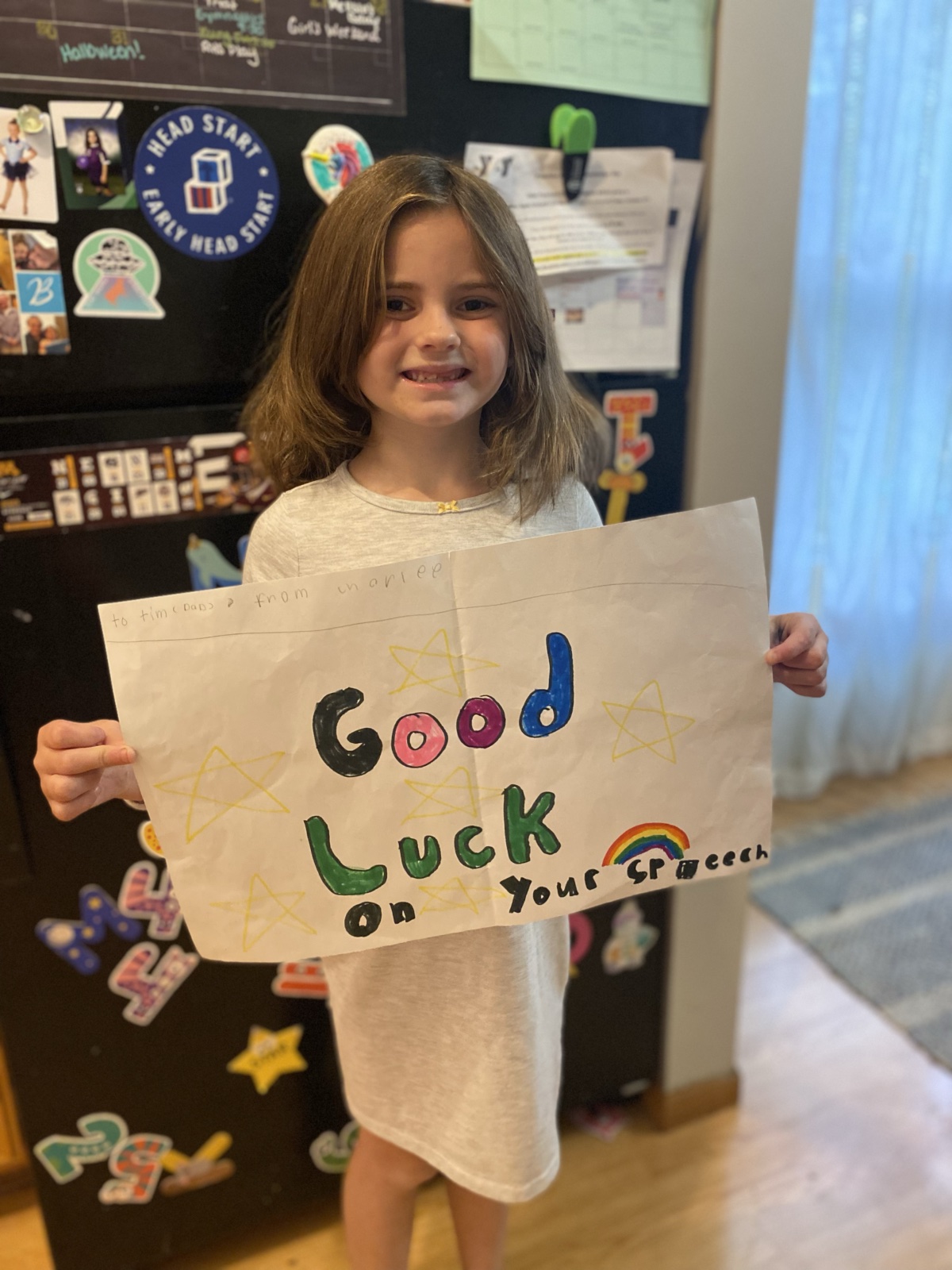
I mentioned my TEDx talk opportunity to a few folks in the lead up to the event, and there wasn't a single person whom I asked for help that said "no."
It's astounding how much people will help you if you let them.
As much as people want to help you, you do still need to go to them with specific asks. If you ask general questions, you'll get back general answers.
Instead, I asked a friend of mine who is an expert in branding how can I turn this talk into more talks.
I asked a friend who has spent tons of time investing in understanding the underlying AI technologies what insights he learned that would surprise normal people.
I practiced my talk with a few co-workers and asked them for ideas to improve my stage presence.
I met with the TEDx-assigned speaker coach and asked her for memorization techniques that previous successful speakers used.
People want to help. They feel honored to be part of the team, part of the mission. And it feels good to know I have a deep roster of allies who want to help see me succeed too.
Follow the TED way.
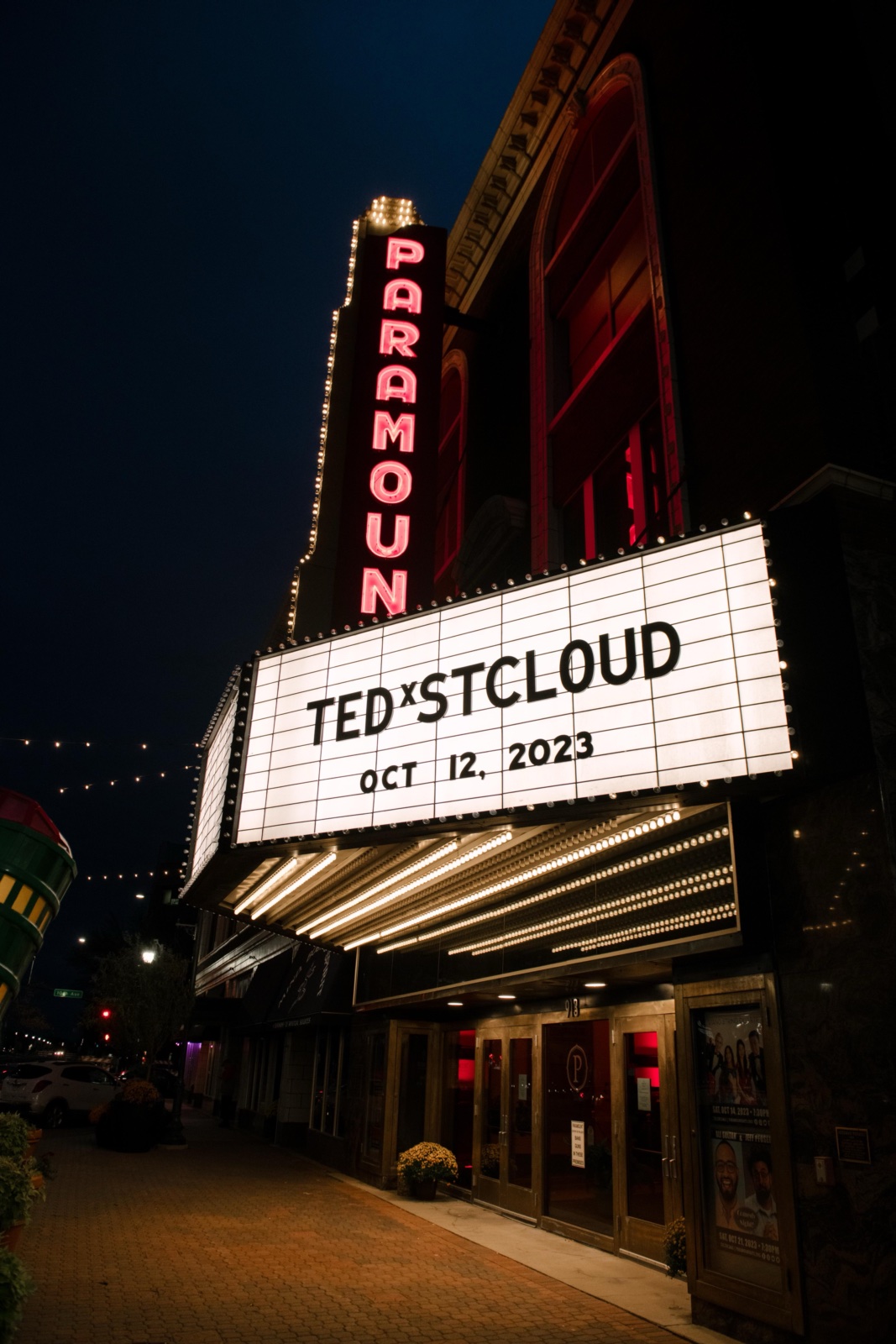
The organizers of TEDx St. Cloud strongly recommended we should read The Official TED Guide to Public Speaking shortly after we said "yes". It's written by Chris Anderson, the Head of TED, who has a delightful British sensibility to his delivery on best public speaking practices specifically as they relate to giving a TED talk.
A fellow presenter and I were chatting and he mentioned that he didn't have time to read the book, but he rather got the audiobook version.
I decided to use my early morning bike ride time to listen to the book, and for me, it was the perfect way to consume the information.
If you've watched more than a dozen TED talks, you probably could guess at the high level concepts of a quality one: don't read text from slides, maintain good eye contact with the crowd and keep them engaged, be able to distill the core ideas of your talk down to a sentence or two, and so forth.
Besides these points, the book also has some good takeaways such as considering what wardrobe you're going to wear and pick something that won't cause mic feedback or clash with the cameras.
Regardless of how you consume the book, the book is critical in helping you internalize and implement the core qualities that make up a good TED talk.
I would strongly encourage any future TED speaker to take the time to read it as well.
You'll ultimately need to deliver a speech you know isn't perfect.
I'm a recovering perfectionist. I hold myself to impossible standards and feel tremendous guilt when I don't live up to them.
As such, I tried hard during this process to let that go and be comfortable with "good enough".
What helped me the most was giving a copy of my speech to some trusted friends and asking them to pick things apart.
The vast majority offered one or two tiny semantic tweaks, but otherwise gave it a resounding two thumbs up.
If you're a recovering perfectionist like myself, you may find yourself wanting to spend your time continuously rewriting your talk instead of memorizing the talk.
Take it from me: after a certain number of iterations, the talk will be good enough. Lean on your support systems and trust them to tell you when you've hit that point.
Memorize moments, not words.
I have a recurring nightmare where I am suddenly standing backstage at my high school, and I'm compelled to walk out on stage during a theatrical performance, and the other characters all stare at me, and I have no idea what the lines are to the show.
There's probably some trauma to unpack there, but suffice it to say that I have a deep seated fear around rote memorization.
In all the talks I've given in my career, I've never tried to memorize a speech word for word. I believe it limits my ability to feel the crowd and tailor the specific wordage of a point I'd like to make on the spot.
Instead, I try to memorize moments. The process I normally follow when constructing talks looks like this:
- Write a thorough outline covering the main points I'd like to make.
- Build a slide deck to illustrate those main points.
- Rehearse walking through the deck over and over again until you can use the presenter view to remind yourself what point comes next.
The one hiccup with this TEDx talk is that we did not have a "presenter view" monitor in front of us while on stage. We did have a "confidence monitor" which was a mirror of the giant screen we had behind us, but there was no way to prepare for what slide was coming next.
In order to combat this, I had to actually get closer to word-for-word memorization, but instead of words, I memorized phrases.
When I was transitioning between points, I knew the exact phrases I wanted to hit, and then I remembered one or two words associated to that phrase.
As an example, one piece I continually kept missing in my rehearsals was this two-part phrase:
Each of those leaps in technology brought many changes to my life, both voluntarily and mandated by societal pressures. I mean, try being a kid in 2004 without a MySpace.
Adapting our lives to this new tech requires a bit of optimism and a ton of curiosity. None of it will work right out of the gate without us changing our behaviors and our expectations.
I'd always nail my epic MySpace joke, but then I'd forget what my next phrase was, so I memorized that the word "adapting" came after the word "MySpace."
That way, I wouldn't forget that my "MySpace" moment led into my "adapting our lives" moment.
Memorize by listening to yourself.
Much in the same way I found it was easier to consume the TED book by listening to the audiobook, I found it was easiest to practice my speech by recording myself giving it into my phone's voice memo app, and then replaying that again and again and again.
One funny part of that is that you need to get a take of you recording it without screwing up. The reason I kept missing my "Myspace"/"adapting" transition was because I recorded my talk while walking around the front of my office, and a truck nearly hit me while I was in the middle of that take.
That particular moment took place in the last 90 seconds of my talk, so I would've needed to re-record the whole thing to get a clean version of that take.
Learn from my mistake: if you're going this route, record yourself in a quiet room where you're focusing on the script and nailing it as perfectly as you can.
By the way: this was one area I was particularly proud of myself for not overcomplicating. I'm a professional podcast editor and a former podcast host. I have access to high quality production equipment, and I could've easily made a ton of work for myself to edit and produce a high quality recording that nobody would've listened to except myself.
Instead, I decided to keep it simple. More often than not, your phone is good enough.
Reciting your speech to yourself is one thing. Doing it in front of others is entirely different.
Most of my practicing of the speech took place while on a walk around the block or in front of a mirror by myself.
The first time I practiced it in front of others was when my coworkers assembled around me about two days before I gave the talk.
It's amazing how much higher the stakes are when you are forced to look at others in their eyes and try to convince them that what you are saying is worth their time (let alone inspire them to take action in some regard).
Besides my coworkers, I also performed my speech twice for my wife, twice for my fellow TEDx presenters, and once for my seven year old daughter.
If I have one regret, it was that I didn't try to practice it in front of more people. I was so damn nervous trying to stutter through my speech for all of those audiences.
And maybe it's because I deeply care about the opinions of these folks. Performing for those I love induced all those anxiety-laden parts of my brain that fill me with fear about how they'd react, how they'd perceive the talk, where they'd find holes and flaws.
As you might expect, I wasn't booed off the stage by these people. They offered one or two pieces of constructive criticism, but ended up being far more supportive than I could've anticipated.
Get over your monkey brain reactions and put yourself out there. Each attempt gives you the opportunity to polish your act.
You will swell with pride at the growth of your fellow presenters.
I only had a little interaction with my fellow presenters in the build up to the event, but even from our first group meeting, you could instantly tell two things about them: all of them are optimistic in nature, and all of them have something interesting to say.
Each of the speakers went through a journey to get their idea as polished as they possibly could. Watching them get in the red dot and deliver their talks was an unexpected celebratory moment for me.
One moment that stood out to me in particular was Kyle, a physician who was speaking about the use of artificial intelligence in ACL surgical procedures. He had a good anecdote about grabbing a beer with a professor of his, and then set up a joke like this: "What followed was... several more beers." It was a dry, glorious joke that he rehearsed several times to (what I'm assuming was) empty silence each time he gave it.
Hearing him drop that joke during the actual performance, and hearing the audience respond with boisterous laughter, was just one of many special memories I'll take away from the night.
My coat made me feel like a badass.
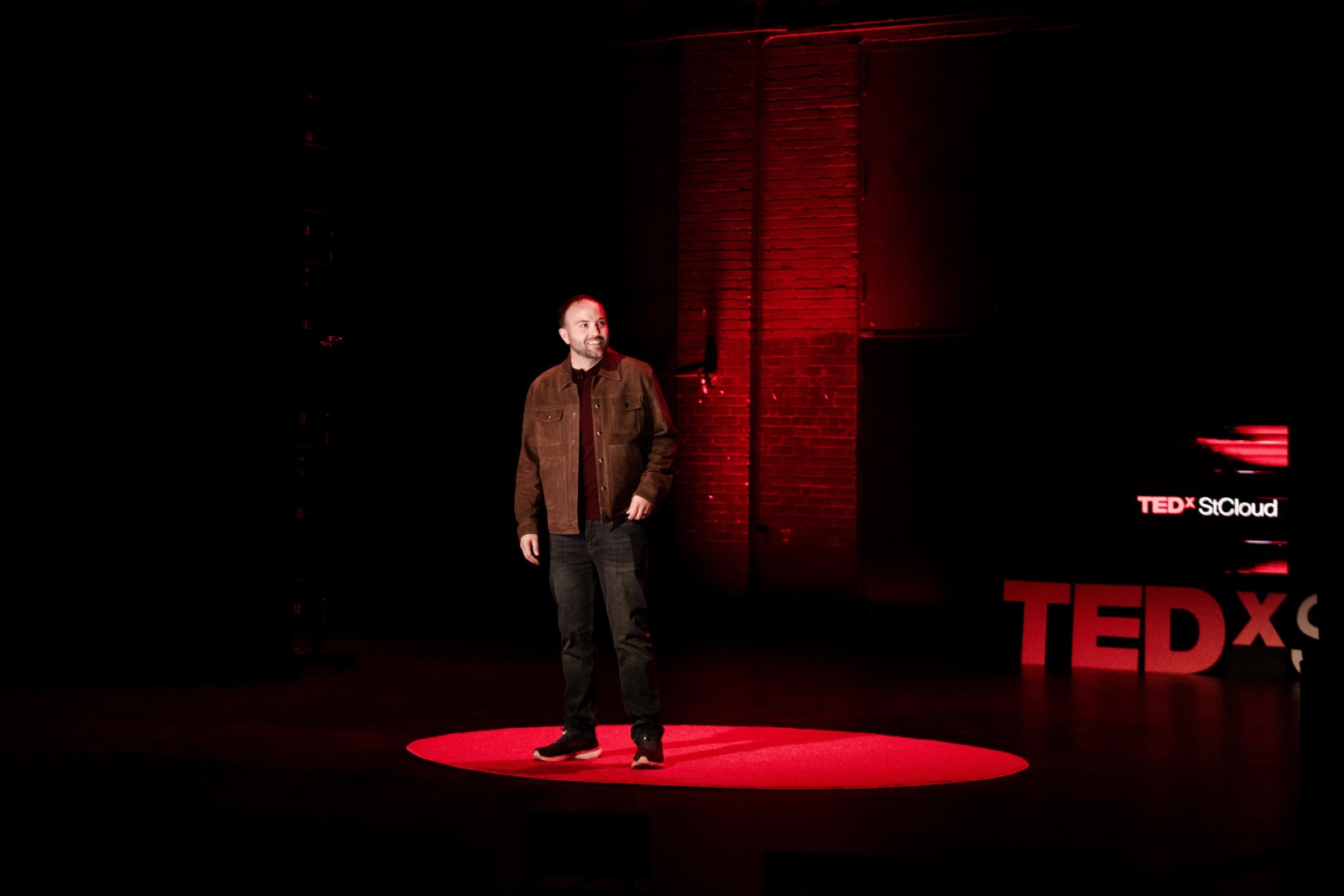
Two disparate things I took away from the TED book were:
- Be cognizant of what you are wearing on stage
- Find a way to include your family as part of your talk preparation
If I had to describe my sense of style over the past 30 years of my life in a thesis, it would be: "whatever is the cheapest thing that doesn't make me look horrible."
My wife has been instrumental in helping me evolve my wardrobe over the past decade, so it only made sense to give her the assignment of making me look good on stage.
We decided to head up to the Mall of America and walk around to figure out what would look best for me.
One of the first stores we went into was a Banana Republic. For those of you like me who are not well-informed when it comes to fashion, Banana Republic is not exactly a cheap store.
In fact, it's owned by the Gap family of stores, which serves as the most premium brand in the family (the cheapest being Old Navy, followed by Gap itself).
Clearly, this flies in the face of my central fashion thesis.
Giving this talk, though, made me reflect on that thesis. It reminded me of an episode of How I Built This with Jenn Hyman of Rent the Runway that I listened to years ago. Jenn mentioned that she was inspired by the fact that her sister dropped tons of money on a new dress rather than rewear the old one.
Her reasoning? The outfit is part of the memory. It's part of the experience. Rewearing a dress lowers the value of the memory.
I wanted to get something new that made me feel like a confident, stylish tech expert. Dressing the part would further emphasize the importance of the event and make the memory that much more impactful for me.
So I decided while we were shopping that I wasn't going to look at price tags. I told my wife to pick out whatever she thought would make me look the best.
One of the outfits she came back with was a brown suede jacket, a pair of jeans, and an orange t-shirt.
The second I put that jacket on and looked in the mirror, I felt like a million bucks.
We went to a bunch of other stores, but nothing even came close to the feeling I had when I put that jacket on.
It was the first time in my life I went up to a register in a clothing store and presented my credit card without any hesitation.
Now, it's hard to get out of the "wear a free t-shirt you got from a tech conference paired with a hoodie you got from working at a marathon and jeans you got four years ago that have the shape of your cell phone permanently burned into your left thigh" mentality, so no, I won't be retiring the jacket. It will be brought out at most important events in the near future.
But if you're going to be giving your own important speech, I highly suggest you find your own "jacket" to give you some artificial confidence.
The worst part is the hour before you go on stage.
Pulling up to the theatre and seeing "TEDx St. Cloud" proudly displayed in the marquee was exciting.
Sitting down and having lunch with the talent and crew was delightful.
Grabbing a pre-dinner beer with my family at the brewery down the road was relaxing.
Getting down to the green room and putting on that jacket for realsies? Absolutely terrifying.
Here's a graph of my heart rate during that day:
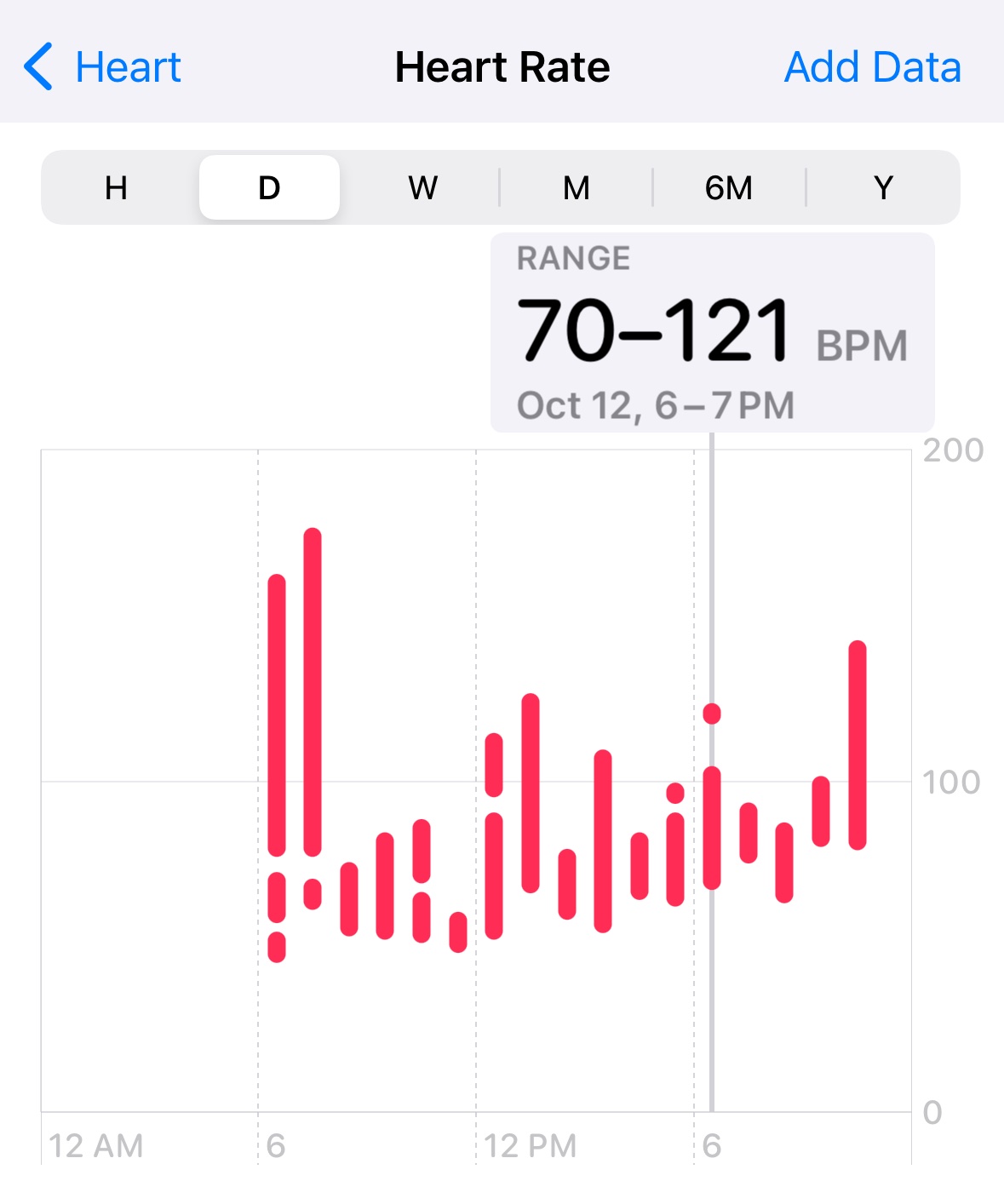
My resting heart rate is in the mid 50s (which you can see around the 11am mark as we were driving up to the event). I was roughly 2.5x that in the moments before walking on stage.
What worked for me? While in the green room, I did a combination of the following activities:
- Positive self talk and visualization
- Deep breathing
- Reading messages that my friends were sending me wishing me luck and telling me I would nail it
- Push ups
- Crying
- Distracting myself by talking with others around me
- Re-running the first few moments of the talk out loud
I can't say which one of those was the most helpful, but killing time prior to being on stage was the absolute worst part.
I'm just grateful I went first.
The biggest surprise of the whole experience came while presenting.
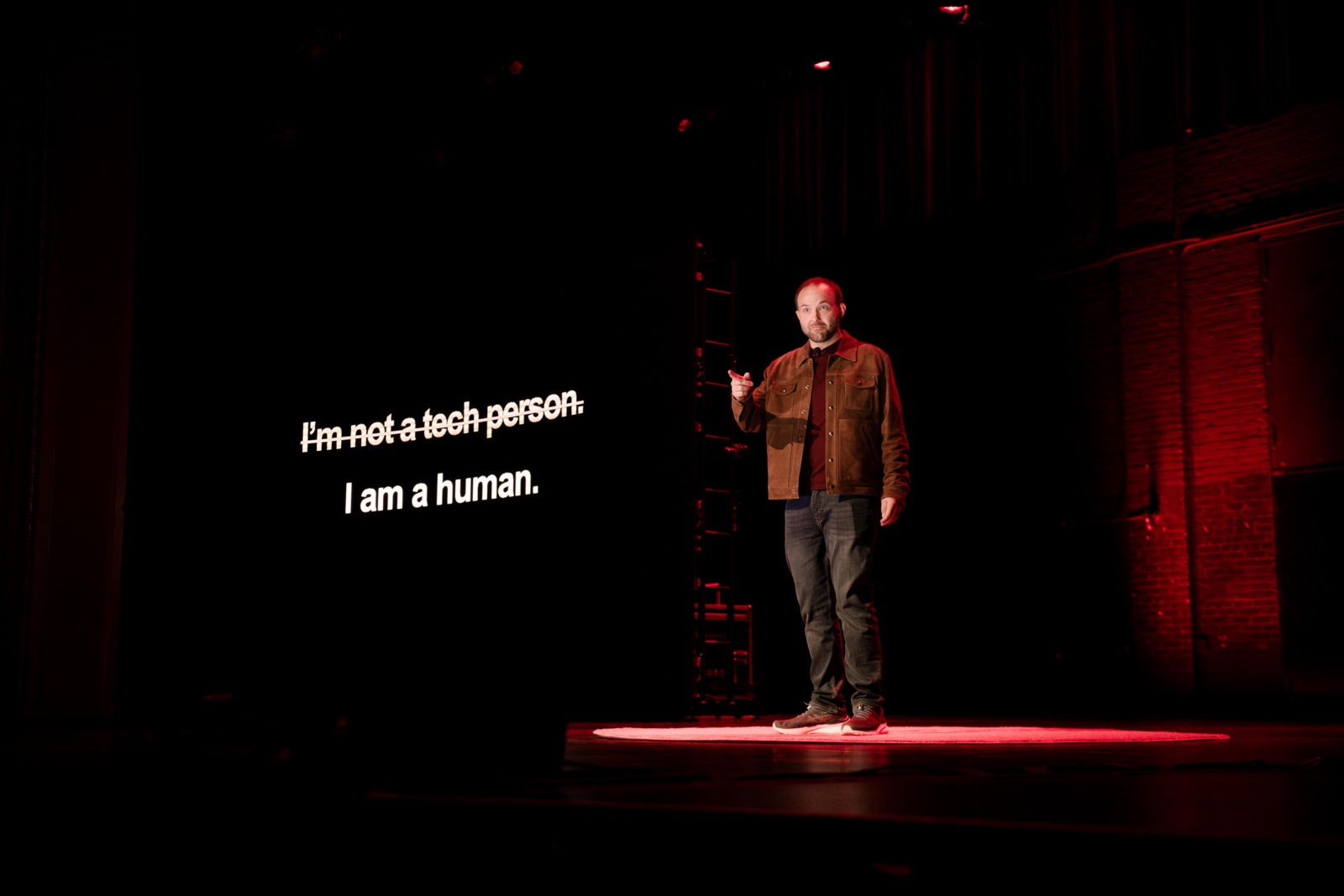
I'm sure you must be sick of me talking about how much I rehearsed at this point in my post.
But seriously, I must have said this talk more than a hundred times over the course of a month.
Each and every time I practiced the talk, I ended with the same feeling: discontent.
I was disappointed that I missed certain beats or that my timing was slightly inconsistent. I was frustrated that I wasn't presenting a novel enough idea around the topic. I was envisioning myself standing in that red dot and getting to the end of my talk, and looking out into a sea of politely-clapping faces, each with a "meh" reaction on their faces.
Putting myself out there and sharing what I believe to be true about technology proved to be quite a fertile field for my depression and anxiety to sow seeds of doubt.
With my heart rate peaking and my anxiety shouting into my ears, I walked out on stage and looked around the audience.
There were hundreds of people cheering, clapping, staring back at me with big smiles on their faces. They were ready to learn, be entertained, and be inspired.
And all of that fear? All of those moments of self doubt? All of that nasty stuff I was telling myself for weeks prior to that moment?
They instantly vanished.
I hadn't even said a word yet, and it felt like my shoulders lowered by a foot.
The feeling of dread was replaced with certainty that I was exactly where I needed to be. I was entirely in the moment, eager to share what I've been thinking about AI with an audience of people who were ready to hear it.
Walking off the stage was the first time I concluded my speech without disappointment. Instead, I was filled with an unexpected emotion: pride.
5 out of 5 stars would do again
The part of my talk I'm most proud of was a moment where I asked the audience to shout out what they think would finish various phrases.
The second time I did it, I heard the audience shout out the answer I was expecting ("paint"), but a beat later, I hear my son, clear as day, yell "ice cream".
It was the perfect moment, an unexpected contribution that acts as the sprinkles on top of the whipped cream which sits atop the sundae that represents my entire TEDx experience.
There are a ton of people I insist on thanking for helping me get to the stage, so I'll do so quickly here (if I left you off this list, assume I did it with malicious intent):
- Brian Hart for giving me the opportunity to help people feel comfortable with artificial intelligence
- Sonja Gidlow for numerous therapy sessions and reassuring me that I'm on the right track
- Shannon Bornholdt for always giving me the right advice and for picking out the dopest jacket on the planet
- Joe Beard and all my Bionic Giant coworkers for giving me the space to be consumed with this talk for a few weeks
- Wil Galvez for making the trek to St. Cloud to take epic photos of me
- Kelly Heitz, Dana Hagemann, Tony Collen, and Sara Sargent for reviewing early drafts of my speech and providing significant feedback
- Justin Grammens and Maria Ploessl for giving a rookie AI speaker a chance earlier this year
- My mom and dad for decades of sitting in the front row and cheering me on
- My siblings and their partners for having an uncanny ability to both support me unconditionally and keep my ego in check
- and finally, those of you who shot me a note of encouragement and support throughout the last few months.
So yeah, that was my TEDx experience. I guess to wrap this all up, I want to reiterate how grateful I am to have this opportunity.
There's a good reason why people brag about being a TEDx speaker: it take a lot of hard work and vulnerability to pull off a quality speech. The entire process proved to be a unique opportunity to both help others by making them more comfortable with AI, and to help myself practice positive self talk and build my confidence.
Finally, as the kids say: thank you for coming to my TED talk.
William Shatner: “My Trip to Space Filled Me With Sadness”
🔗 a linked post to
variety.com »
—
originally shared here on
I learned later that I was not alone in this feeling. It is called the “Overview Effect” and is not uncommon among astronauts, including Yuri Gagarin, Michael Collins, Sally Ride, and many others.
Essentially, when someone travels to space and views Earth from orbit, a sense of the planet’s fragility takes hold in an ineffable, instinctive manner. Author Frank White first coined the term in 1987: “There are no borders or boundaries on our planet except those that we create in our minds or through human behaviors. All the ideas and concepts that divide us when we are on the surface begin to fade from orbit and the moon. The result is a shift in worldview, and in identity.”
It can change the way we look at the planet but also other things like countries, ethnicities, religions; it can prompt an instant reevaluation of our shared harmony and a shift in focus to all the wonderful things we have in common instead of what makes us different. It reinforced tenfold my own view on the power of our beautiful, mysterious collective human entanglement, and eventually, it returned a feeling of hope to my heart.
In this insignificance we share, we have one gift that other species perhaps do not: we are aware—not only of our insignificance, but the grandeur around us that makes us insignificant. That allows us perhaps a chance to rededicate ourselves to our planet, to each other, to life and love all around us. If we seize that chance.
I had a chance to grab some drinks recently with a good friend of mine who I consider to be the absolute smartest person I’ve ever met.
As is often the case, our chat devolved into a brutal critique of the current state of affairs: the real threat of nuclear war in Europe, dealing with the ramifications of climate change, the weaponization of artificial intelligence, and so forth.
As we were wrapping up our chat, I got the sense that both of us were looking to each other for a glimmer of hope. Something that would allow us to go to bed thinking, “yeah, the world sucks right now, but we’ll figure it out.”
Wiliam Shatner’s observation about our species’ ability to be aware of such things might be the thing that we could have potentially used.
Our awareness is what gives us such existential dread in a moment in history that is otherwise the undisputed best time to be a human.
We need to balance our innate ability of detecting danger with our other innate abilities of strategizing and inventing.
After all, what’s the point of stressing about the future if there is no hope? What’s the point of fixing the future if we can’t also appreciate the present?
On Needing to Find Something to Worry About — Why We Always Worry for No Reason
🔗 a linked post to
theschooloflife.com »
—
originally shared here on
We manic worriers need not sarcasm but supportive and intelligent company to give us the love we need to dare to look back at the past – and the insight with which to try to do so. Our feeling of dread is a symptom of an ancient sorrow that hasn’t found its target in the here and now; and our ongoing quest and alarm is a sign that we keep not finding anything in the outer world that answers to the horror of the inner one.
You will always have more problems than engineers
🔗 a linked post to
betterprogramming.pub »
—
originally shared here on
Most companies don’t get it. Most people don’t get it. To them, problems are a sign of failure. They think that the default state is perfection. They believe that if we just worked hard enough — planned hard enough then there wouldn’t be any problems. The only reason we fall from that perfect state is that someone, somewhere screwed up. But that’s not reality. The default state for our reality is chaos. It is ruin. It is entropy and erosion and human nature. We build things to make a better world, and yeah, part of that is people failing. People fail all the time. That sucks, but you’re not going to change it. So you might as well do a good job living with it.
This is really what we all need to cope with. The times we live in are chaotic, filled with uncertainty, fear, and a sense of impending doom. So much so that even our children are suffering at historic rates.
But as I deal with my own struggles to make sense of things, I continue to fall back on accepting that we've always lived in a world that is rife with turmoil. All we can do is go along for the ride, appreciate what we have, and be grateful for those who we can lean on to help navigate it together.
The History of Cognitive Overload
🔗 a linked post to
fs.blog »
—
originally shared here on
There is too much in this article to even grab a single pull quote from. The entire thing is worth reading from top to bottom.
It did make me think a bit about how I can apply some of this knowledge to my own life. I personally struggle with “what will I be when I grow up” from time to time, and I think even simply knowing that this is not abnormal is helpful.
How Olympians Embraced Mental Health After Biles Showed the Way
🔗 a linked post to
nytimes.com »
—
originally shared here on
The American ski racer Alice Merryweather sat out the 2020-21 season while confronting an eating disorder. She had gone to a training camp in September, hating the workouts and the time on the mountain, wondering where her love of skiing had gone. A doctor diagnosed her anorexia.
“I just kept pushing and I kept telling myself, ‘You’re supposed to love this, what’s wrong with you?’” Merryweather said. “I’m just trying to be the best athlete that I can be.”
Merryweather said that she began to open up to friends and teammates. Most knew someone else who had gone through a similar experience. “I realized, why do we not talk about this more?” Merryweather said. “I am not alone in this.”
The more I deal with my own pressure and anxieties, I wonder this same question myself.
Why don't we talk about this more?
Why is stoicism the preferred method for dealing with mental health struggles?
Why do we pretend that the things we want at the end of the day are different from most any other human?
And when will we learn that the only truly sustainable way to really get the things that you want (and the things that truly matter) is through cooperation?
Proof of Work
🔗 a linked post to
ofdollarsanddata.com »
—
originally shared here on
The world trends towards equilibrium. The world trends towards proof of work. It’s rare for fortunes to be created so effortlessly. Therefore, if you see easy money being made, it’s one of the strongest signals that something’s not right. Of course, some people will hit the lottery or be born into wealth. They are the lucky ones. But, most of us aren’t. Most of us have to work for it. We have to show the proof.
It’s taken me eleven years to feel like I am even close to seeing a somewhat realistic path towards wealth (and to be clear, I'm only seeing the path... I'm nowhere down it yet).
The overall message in this article is immensely helpful in dealing with my anxieties around money.
Your ‘Surge Capacity’ Is Depleted — It’s Why You Feel Awful
🔗 a linked post to
elemental.medium.com »
—
originally shared here on
For the families of soldiers missing in action in Vietnam that Boss studied early in her career, or the family members of victims of plane crashes where the bodies aren’t recovered, this type of thinking means thinking: “He is both living and maybe not. She is probably dead but maybe not.”
“If you stay in the rational when nothing else is rational, like right now, then you’ll just stress yourself more,” she says. “What I say with ambiguous loss is the situation is crazy, not the person. The situation is pathological, not the person.”
An analogous approach during the pandemic might be, “This is terrible and many people are dying, and this is also a time for our families to come closer together,” Boss says. On a more personal level, “I’m highly competent, and right now I’m flowing with the tide day-to-day.”
The Tim Ferriss Show - Paul Conti, MD — How Trauma Works and How to Heal from It
🔗 a linked post to
tim.blog »
—
originally shared here on
Ok, I know posting another Tim Ferriss episode is going to make me look like a fanboy, but I don't care. This episode was flat out exactly what I needed in my life right now.
Dr. Conti and Tim discuss how trauma leads to all kinds of mental disorders like anxiety and depression. They also go over a few ways of addressing trauma.
If you're struggling with your mental health these days, give this episode a listen. I've got the book on my list as well.
How to Free Your Mind From Fear
🔗 a linked post to
everwideningcircles.com »
—
originally shared here on
The thing is when you focus all of your attention on the worst thing that could possibly happen – your body listens.
When you’re pulled out of your comfort zone your hands shake, your voice quivers, not because anything, in particular, IS going wrong, but because you believe it will.
Because if you tell yourself that the world is coming to an end and everything is a disaster, your body doesn’t know the difference.
But what if instead of always mentally preparing for what could go wrong, you focus on what could go right instead?
The power of low expectations
🔗 a linked post to
getrichslowly.org »
—
originally shared here on
At the end of January, I had an epiphany.
Kim and I were sitting in the living room one evening, relaxed in our easy chairs, both reading books. All four of our beasts were nestled nearby. The house was quiet. For the first time in forever, I felt completely content.
For maybe twenty minutes, I paused what I was doing and simply savored the moment. I stopped. I looked around. I made time to be present in the Now.
This article is really helping me cope with my anxiety as of late.
I think the expectations I place on myself are too high.
What My Sled Dogs Taught Me About Planning for the Unknown
🔗 a linked post to
nytimes.com »
—
originally shared here on
Planning for forever is essentially impossible, which can actually be freeing: It brings you back into the present. How long will this pandemic last? Right now, that’s irrelevant; what matters is eating a nourishing meal, telling someone you love them, walking your dog, getting enough sleep. What matters is that, to the degree you can, you make your own life sustainable every day.
The Science of Developing Self-Control in Life
🔗 a linked post to
dariusforoux.com »
—
originally shared here on
If you examine your life, you’ll find that you do a lot of things to simply manage stress. In fact, I believe that for most of us, that’s all that we do.
It’s been a tough year on many fronts, and I know the general crux of this article is very important, but I thought this point about stress was very poignant.
Self-control and stress are inextricably linked. If you feel like life is out of control, once you are placed in a stressful situation, you’ll do bad things to alleviate that stress.
Everything is temporary; nearly everything is reversible
🔗 a linked post to
cityfrugal.com »
—
originally shared here on
My mindset has always been that life is a series of things you Have To Get Right or face the consequences of being a Big Failure. That has led me to put immense pressure myself and on many of my individual decisions, including minor ones. As a consequence, I ended up with unreasonably high expectations for myself and others.
My neck hurts from nodding along so aggressively with this self-analysis.
This article has some solid advice if your neck hurts too.