When she feels as if she is running on shards of glass, when her legs feel like they are about to split open, when she thinks she can’t possibly run one more mile, Courtney Dauwalter starts visualizing the pain cave. It’s a place she constructs in her mind with elaborate detail. She conjures every crevice of the cave’s architecture: a large space with different tunnels inside. The cavernous paths in her mind can be wide or narrow, depending on the length and duration of the race. But with Courtney, they’re usually impossibly long.
Dauwalter, 37, is considered the world’s best female ultramarathon runner. She might just be the greatest ultrarunner of all time, period. She races astonishing distances of 100- and 200-plus miles, even once attempting a 486-mile course. She is often on her feet for a mind-bending 24 or 48 straight hours, in the harshest environments imaginable, from steep terrain and high elevation to extreme weather.
Each race, she intends to go into the pain cave. She almost craves it. She warns herself, standing at the start line right before the gun goes off, that she is about to embark on another uncomfortable journey to the cave. “It’s not always going to feel great,” she tells herself. “But that’s going to make us better. We’re going to get better from visiting it.”
I got to meet Courtney while recording an episode of C Tolle Run, and I can confirm that she is incredibly nice and wonderful to be around.
Her attitude here towards approaching uncomfortable situations is the one I want to have when I grow up.
This whole article is insanely inspiring. Courtney serves as one of those people who seem to understand how to live your best life: push yourself to do your best, explore the world around you, appreciate every little thing, and use all your tools to help you get better (even tools like negative thoughts and pain).
There is nothing quite like running super long distances, and reading this article makes me think I need to set myself up with another challenge.
(Not running-related, though. I think I’ve gone as far as I can realistically go with that sport. Tomorrow morning, I’m gonna pick up my bike and start building there.)
Continue to the full article
→
Saying “use the right tool for the job” is easy, but actually selecting the right tool for the job is anything but. Good tools are hard to find, hard to evaluate, hard to learn. We have constraints, we have biases, we have shortcomings.
But that’s all part of the work.
And if you “just use Go” or “just use React” or “just use Postgres” for every problem that crosses your keyboard, you’re just not putting in the work.
I’ve only worked in agencies my entire professional career, and that work has honed two important traits of a good engineer: curiousity and agility.
Being curious gives you the ability to explore new tools and understand how they work.
Being agile (not in the project management sense, but the “moving freely and quickly” sense) gives you the ability to deploy those tools to solve increasingly complex problems.
It’s not that I don’t have a standard set of tools I reach for when solving a wide swatch of problems (Rails, Postgres, etc.), but as I get older, I’m finding that I am more willing to engage with newer tech.
I come from a background of writing Javascript by hand, but I'm starting to play more with Vue and React, and I can see why people like these tools.
Same thing with CI/CD pipelines. I always thought they were more fiddle-y and brittle than they were worth, but that's because I've generally been a lone wolf. In a team context, they are extremely useful.
If you keep hearing noise about a new technology, it's probably worth taking a look over the fence to see how that tool could be used.
Continue to the full article
→
The idea of an "evil laugh" for a villainous character is much older, and the idea that laughter can be a sign of moral failings is even older still!
In "Social Signals and Antisocial Essences: The Function of Evil Laughter in Popular Culture", Jens Kjeldgaard-Christiansen traces negative attitudes about laughter all the way back to Plato. In The Republic, Plato says that laughter is a malignant, violent paroxysm that seizes its subject by force, signalling the unfortunate triumph of passion over rationality.
The AskHistorians subreddit is my go-to example of the internet done right.
Every day, normal people ask bizarre, inane questions that are then answered by serious academics.
This is a prime example of the kind of topic you never imagined could be interesting, yet once you read the answer, you walk away amused, educated, and grateful that someone took the time to give an extremely detailed answer to such a question.
The internet is often filled with garbage, but this subreddit serves as a golden example of the cool stuff people can build when they give a damn.
Continue to the full article
→
ROGEN: What’s horrifying is a comment I get a lot where cops come up to me and say, “I became a cop because of Superbad.” That has been said to me on numerous occasions. And when they say that to me, I say, “That is fucked up. You did not understand the movie.”
This movie had a profound impact on me when it came out. I probably watched it 50 times on DVD.
I think I should go watch it again.
Continue to the full article
→
Happiness often follows a U-curve in which middle age is uniquely stressful, with a heavy dose of responsibilities. That’s all the more reason to seek out atelic activites when the midlife blues hit: meditation, music, running, or almost anything that brings inner peace. But self-reported happiness does increase later in life.
Oddly, as Setiya observes, many of the most consequential choices we make occur in our 20s and early 30s: careers, partners, families, and more. The midlife crisis is a delayed reaction, hitting when we feel more weighted down by those choices. So the challenge is not necessarily to change everything, he says, but to ask, “How do I appreciate properly what I now am doing?”
My daughter turns 7 tomorrow. I’m feeling like I’m finally hitting a point with that relationship where I am not needed as heavily, and I’ll soon be able to indulge in atelic activities more frequently.
The beautiful thing is that I’m now able to enjoy some of these activities with my kids as they get older.
I think that’s the part of parenting I was looking forward to the most: getting to do cool stuff (like go on rides and play Pokémon) with two really cool little people.
Continue to the full article
→
Let the mastering engineers do their thing, using whatever technology they find best. Get the reproduced music however you can. And focus on the analog component you are going to have to add to the chain in the end, no matter what: your ears.
A while back, NPR had a test that allowed you to tell whether you could tell the difference between various levels of audio compression.
Even though I did decent on that test, I’ve still never really been able to discern the difference listening to an album on vinyl versus a 320kbps MP3 rip.
That could be because I’m not listening to it on amazing headphones or speakers, but I think the main reason I enjoy listening to vinyl records is that it forces me to focus.
Having a majority of the music ever recorded at our fingertips is incredible, but taking time to really listen to an artist’s work from front to back feels like a luxury. The ceremony of selecting a record, setting it on the table, and dropping the needle feels more special than shouting into the air for Siri to start it.
(Shouting into the air to summon music is also supremely dope, though… don’t get me wrong.)
Continue to the full article
→
A solitary figure, a microphone and a stool. Those are the primary images of stand-up comedy — as reliable and ubiquitous as a book’s cover, spine and chapter titles.
But there is another element in the iconography, and it’s the most revealing: The water bottle.
Continue to the full article
→
More specifically, it will always end up frustrating very large segments of the population and will always fail to accurately represent the “proper” level of moderation of anyone.
The argument made in this theorem that you can be 99.9% right and still be a colossal failure at scale is beautiful.
Continue to the full article
→
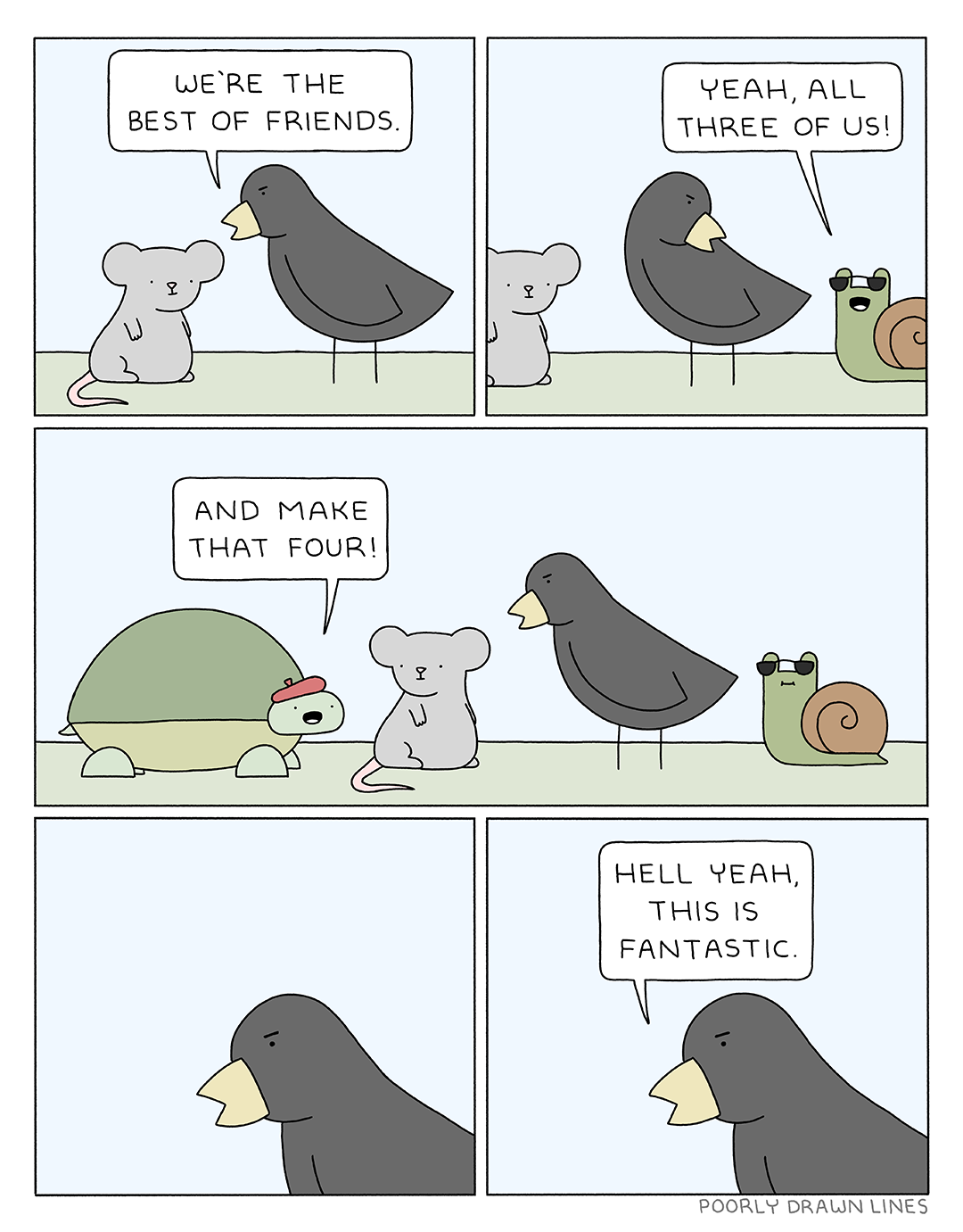
Get me a print of this, stat.
Continue to the full article
→
For most companies, accessibility isn’t a priority, or worse, something that they pay lip service to while doing the bare minimum to meet regulatory compliance. Ojala’s pet peeve is people thinking that accessibility is a feature, a nice-to-have addition to your product. When they tack on accessibility later, without thinking about it from the very beginning, Ojala can tell — it feels haphazard. (Imagine first creating a product with a colorless UI, then to add colors later as an afterthought, only to use the wrong color combination.)
I heard long ago that the reason developers should start testing software with accessibility in mind is that everyone, at some point in their life, will benefit from accessible technology.
At a minimum, as your eyesight gets older with age, an increase in font size will make it more comfortable to read things.
Any story that revolves around a few people banding together to solve an actual problem, and how that solution literally changed people’s lives, is so inspiring to me.
It’s what I yearn for at this point in my life. I don’t mind making money and building apps which drive business value. The stability of my job has done wonders for my mental health, and I am supremely grateful that I have it.
But boy, wouldn’t it be fun to get to work on something that has an outsized positive impact on people’s ability to live productive lives?
Continue to the full article
→


